

Key Takeaways
- How long does it really take to train a cat to use an inhaler? — realistic 5-day starter protocol plus 2-6 week reliability timeline, with Reddit owner reports.
- A cat inhaler spacer (also called an aerosol chamber) is a device that holds medication from an inhaler so your cat can breathe it in through a mask — no coordination required.
- Vets recommend spacers because cats cannot use inhalers directly: they can't inhale on command, and a direct puff wastes most of the medication.
- The right spacer has two features that matter most: a Visual Flow Indicator that confirms your cat is inhaling the medication, and a Comfort Feeder design that helps your cat accept the mask.
- Inhaled medication through a spacer is the gold standard for feline asthma — safer than oral steroids long-term, with fewer side effects.
- If your vet has prescribed an inhaler for your cat, a spacer is not optional — it's the only way to deliver the medication effectively.
📖 The Complete Cat Inhaler Spacer Guide
This is the hub of our spacer guide cluster. Use the map below to jump to the specific question you have — every link opens a deep, vetted guide.
1. Fundamentals
2. Choosing & Comparing Spacers
- AeroKat vs Neobay: Which Is Right for You?
- AeroKat vs Generic vs Neobay: 3-Way Comparison
- How to Source Replacement AeroKat Masks & Parts
3. Sizing & Fit
4. Maintenance & Troubleshooting
- How to Clean & Maintain Your Spacer
- AeroKat Flow Indicator Stuck? Real Fixes
- DIY Cat Inhaler Chamber: Why It Fails
- How to Administer Medication Stress-Free
5. Medication & Cost
6. Training Your Cat
Quick Picks: Which Spacer Fits Your Situation?
If you just want a fast recommendation, here's how the three main options compare. Full details in our 3-way comparison article.
| Feature | Neobay | AeroKat | Generic Brands |
|---|---|---|---|
| Price range | $34–55 | $61.95 | $25–45 |
| Visual Flow Indicator | ✓ Yes (low-stick design) | ✓ Yes (Flow-Vu, prone to sticking) | Varies |
| Comfort Feeder (food-lure) | ✓ Yes | ✗ No | ✗ No |
| Mask sizes included | 2 (small + large) | 2 (small + large) | 1–2 |
| Best for | Value + cat acceptance | Established brand | Tightest budget |

If your veterinarian has diagnosed your cat with asthma and prescribed an inhaler, you've probably heard the word "spacer" come up. Maybe your vet recommended one, or maybe you've seen them mentioned in feline asthma support groups. But what exactly is a cat inhaler spacer, why is it necessary, and how do you choose the right one?
This article answers those questions directly — because understanding what a spacer does (and doesn't do) is the difference between effective treatment and wasted medication.
What Is a Cat Inhaler Spacer?
A cat inhaler spacer — technically called a feline aerosol chamber — is a handheld device with three parts:
- A chamber (the main body) that holds the medication after it's released from the inhaler.
- A mask that fits over your cat's nose and mouth, creating a seal so they breathe in the medication.
- A one-way valve that ensures medication flows toward your cat and not back out.
Here's how it works in practice: you press the inhaler to release a dose into the chamber, then hold the mask gently over your cat's face. As your cat breathes normally through the mask, they inhale the medication from the chamber over 7–10 breaths. No timing. No coordination. Just normal breathing.
This is fundamentally different from how humans use inhalers. A person can take a sharp, deep breath at the exact moment they press the inhaler. A cat can't. Without a spacer, the medication from an inhaler either hits the back of the cat's throat or disperses into the air — barely reaching the lungs where it's needed.
Why Your Vet Recommends a Spacer
When a vet prescribes inhaled medication for feline asthma, they're almost always prescribing it to be used with a spacer. Here's why:
1. Cats Can't Coordinate Inhaler Timing
Human asthma patients are trained to press the inhaler and inhale simultaneously. Cats can't do this. A spacer solves the problem by decoupling the two actions: you press the inhaler into the chamber first, then let your cat breathe at their own pace.
2. Direct Inhaler Use Wastes Most of the Medication
Studies show that without a spacer, as much as 80–90% of the medication from a metered-dose inhaler never reaches the lungs in cats (Dye & McKiernan, Journal of the American Veterinary Medical Association, 2004). The aerosol spray is too fast and too forceful for a cat's smaller, slower breathing pattern. A spacer slows the medication down, turning a concentrated blast into a breathable mist.
Without a spacer, the fast MDI blast deposits most of the dose in the mouth and throat. With a spacer chamber, the medication slows into a fine mist the lungs can actually absorb — that is the difference behind the 80–90% waste figure above.
3. Inhaled Medication Targets the Lungs Directly
Oral steroids (prednisolone) are absorbed into the bloodstream and affect the entire body — liver, kidneys, immune system, everything. Inhaled medication delivered through a spacer goes straight to the lungs, where it's needed. This means:
- Lower effective dose — less medication achieves the same result.
- Fewer systemic side effects — no weight gain, no increased thirst, no immune suppression.
- Better long-term safety — especially important for cats who need daily medication for years.
According to the Cornell Feline Health Center, inhaled corticosteroids delivered via a spacer chamber are the preferred long-term treatment for feline asthma due to their targeted action and minimal systemic effects.
4. It Works With Both Rescue and Controller Medications
Your vet may prescribe two types of inhalers:
- Rescue inhaler (albuterol/salbutamol) — used during an active asthma attack to open the airways quickly.
- Controller inhaler (fluticasone) — used daily to reduce airway inflammation and prevent attacks.
Both are delivered through the same spacer. The controller medication is what your cat takes every day — and that daily routine is exactly where spacer quality matters most.
Learn more about the condition that makes a spacer necessary: Why Is My Cat Wheezing? A Comprehensive Guide to Feline Asthma and Respiratory Health
What to Look for in a Cat Inhaler Spacer
Not all cat spacers are the same. If you're choosing one — or wondering whether the one you have is good enough — here are the features that actually matter:
Visual Flow Indicator
When you hold a mask over your cat's face and press the inhaler, how do you know they're actually breathing in the medication?
Most of the time, you can't tell. Cats breathe quietly, and the medication is invisible. A Visual Flow Indicator solves this: it's a small mechanical indicator inside the chamber that moves with each breath your cat takes. You can see it flutter or move as your cat inhales and exhales.
This is not a gimmick. Without a flow indicator, you're guessing. And with a condition like feline asthma — where undertreatment leads to worsening disease — guessing isn't good enough. A Visual Flow Indicator gives you real-time confirmation that your cat received their medication.
Comfort Feeder Design
The single biggest reason cat owners struggle with inhaled medication isn't the medication itself — it's getting their cat to accept the mask. Most cats pull away, panic, or fight the first few times. This is normal. But it's also the reason some owners give up on inhaled treatment entirely.
A Comfort Feeder design addresses this at the hardware level. The mask rim is designed to hold a squeeze treat (Churu, squeeze treats) — less like something being pressed onto them and more like something they voluntarily lean into for food. This reduces the initial alarm response and makes the acclimation period shorter.
In practice, this means the difference between a 2-week adjustment period and a 2-day one. For a cat who needs daily medication, that's a significant quality-of-life improvement.
Chamber Volume and Valve Quality
The chamber needs to be the right size for a cat's tidal volume (the amount of air per breath). A chamber that's too large means the medication disperses too thinly; too small, and there isn't enough space for the aerosol to form a breathable mist. A well-designed feline aerosol chamber is sized specifically for cats — typically 150–200 mL.
The one-way valve is equally important. It needs to open easily when your cat inhales (cats don't generate as much suction as humans or dogs) and close tightly when they exhale, preventing medication from escaping back out.
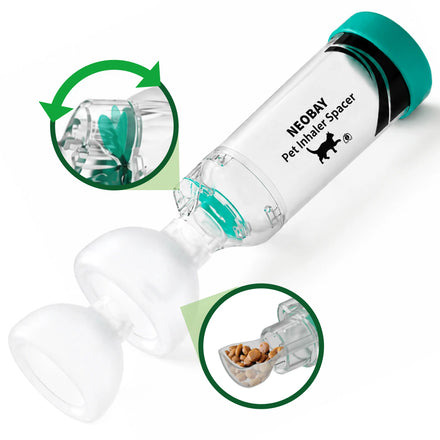
Neobay Cat Aerosol Chamber with Comfort Feeder — Green
- See each breath with the Breath Indicator
- Built-in treat holder makes mask practice easier
- Anti-static chamber helps keep medication airborne
How to Use a Cat Inhaler Spacer
The process is simpler than most cat owners expect. Here's the basic routine:
- Shake the inhaler and insert it into the back of the spacer.
- Press the inhaler once to release the medication into the chamber.
- Hold the mask gently over your cat's face, creating a seal around the nose and mouth.
- Let your cat breathe — watch the Visual Flow Indicator to confirm they're inhaling.
- Count 7–10 breaths, then remove the mask.
- Reward your cat with a treat or praise immediately.
The entire process takes about 15–30 seconds. If your vet has prescribed two puffs, wait 30–60 seconds between them to allow the medication to settle.
For a detailed guide on getting your cat comfortable with the process: How to Administer Inhaled Medication Stress-Free
Common Mistakes Cat Owners Make With Spacers
Related: Once your spacer technique is solid, the next question is usually Flovent 110 vs 220 mcg for cats — which dose your cat actually needs, with 2026 cost data and a tapering protocol.
Not Creating a Proper Seal
If the mask doesn't form a seal around your cat's face, medication leaks out and your cat gets less than the prescribed dose. Press gently but firmly — the soft mask edge should sit flat against the fur and skin around the nose and mouth.
Pressing the Inhaler Multiple Times Into the Chamber
One press = one dose. Never press the inhaler twice into the chamber before your cat breathes. The chamber can't hold two doses effectively, and you'll waste medication and risk overdosing.
Rushing the Breathing Time
Cats breathe more slowly than humans. 7–10 breaths may feel like a long time when you're holding a mask over a squirming cat, but removing it too early means your cat didn't get the full dose. The Visual Flow Indicator helps here — you can see exactly when your cat is breathing and when they're not.
Giving Up Too Early
Most cats resist the mask the first few times. This doesn't mean the spacer doesn't work — it means your cat needs time to adjust. With consistent, gentle training (and a Comfort Feeder design that pairs the mask with food), the vast majority of cats accept the routine within 1–2 weeks.
Oral Steroids vs. Inhaled Medication: Why the Spacer Matters
Some cat owners wonder whether they can skip the spacer and just give their cat oral steroids instead. It's a fair question — pills are easier to administer. But the medical consensus is clear:
| Factor | Oral Steroids (Pills) | Inhaled Medication (via Spacer) |
|---|---|---|
| Delivery | Systemic (bloodstream) | Targeted (lungs only) |
| Side effects | Weight gain, thirst, diabetes risk, immune suppression | Minimal — medication stays in the lungs |
| Long-term safety | Risk increases over time | Safe for daily, long-term use |
| Effectiveness | Controls symptoms but doesn't target the source | Directly reduces airway inflammation |
| Onset | Hours to days | Rescue: minutes; Controller: days to weeks |
| Vet recommendation | Short-term or last resort | First-line long-term treatment |
Oral steroids still have a role — they're sometimes needed initially to bring severe inflammation under control, or as a bridge while transitioning to inhaled medication. But for long-term management, inhaled medication delivered through a spacer is the standard of care.
How Long Does a Cat Inhaler Spacer Last?
A quality spacer chamber is a durable device that can last for years with proper care. Here's what to know:
- Daily use lifespan: A well-maintained spacer typically lasts 12–18 months before the valve or chamber shows wear.
- Cleaning: Rinse the chamber and mask with warm water weekly. Let it air dry completely — never use a towel, as lint can clog the valve.
- Valve check: Inspect the one-way valve regularly. If it sticks open or closed, or appears warped, replace the spacer.
- Mask fit: If the mask edge cracks or loses its softness, the seal breaks and medication escapes. Replace the spacer or mask when you notice this.
Keeping a spare spacer on hand is a good idea if your cat depends on daily medication — you don't want to miss doses because of a worn-out valve.
Related: Read our detailed guide on what's normal for cat hairballs — including when frequent hairballs signal something more serious than grooming.
Frequently Asked Questions
Can I use a human spacer for my cat?
No. Human spacers are designed for human lung volumes and breathing patterns. They're too large, the valves require too much suction for a cat to open, and the mask doesn't fit a cat's face. A cat-specific spacer is sized, valved, and shaped for feline anatomy.
Is a spacer the same as a nebulizer?
No. A nebulizer converts liquid medication into a fine mist using a compressor — it requires power and takes 10–15 minutes per session. A spacer holds medication from a metered-dose inhaler and requires no power — treatment takes seconds. For daily feline asthma management, spacers are the standard tool.
Do I need a prescription for a cat spacer?
The spacer itself doesn't require a prescription — it's a delivery device, not a medication. But the inhaler medication (albuterol, fluticasone) does require a veterinary prescription. Your vet will prescribe the appropriate medication and dose for your cat's condition.
My cat refuses the mask. What should I do?
This is common and fixable. Start by leaving the mask near your cat's food bowl for a few days. Gradually pair it with treats. Hold it near their face for a few seconds, then reward. Build up to brief contact, then to a full treatment session. Most cats adjust within 1–2 weeks. A Comfort Feeder design makes this process significantly easier.
For the full step-by-step training guide: How to Administer Inhaled Medication Stress-Free
How do I know if the spacer is working?
Watch the Visual Flow Indicator. If it moves with your cat's breathing, medication is flowing through the chamber and being inhaled. If it doesn't move, check that the mask has a proper seal and that the valve isn't stuck.
For a practical purchase comparison of complete kits, live checkout terms and pack value, read our cat inhaler spacer buyer’s guide.
What to Do Next
If your cat has been diagnosed with feline asthma and your vet has prescribed inhaled medication, here's your action plan:
- Get a cat-specific spacer — do not attempt to use an inhaler without one. It won't work effectively.
- Choose a spacer with a Visual Flow Indicator — so you can confirm your cat is actually receiving the medication.
- Choose a spacer with a Comfort Feeder design — so your cat adjusts to the routine faster and with less stress.
- Follow the training process — be patient for the first 1–2 weeks. It gets easier quickly.
- Stick with it — inhaled medication through a spacer is the safest, most effective long-term treatment for feline asthma.
The Neobay Cat Aerosol Chamber is designed specifically for feline asthma treatment, with both a Visual Flow Indicator and a Comfort Feeder design. It's the spacer vets recommend because it works — and because cats actually accept it.
Have questions? Visit our FAQ page or reach out to us — we're here to help.
Sources:
- Dye JA, McKiernan BC, Rozanski EA, Hoffmann WE. "Bronchopulmonary disease in the cat: historical, physical, radiographic, clinicopathologic, and pulmonary functional evaluation of 24 affected and 15 healthy cats." Journal of Veterinary Internal Medicine, 1996; 10(6): 385-400.
- Padrid P. "Feline asthma. Diagnosis and treatment." Veterinary Clinics of North America: Small Animal Practice, 2000; 30(6): 1279-1293.
- Cornell Feline Health Center. "Feline Asthma: What You Need to Know." Cornell University College of Veterinary Medicine. https://www.vet.cornell.edu/departments-centers-and-institutes/cornell-feline-health-center/health-information/feline-health-topics/feline-asthma-what-you-need-know
- Reinero CR. "Advances in the understanding of pathogenesis, and diagnostics and therapeutics for feline allergic asthma." The Veterinary Journal, 2011; 190(1): 28-33.
Related: Read our guide on how to clean and maintain your cat's inhaler spacer for step-by-step cleaning instructions and troubleshooting tips.
Related: One Chamber for Flovent and Albuterol? Why Vets Recommend Two — why feline vets suggest separate chambers for daily corticosteroids and rescue bronchodilators.
Related: Can You Get a Cat Asthma Prescription via Telehealth? 2026 Guide — which states allow virtual VCPR, telehealth platform costs, and how to prepare for your online vet visit.
Related: How Fast Can You Train a Cat to Accept an Inhaler? 5-Day Timeline — the accelerated multi-session protocol backed by certified cat behaviorists, with a day-by-day plan from mask introduction to full medication delivery.


