

Your cat crouches low, neck stretched forward, making that hacking sound. You wait for the wet little cigar of fur to appear on the floor. Maybe you step away to grab a paper towel.
But this time, nothing comes out. The cat stops, shakes it off, and walks away like nothing happened.
You tell yourself it was just a failed hairball. Happens all the time.
Here's the thing: that wasn't a failed hairball. That was a cough. And the fact that your cat is coughing — not retching, not gagging, not vomiting — raises a question that matters a lot more than most cat owners realize.
This article covers what's actually normal for cat hairballs, what frequent hairballs can mean, and how to tell the difference between a hairball episode and something much more important: feline asthma.

What Is a Hairball? And No, It's Not Actually a "Ball"
The name is misleading. A hairball — technically a trichobezoar — isn't round. It's a compact, cigar-shaped tube of fur mixed with digestive fluid. It forms in the stomach, not the lungs, which is why the whole idea of "coughing up" a hairball is medically inaccurate.
Here's what happens: cats groom themselves constantly. Their tongue has backward-facing barbs called papillae that trap loose fur. Most of that fur passes straight through the digestive tract and exits in the stool. But some collects in the stomach, mats together, and eventually triggers a vomiting reflex.
The cat vomits the hairball. Not coughs it up. Vomits.
This distinction is the foundation of everything that follows. Hairball expulsion is a GI event — the stomach contracting to eject its contents through the esophagus and out the mouth. Coughing is a respiratory event — the airways constricting, the diaphragm spasming, the body trying to clear something from the lungs or trachea.
They use different muscles. They come from different body systems. And confusing the two is the single most common reason feline asthma goes undiagnosed for months or years.
How Many Hairballs Are Actually Normal?
Let's start with the baseline most cat owners get wrong.
A survey of the American Association of Feline Practitioners found that 73% of short-haired cats never brought up a hairball at all over the study period. Long-haired cats were roughly twice as likely to vomit hairballs, but even among them, frequent hairballs were not the majority experience.
Here's what veterinary consensus says:
| Frequency | Assessment | Action |
|---|---|---|
| A few times per year | Normal | No action needed |
| 1-2 times per month | High end of normal, but worth monitoring | Increase brushing, monitor for other symptoms |
| Once a week or more | Abnormal | Vet visit warranted |
| Sudden increase in frequency | Red flag | Vet visit — don't wait |
| Daily or near-daily | Serious problem | Could indicate IBD, lymphoma, or obstruction |
A cat vomiting hairballs every week is not "just a hairy cat." That cat has either an excessive hair intake problem, a GI motility problem, or both. Something is preventing the normal passage of ingested fur through the digestive tract.
Why Some Cats Get More Hairballs
Long-haired breeds — Persians, Maine Coons, Himalayans, Ragdolls — simply swallow more fur per lick. Longer coat, more shedding, more ingested.
Heavy groomers — cats who groom compulsively from anxiety, boredom, or pain. Stress-grooming can double or triple normal fur intake.
Skin conditions — flea allergies, food allergies, mites, ringworm. Anything that makes a cat itchy makes them groom more.
Seasonal shedders — spring and fall coat changes temporarily increase the loose-fur load. A seasonal uptick in hairballs is normal.
Older cats — age-related GI slowdown means ingested fur sits in the stomach longer, increasing the chance of matting into a mass.
Cats with GI disease — chronic inflammation from IBD or food intolerance reduces motility. Hair sits in the stomach instead of moving through.
When Frequent Hairballs Signal Something Serious
This is what many primary-care vet visits miss. The hairball isn't the problem — it's a visible symptom of a problem further up the chain.
Inflammatory Bowel Disease (IBD)
IBD is chronic inflammation of the GI tract. It thickens the intestinal wall, slows motility, and makes the stomach and intestines less effective at moving contents through. Hair that would normally pass in stool accumulates in the stomach instead. The cat vomits it. Owner thinks "hairball problem." The real problem is IBD, and without treatment, it progresses.
Intestinal Lymphoma
Small-cell intestinal lymphoma in cats is insidious. Early symptoms look exactly like IBD — intermittent vomiting, weight loss, occasional diarrhea, more frequent hairballs. The vomiting is the same. The hairballs are the same. But the underlying disease is cancer.
There is no way to distinguish IBD from early lymphoma without a biopsy. If your cat's hairball frequency increases and doesn't respond to dietary or grooming changes, don't let your vet stop at "hairball cat." Push for blood work, abdominal ultrasound, and a GI panel at minimum.
Food Intolerance or Allergy
Cats can develop food sensitivities at any age. The most common reaction isn't hives or itching — it's chronic GI inflammation and vomiting. A cat with undiagnosed food intolerance may produce more hairballs because their stomach isn't processing contents normally, not because they're grooming more.
Anxiety and Over-Grooming
Psychogenic alopecia — over-grooming driven by stress — can produce bald patches, skin irritation, and an enormous increase in swallowed fur. The cat isn't itchy. The skin isn't irritated. The behavior is compulsive. Common triggers: a new pet, a move, a change in routine, construction noise, new baby, owner returning to office after working from home.
The hairballs are the visible symptom. The actual problem is anxiety.
The Critical Mistake: Thinking Asthma Is a Hairball
This is the section that could change your cat's life. Read it carefully.
Feline asthma affects 1-5% of all cats. Siamese and Oriental breeds are at higher risk. And the #1 reason asthmatic cats go undiagnosed for months or years is that their owners interpret the coughing as "trying to bring up a hairball."
The posture is almost identical. Cat crouches. Neck extends forward. Elbows out. A rhythmic hacking motion. From across the room, it looks like the preamble to vomiting.
But what comes after matters more than the posture:
Hairball episode: Rhythmic abdominal contractions → retching sound → hairball is expelled. Takes 10-60 seconds from start to finish. The cat walks away normally. You see fur and mucus on the floor.
Asthma cough: Repeated dry coughing, often 5-10 coughs in a row → nothing is produced. The cat may swallow afterward (clearing saliva from the throat). The coughing may happen in clusters throughout the day, especially at night or early morning. Episodes last 10-30 seconds. The cat seems normal between episodes.
Key differentiators:
| Sign | Hairball | Asthma |
|---|---|---|
| Something produced | Yes — fur, mucus | No — dry cough |
| Sound | Wet, retching, gurgling | Dry, hacking, wheezy |
| Frequency | Variable; tied to grooming | Often daily; tied to triggers (exercise, dust, stress) |
| Post-episode | Cat walks away, normal | May stretch neck, swallow, resume normal activity |
| Timing | Random | Common at night/early morning |
| Response to treatment | Reduced by brushing, hairball remedies | Not affected by grooming or diet; responds to corticosteroids |
The "Nothing Comes Out" Rule

If your cat goes through the coughing/crouching motion more than twice a week and never produces a hairball — that is not a hairball problem. That is feline asthma until proven otherwise.
Record a video of the episode on your phone. Show your vet. The posture, the sound, the duration — these are diagnostic clues. A 15-second phone video is worth more than a detailed verbal description.
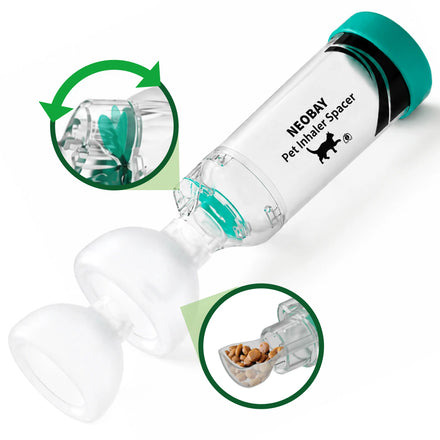
Neobay Cat Aerosol Chamber with Comfort Feeder — Green
- See each breath with the Flow Indicator
- Built-in treat holder makes mask practice easier
- Anti-static chamber helps keep medication airborne
Why Getting This Right Matters
Untreated feline asthma causes progressive airway remodeling. Each inflammatory episode thickens the bronchial walls, making future attacks more severe. Cats who go years without treatment don't just have worse symptoms — they have permanently narrowed airways that don't fully respond to medication the way a newly diagnosed cat's would.
Asthma treatment is inhaled corticosteroids — Flovent (fluticasone) delivered through an aerosol chamber like the Neobay Cat Aerosol Chamber, sometimes with a rescue bronchodilator (Albuterol) for breakthrough attacks. The medication goes directly to the lungs, where the problem is. Minimal systemic absorption. Far safer than long-term oral steroids.
Read our detailed guide on feline asthma vs. hairballs for a deeper comparison, and our article on how vets diagnose feline asthma walks through the full diagnostic process.
Hairball Prevention: What Actually Works

If your cat's hairball frequency is high but vet workup rules out underlying disease, prevention comes down to reducing fur intake and improving GI transit.
1. Brushing (By Far the Most Effective)
The math is simple: less loose fur on the cat = less fur swallowed.
- Short-haired cats: 2-3 times per week, daily during shedding season
- Long-haired cats: Daily, with a slicker brush or deshedding tool
- Focus on the undercoat — the soft, fine fur that mats and sheds most
A 5-minute brushing session removes more dead fur than a week of self-grooming. If you do nothing else, do this.
2. Diet: Fiber and Moisture
High-fiber cat foods add bulk to the stool and help ingested hair pass through instead of accumulating. "Hairball control" formulas (Hill's, Royal Canin, Purina ONE) achieve this with cellulose, beet pulp, or psyllium.
Wet food adds moisture, which improves GI motility. Dry food alone — especially for cats who don't drink much water — can contribute to slow gastric emptying. Even adding a tablespoon of water to dry kibble helps.
3. Hairball Lubricant Gels
Laxatone, Petromalt, and similar products contain petrolatum or mineral oil that coats the stomach contents and helps hair slide through. A pea-sized amount on the cat's paw once or twice a week.
These are safe for occasional use, but they treat the symptom, not the cause. If you're reaching for the Laxatone tube every other day, your cat needs a veterinary workup, not more gel.
4. Environmental Enrichment
A stressed cat grooms more. Environmental enrichment — puzzle feeders, window perches, regular play sessions, a consistent daily routine — reduces anxiety-driven over-grooming. For cats with diagnosed anxiety, Feliway diffusers and prescription anti-anxiety medication are options.
5. Professional Grooming
Long-haired cats benefit from a "lion cut" (body shaved short, leaving fur on head, legs, and tail) 2-3 times per year during shedding season. It looks dramatic, but it works. Less fur on the cat means less fur in the cat.
When to See the Vet Immediately
Most hairball situations are not emergencies. These are:
- Repeated, unproductive retching for more than a few minutes — could be a hairball lodged in the esophagus or a GI obstruction
- Complete appetite loss for 24+ hours with or without vomiting
- Lethargy, hunched posture, or hiding — signs of abdominal pain
- Swollen or tender belly when touched
- Constipation or straining in the litter box with no stool produced
- Vomit that looks like coffee grounds — digested blood, a true emergency
- Any breathing difficulty — open-mouth breathing, panting, blue gums
A hairball obstruction is a surgical emergency. Don't "wait and see" on these symptoms.
Frequently Asked Questions
How many hairballs a week is normal?
Zero. Most healthy cats should not vomit hairballs weekly. One or two per month is the high end of normal. More than that, or any sudden increase, warrants a vet visit.
Can hairballs cause coughing in cats?
No. Hairballs are in the stomach and GI tract — they cause retching, gagging, and vomiting, not coughing. Coughing is a respiratory symptom. If your cat makes a hacking sound and nothing comes out, that's a cough, not a hairball problem.
What's the difference between a hairball cough and asthma cough?
A hairball doesn't cause a cough — it causes retching that ends with something being expelled. An asthma cough is dry, repeated, produces nothing, and the cat goes back to normal activity immediately after. If the "coughing" sessions end with fur on the floor, that was a hairball. If they never do, that's likely asthma.
When should I worry about cat hairballs?
Worry when frequency exceeds once a month, when there's a sudden increase, when the cat retches repeatedly without producing anything, or when hairballs are accompanied by appetite loss, weight loss, lethargy, diarrhea, or constipation. Frequent hairballs are a symptom, not a standalone condition.
Why is my cat throwing up hairballs every day?
Daily hairballs are abnormal and point to either excessive fur intake (anxiety, skin disease, seasonal shedding) or a GI motility disorder (IBD, food intolerance, early lymphoma). This cat needs blood work, an abdominal ultrasound, and possibly an endoscopy — not just a hairball-control diet.
Do some cats never get hairballs?
Yes. Most short-haired cats never vomit a hairball. The idea that "all cats get hairballs" is wrong. Some cats pass all ingested fur in their stool without issue. If your cat has never produced a hairball, that's actually the normal experience for most cats.
What to Do Next
-
Count. Track your cat's hairball frequency for the next 30 days. Write down dates. If it's more than twice in a month, book a vet appointment.
-
Record. The next time your cat does the crouch-hack routine, video it on your phone. Show it to your vet. A 15-second video is the single most useful diagnostic tool for distinguishing hairballs from asthma.
-
Brush. Start a daily or every-other-day brushing routine today. Five minutes. It's the single most effective prevention measure.
-
Look at what's on the floor. After an episode, examine what came up. A tubular mass of compacted fur with some fluid = hairball. Clear or yellow fluid with just a few strands of hair = vomit with hair, not a hairball. Nothing at all after repeated coughing = respiratory event, not a hairball.
-
If your cat coughs without producing anything more than twice a week, ask your vet specifically about feline asthma. Don't let them dismiss it as "just hairballs" without at least doing chest X-rays.
A hairball every now and then is not a crisis. But confusing asthma for hairballs — and letting it go untreated for years — is. You now know the difference.
Have more questions about your cat's respiratory health? Visit our guide on cat coughing after running or explore our cat breathing resource center.
Sources: - Cornell Feline Health Center, Cornell University College of Veterinary Medicine. "Feline Asthma and Other Respiratory Conditions." Accessed 2026. - Foster DM, et al. "Outcome of idiopathic feline inflammatory bowel disease: 48 cases (1992-2004)." Journal of the American Veterinary Medical Association, 2006. - Trzil JE. "Feline Asthma: Diagnostic and Treatment Update." Veterinary Clinics of North America: Small Animal Practice, 2020; 50(2): 375-391. - Batchelor DJ, et al. "Association between hairballs and underlying gastrointestinal disease in cats." Journal of Feline Medicine and Surgery, 2013; 15(7): 583-588. - American Association of Feline Practitioners. "Hairballs — Survey Findings." Accessed via Cat Friendly Homes, 2026. - Dye JA, et al. "Bronchoalveolar lavage cytology in cats with chronic bronchial disease." Journal of Veterinary Internal Medicine, 1996; 10(6): 373-379.
Related Reading
This article is part of our How Vets Diagnose Feline Asthma — covering tests, X-rays, at-home monitoring, and what to expect at every step of the diagnostic process.


