

Key Takeaways
- The Flow-Vu indicator is a counter, not a delivery valve — your cat can still receive medication even when the green flap stays still, per Trudell Animal Health's own FAQ.
- Roughly 4 in 5 "stuck flap" cases trace back to two causes: trapped water in the hinge after washing, or a shallow-breathing cat who hasn't fully relaxed into the mask yet.
- The official reset takes 5 seconds: stand the chamber upright green-side-down, press the mask in, release abruptly — the negative pressure pops the flap loose.
- A poor mask seal is the silent killer — even a 1 mm gap between mask and fur breaks the pressure differential the flap needs to move.
- AeroKat chambers need replacement at 12 months with daily use; sticky, warped, or residue-coated flaps signal it's time to swap.
You loaded the puff. Held the mask to your cat's face. Counted the seconds. And that little green flap — the one supposed to tell you the medication is going in — just sat there, frozen.
It's one of the most anxious moments in feline asthma care, and it happens to almost every owner in the first two weeks. Here's what's going on, how to diagnose it in 30 seconds, and the fixes that work.
First: A Stuck Flap Doesn't Mean No Medication
Before you panic, hear this from the manufacturer. Trudell Animal Health states plainly in their official FAQ that the Flow-Vu indicator is "simply to help you count the number of breaths; it does not affect the actual delivery of medication." The flap is a counter. The dose reaches your cat's lungs through the chamber's inner valve, which works whether the green flap moves or not.
Most blog posts skip this and jump to "try this, try that." So take a breath. Then run the diagnostic below.
The 5-Step Diagnostic (Run This First)
Most owners try random fixes in the wrong order and get frustrated. Use this sequence — it isolates the root cause in under a minute.
- Step 1 — Test the flap yourself. Take the chamber off the cat, hold the mask to your own mouth, and breathe in normally. If the flap moves, the device works and the problem is at the cat-end (seal, anxiety, or breathing depth). If it doesn't move for you either, jump to Step 4.
- Step 2 — Check the mask seal. Watch the contact between mask rim and fur. Any gap, any whisker crushed outward, any tilt — and the pressure differential that drives the flap disappears. Press gently but firmly so the seal is complete around the muzzle.
- Step 3 — Reassess mask size. The small mask often doesn't create enough airflow to move the flap on shallow breathers. The large mask can cover a small cat's eyes and trigger a flinch. Both look like a "broken" flap. The right size sits fully around the muzzle without touching the eyes.
- Step 4 — Check for trapped water. If the flap won't move even for you, this is the most likely culprit. Wash the chamber, shake out every drop, and stand it mask-side down to dry for at least 4 hours. A hair dryer on the cool setting speeds this up — never warm, which warps the plastic.
- Step 5 — Run the official reset. Stand the chamber upright with the green back piece on the counter. Place your palm on the mask, push it firmly toward the chamber body, then pull your hand away fast. The sudden negative pressure pops the flap free.
If Steps 1-3 fix it, your issue was technique or fit — totally normal in the first two weeks. If Steps 4-5 fixed it, your issue was maintenance. Either way, you now know which category of fix to focus on.

The Four Real Causes (and Their Fixes)
1. Trapped Water in the Hinge
The Flow-Vu flap is so light that a single drop of water in the hinge is enough to glue it in place. This is the single most common cause reported across the Feline Asthma Inhaled Medications community on Groups.io. Fix: weekly washing, vigorous shake, mask-side-down air dry for at least 4 hours. Skip the dishwasher — heat warps the flap.
2. Cat Is Holding Their Breath
Cats new to the AeroKat often "shallow breathe" — taking tiny sips of air that don't generate enough pressure differential to move the flap. One Reddit owner in r/CatAdvice described it perfectly: "I can feel her breathing when I put my hand on her belly, but the flap never seems to move." Her update two weeks later: "One day she finally took a deep breath and each day after that would take more and more." Fix: short, treat-loaded sessions, no forcing — covered in detail below.
3. Poor Mask Seal or Wrong Size
Even a small leak kills the flap's signal. Common offenders: a mask tilted because you're reaching across the cat, crushed whiskers creating a gap, or the wrong mask size for your cat's face. See our AeroKat mask sizing guide if you're unsure which size fits.
4. Residue Buildup or Damaged Flap
Over months of use, medication propellant leaves a sticky film on the flap hinge. Weekly cleaning prevents it. If your chamber is past 12 months and the flap is warped, cloudy, or permanently sticky after a thorough wash, the plastic has aged out — replace it.

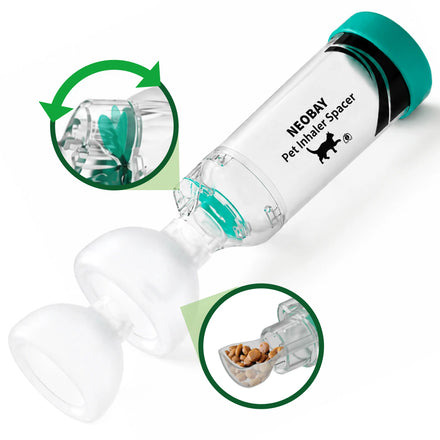
Neobay Cat Aerosol Chamber with Comfort Feeder — Green
- See each breath with the Flow Indicator
- Built-in treat holder makes mask practice easier
- Anti-static chamber helps keep medication airborne
When the Cat Is the Cause: A 7-Day Desensitization Plan
If Steps 1 and 4-5 confirmed the device works but the flap still won't move during actual use, your cat is almost certainly shallow-breathing out of anxiety. This is normal, fixable, and not a sign you're doing anything wrong.
- Days 1-2 — Mask only, no puff. Hold the mask near your cat's face with a treat on the other side. Don't push it on. Goal: cat chooses to approach the mask.
- Days 3-4 — Brief contact. Touch the mask to your cat's muzzle for 2 seconds, then treat. Build to 5 seconds of contact, no chamber attached.
- Days 5-6 — Chamber on, no medication. Attach the chamber, hold the mask to the muzzle for 5-10 seconds. Reward calm breathing. This is where most cats start taking real breaths.
- Day 7 — First real dose. Load the inhaler, actuate one puff, hold for 7-10 breaths. Count chest rises if the flap still isn't moving — your hand on the cat's side is a more reliable counter than you think.
Most cats begin moving the flap reliably between days 7 and 14. Past day 14 with no progress and a working device, ask your vet about anti-anxiety options — some cats benefit from a brief gabapentin protocol before sessions.
When to Replace the Chamber
Trudell rates the AeroKat for 12 months of daily use. Beyond that, the anti-static coating degrades and the flap hinge loosens. Replace yours if you see any of these five signs:
- Flap stays stuck after a full wash, dry, and reset
- Visible warping, cloudiness, or cracks in the flap or mask
- Mask rim no longer sits flat against your cat's face
- Medication residue that won't come off with soap and water
- Chamber is past 12 months old, even if it "still works"
An aging chamber doesn't just fail to count breaths — it can quietly under-deliver medication. For context on how AeroKat compares to alternatives with different flow-indicator designs, see our 3-way spacer comparison.
Frequently Asked Questions
My cat's AeroKat flap doesn't move but the device is dry and works when I test it. Is my cat getting medication?
Almost certainly yes. Per Trudell Animal Health's official FAQ, the Flow-Vu indicator is a counter only — the inner valve that delivers the dose works independently of the green flap. Focus on the mask seal and helping your cat relax.
How long does it take for a cat to start moving the flap reliably?
Most cats move the Flow-Vu indicator consistently within 7-14 days of daily training. Short, treat-loaded sessions without forcing work faster than long stressful ones.
Can I use a hair dryer to dry the AeroKat flap?
Yes, but only on the cool setting. Warm or hot air will warp the thin plastic flap and ruin the hinge permanently. Aim cool air at the indicator area for 2-3 minutes after washing, then let it air dry mask-side down for another few hours before use.
Does the small AeroKat mask work as well as the large one?
The small mask fits smaller muzzles and avoids covering the eyes, but it can require deeper breaths to move the flap. If your cat takes shallow breaths and the small mask's flap won't move despite a good seal, try the larger mask briefly to see if airflow improves.
How often should I clean the AeroKat chamber?
Weekly, with mild soap and warm water. Shake out all excess water and let it air dry mask-side down for at least 4 hours before the next use. Skipping weekly cleaning is the top cause of a sticky flap.
What to Do Next
- Run the 5-step diagnostic above — most cases resolve at Step 1 or Step 4.
- If the device works but your cat is the issue, start the 7-day desensitization plan today.
- If your chamber is past 12 months old or shows any of the five replacement signs, see the Neobay Aerosol Chamber — its Visual Flow Indicator is designed to address the exact failure modes covered in this article.
Have questions about your cat's specific situation? Visit our FAQ page or contact us directly — we read every message.
Sources
- Trudell Animal Health. "FAQs — Flow-Vu Indicator troubleshooting." Trudell Animal Health, 2024.
- Feline Asthma Inhaled Medications Community. "When AeroKat's flap doesn't move." Groups.io, accessed 2026.
- Reddit r/CatAdvice. "Aerokat flap not moving — 2-year archived thread with owner follow-up." Accessed 2026.
- Cornell Feline Health Center. "Feline Asthma: Owner Guide." Cornell University College of Veterinary Medicine, 2024.
Related Reading
This article is part of our What Is a Cat Inhaler Spacer? — covering device types, how to use them, proper technique, cleaning, and troubleshooting.


