

Key Takeaways
- 110 mcg and 220 mcg work about equally well — a 2010 Journal of Feline Medicine and Surgery study found both doses reduced airway inflammation by 80–82%, with no significant difference between them
- Most vets start cats at 110 mcg, 1 puff twice daily — severity, weight, and response over 2–4 weeks decide if you step up
- 220 mcg is typically reserved for severe asthma — daily attacks, clear X-ray changes, or cats who haven't responded to 110 after a fair trial
- Monthly cost in 2026: roughly $80/month on 110 mcg via GoodRx in the US, $100–$120/month on 220 mcg, or $35–$55/month through verified Canadian pharmacies
- Never stop Flovent abruptly — taper one puff at a time every 2–4 weeks to avoid rebound airway inflammation. See our guide to tapering vs cold turkey for the full protocol
Your vet hands you a Flovent prescription. You look at the box. It says 110 mcg. You go online and half the cat asthma groups say 220 mcg. The other half say 110 mcg is fine. You stand in the pharmacy aisle wondering if you're under-treating your cat.
You're not the first owner stuck here. The 110-vs-220 question is the single most-asked Flovent question on cat asthma forums, and most online articles don't actually answer it. Here's what the veterinary evidence, Plumb's, and real-owner cost data actually say.

Why Flovent Comes in Two Strengths for Cats
Flovent (fluticasone propionate HFA) was originally a human asthma inhaler made by GSK in three strengths — 44, 110, and 220 mcg per actuation. Brand Flovent was discontinued in the US in 2022, replaced by an authorized generic, but the same three strengths survived.
Cats use the 110 and 220 strengths. The 44 mcg is too weak to be practical — you'd need four puffs to equal one puff of 110. So veterinary dosing essentially splits into two camps: 110 mcg twice daily (BID) or 220 mcg twice daily (BID), delivered through an aerosol chamber like the Neobay or AeroKat spacer.
Both doses are "correct" in the sense that both are widely prescribed. The question is which one your cat needs.
When 110 mcg Is the Right Starting Dose
Most general practitioners start cats at 110 mcg, 1 puff twice daily. This is the Plumb's Veterinary Drugs default and the most common regimen for mild to moderate feline asthma — think a cat who coughs a few times a week, has normal activity, and whose chest X-rays show only mild bronchial changes.
Here's the part most online resources skip: the evidence for starting low is actually strong. In a landmark 2010 study published in the Journal of Feline Medicine and Surgery, researchers tested three doses — 44, 110, and 220 mcg twice daily — in an experimental feline asthma model. The 110 and 220 doses reduced airway eosinophilia (a key asthma marker) by 82% and 81% respectively. Statistically, no difference.
So if your cat has mild asthma and your vet prescribed 110 mcg, you're not under-treating. You're following evidence-based medicine. The Facebook-group wisdom of "always start at 220" comes from power users whose cats tend to have more severe disease — selection bias, not consensus.
When 220 mcg Is Actually Needed
There are three legitimate reasons to be on 220 mcg:
- Severe asthma at diagnosis — daily coughing attacks, labored breathing, or pronounced "donut" patterns on chest X-rays
- Failed 110 mcg trial — 2–4 weeks of consistent 110 mcg BID with good technique and no improvement (we'll cover this below)
- Large cats with poor technique tolerance — if your cat only holds the mask for 5 seconds instead of 10, a higher dose per puff partially compensates for what gets lost
Some specialists — including voices in the WSAVA 2001 inhaled therapy consensus — prefer starting directly at 220 mcg. Their logic: skip the step-up, get control fast, then taper down. This is defensible, but it's a specialist approach, not the default.
If your GP vet prescribed 110 mcg and your cat improves, you've saved money and exposed your cat to less steroid. That's a win.
1 Puff vs 2 Puffs: The Actuator Math
Owners get confused between "110 vs 220 mcg" and "1 puff vs 2 puffs." They're not the same question. One actuation of the 110 delivers 110 mcg; one of the 220 delivers 220 mcg. So 110 mcg, 2 puffs BID and 220 mcg, 1 puff BID deliver the same 440 mcg/day total. The 220 version costs more per inhaler but lasts twice as long — monthly cost is similar. Pick based on what your cat tolerates: some hate holding still for two puffs.
What Flovent Actually Costs in 2026
Brand Flovent is gone in the US. Here's what owners actually pay today for generic fluticasone HFA:
| Option | 110 mcg (per inhaler) | 220 mcg (per inhaler) | Monthly Cost (1 puff BID) |
|---|---|---|---|
| US retail (no insurance) | $276–$297 | $330–$400 | $138–$200 |
| US GoodRx coupon | $160–$165 | $200–$240 | $80–$120 |
| Canada pharmacy (shipped) | $55–$90 | $90–$125 | $35–$55 |
One inhaler holds 120 doses. At 1 puff BID (2 doses/day), that's 60 days. At 2 puffs BID (4 doses/day), it's 30 days. To use a GoodRx coupon, ask your vet to write the prescription in your name — pharmacies honor it because fluticasone is a human drug.
The Canada route is legal and widely used. The FDA's personal-importation policy tolerates up to a 90-day supply of non-controlled medications. Expect delivery in 2–3 weeks.
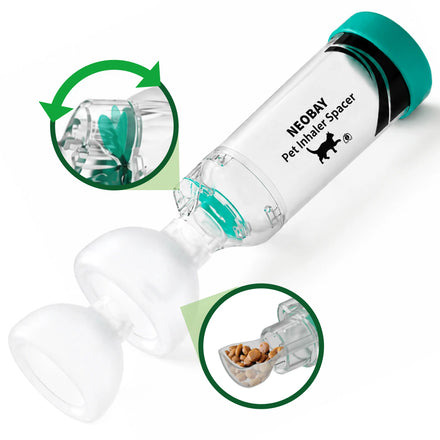
Neobay Cat Aerosol Chamber with Comfort Feeder — Green
- See each breath with the Breath Indicator
- Built-in treat holder makes mask practice easier
- Anti-static chamber helps keep medication airborne
How to Step Down From 220 to 110
If your cat has been symptom-free for at least 4 weeks on 220 mcg BID, ask your vet about stepping down. Going straight to 110 mcg is usually fine, but taper carefully:
- Week 1–2: drop from 220 mcg BID to 110 mcg, 2 puffs BID (same total daily dose, just swapped strengths)
- Week 3–4: if still symptom-free, reduce to 110 mcg, 1 puff BID
- Month 2+: some cats can drop to once-daily dosing; others stay at BID long-term
Watch for cough, wheeze, or increased respiratory rate at rest. Any of those = step back up for 2 weeks and try again. Never stop Flovent cold turkey — rebound airway inflammation can land a cat in the emergency clinic.

5 Signs Your Cat's 110 mcg Dose Isn't Enough
- Coughing continues daily after 4 weeks of consistent 110 mcg BID — true response window has closed
- Symptoms improved briefly, then returned — suggests under-dosing rather than non-response
- Sleeping respiratory rate above 30 breaths per minute — see our home breathing rate monitoring guide
- You've confirmed technique isn't the problem — 7–10 breaths per puff, mask sealed, actuator at the spacer back, per our stress-free administration guide
- Asthma flares more than once a week despite good adherence — step-up conversation warranted
If two or more apply, talk to your vet about either increasing to 220 mcg BID or investigating whether the diagnosis is right. Misdiagnosis is more common than owners realize — see our piece on conditions that mimic feline asthma.
Side Effects: Is 220 Riskier Than 110?
Modestly yes. Inhaled fluticasone has a far cleaner profile than oral prednisolone, but dose still matters. The most common issues at 220 mcg long-term are weight gain and, less often, skin thinning or behavioral changes. Adrenal suppression appears rare in cats at standard inhaled doses. Practical move: use the lowest dose that keeps your cat symptom-free.
Frequently Asked Questions
Is 110 mcg of Flovent enough for a cat?
For mild to moderate feline asthma, yes. The 2010 JFMS study found 110 mcg twice daily reduced airway inflammation by 82%, statistically identical to 220 mcg's 81%. Vets typically reserve 220 mcg for severe cases or cats who don't respond to a proper 110 mcg trial.
How many puffs of Flovent should my cat take?
The standard regimen is 1 puff (110 or 220 mcg) twice daily, delivering 7–10 breaths per puff through a spacer. Some cats need 2 puffs per session. Always shake the inhaler before each puff and wait 30–60 seconds between back-to-back puffs so the medication disperses properly.
How long does Flovent take to work in cats?
Cough reduction usually starts within 1–2 weeks. Full effect takes 4–6 weeks as airway inflammation resolves. If your cat shows zero improvement after 4 consistent weeks on the correct dose with good technique, talk to your vet — either the dose is wrong, the technique is off, or the diagnosis isn't asthma.
Does pet insurance cover Flovent for cats?
Most major pet insurance plans cover Flovent when asthma was diagnosed after the policy's effective date. Reimbursement typically ranges from 70–90% of the pharmacy receipt. See our full breakdown of pet insurance for cats with asthma.
Can I use a GoodRx coupon for my cat's Flovent?
Yes, if your vet writes the prescription in your name. Pharmacies fill it because fluticasone is a standard human asthma drug. GoodRx brings 110 mcg down from ~$290 to ~$160, and 220 mcg from ~$360 to ~$220.
Is it safe to buy Flovent from Canada for my cat?
Many US cat owners import Flovent or Apo-Fluticasone from licensed Canadian pharmacies at roughly one-third of US prices. Use only pharmacies verified through CIPA or PharmacyChecker, and expect 2–3 week delivery.
What to Do Next
- Confirm your cat's current dose matches their severity — mild cats don't need 220 mcg, and severe cats shouldn't stay on 110 if it's not working
- If technique is shaky, lock that in first. Most "Flovent isn't working" cases are actually technique problems — see how to deliver each dose correctly
- If you're stepping up or tapering down, use a spacer with a visual flow indicator so you can confirm each dose was delivered
If your vet has confirmed feline asthma and you're ready for the right spacer chamber, visit our inhaler spacer collection or read our complete cat inhaler spacer guide.
Have questions about dosing or your cat's response? Always check with your veterinarian first — this article is general education, not a prescription. For product questions, visit our FAQ page or contact us directly.
Related Reading
This article is part of our complete Cat Inhaler Spacer Guide — everything you need to know about choosing, using, and maintaining a spacer chamber for your asthmatic cat.
Related: Once you've chosen between oral and inhaled steroids, learn how to safely taper your cat off prednisolone when making the transition to Flovent.


