

Key Takeaways
- Fluticasone residue clings to chamber walls — a 2023 Animals (MDPI) review found that without weekly washing, drug deposits inside a valved holding chamber can reduce the next dose's effective delivery by up to 30%
- Flovent (fluticasone) is a daily corticosteroid — typically 1 puff twice daily, every day, to keep airway inflammation suppressed
- Albuterol is a rescue bronchodilator — used only during coughing or wheezing episodes to open airways within 5–10 minutes
- Weekly chamber cleaning takes 24 hours of air-drying — during that window, you have no usable chamber unless you own a second one
- Most feline-only veterinarians recommend two chambers — one dedicated to Flovent, one to albuterol — once a cat is stable on both medications
Veterinarians who manage feline asthma routinely recommend two separate spacer chambers — one dedicated to daily Flovent (fluticasone) and one to rescue albuterol — once a cat is stable on both medications. The reason isn't marketing. It's that corticosteroid residue builds up inside a chamber between cleanings, and mixing a rescue bronchodilator into that same residue complicates both dosing and emergency use. A second chamber also covers the 24-hour drying window after weekly cleaning, so a 2 a.m. asthma attack never depends on a wet spacer. The Neobay 2-Pack exists specifically for this two-chamber setup.
Here's what the veterinary evidence actually says about why two chambers beat one, when one chamber is fine, and how to think about cost.

What Actually Happens Inside a Chamber After Each Puff
Every time you actuate an MDI into a spacer, a portion of the drug sticks to the inside walls of the chamber before it reaches your cat's lungs. This is well-documented in both human and veterinary inhalation research. A 2023 review in Animals (MDPI) noted that valved holding chambers accumulate drug deposits over repeated use, and this residue changes the electrostatic environment inside the chamber — which affects how much medication gets through on the next puff.
The practical translation: a chamber used repeatedly without cleaning slowly becomes lined with the medication you've been puffing into it. With Flovent, that means a thin film of fluticasone propionate. With albuterol, a film of salbutamol sulfate. Neither film is dangerous on its own. The problem is what happens when the two films mix, or when buildup grows thick enough to trap the next dose.
Trudell Animal Health, the manufacturer of AeroKat, recommends cleaning the chamber weekly with regular use — a guidance that matches Neobay's own cleaning and maintenance guide.
The Three Real Reasons Vets Recommend Two Chambers
1. Medication residue mixing is a chemistry problem
Flovent is a suspended corticosteroid designed to land on airway tissue and suppress local inflammation over hours. Albuterol is a fast-acting β2-agonist designed to relax bronchial smooth muscle within minutes. They work on completely different pathways — but when residue from one drug is sitting inside the chamber and you puff in the other, that residue partially absorbs the new dose. The cat doesn't get the full amount you actuated. With Flovent, that means under-controlled inflammation. With albuterol during an active attack, that means a rescue dose that may be 10–20% weaker than intended.
2. Cleaning takes 24 hours, and asthma doesn't wait
The correct way to clean a chamber — disassemble, wash in lukewarm water with mild dish soap, rinse, and air-dry completely before reassembly — takes a full day. Towel-drying leaves lint and fibers that contaminate the next dose. A damp chamber left closed grows mold. So the realistic cleaning window is overnight, minimum.
During that window, a single-chamber household has no working spacer. If your cat has an asthma attack at 6 a.m. and the chamber went into the sink at 10 p.m., you're either delaying the rescue dose or puffing albuterol through a wet chamber — which both reduces the dose and risks introducing water droplets into already-compromised airways.
Can I just rinse the chamber quickly between Flovent and albuterol doses?
No — a quick rinse doesn't remove fluticasone residue, it just spreads it around the inside of the chamber. Fluticasone propionate is poorly soluble in water; that's part of why it works as an inhaled steroid. It needs warm soapy water and mechanical agitation (a soft bottle brush) to come off, followed by full air-drying. A 30-second rinse between morning Flovent and an evening albuterol rescue dose gives you a chamber that's wetter, with the same residue still on the walls — the worst of both worlds.
3. Emergency use should never depend on chamber state
The most underrated argument for a second chamber is psychological. Asthma attacks in cats often happen at night or early morning. The owner is half awake, the cat is coughing and distressed, and the last thing you want to be thinking about is "did I wash the chamber yesterday? Is it dry? Did I leave it apart?" A dedicated rescue chamber that lives assembled, clean, and labeled "albuterol only" beside the rescue inhaler removes that cognitive load. You grab it, you puff, you act. That's how emergency medication is supposed to work.
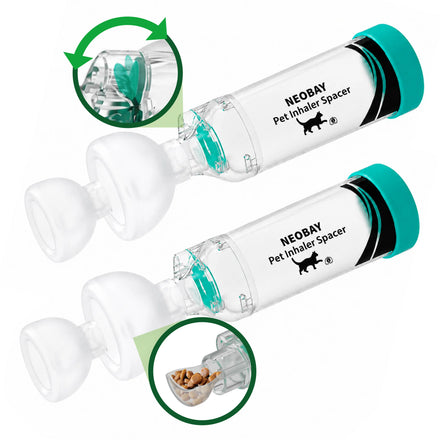
Neobay Cat Aerosol Chamber with Comfort Feeder — Green 2-Pack
- $30 per chamber vs AeroKat $61.95 — about 52% less
- One in use, one air-drying — no skipped doses on cleaning day
- Two chambers for multi-cat homes — no cross-contamination

When One Chamber Is Actually Fine
Not every cat needs two chambers. If your cat is:
- Prescribed Flovent only (no rescue albuterol on hand)
- Well-controlled and rarely coughs
- On albuterol only as a true once-a-quarter emergency tool
…then one chamber, cleaned weekly, is medically appropriate. The two-chamber recommendation kicks in once both medications are in regular rotation — meaning Flovent daily plus albuterol at least a few times a month. If your cat hasn't needed albuterol in six months, you don't need a second chamber for them. You might still benefit from one for peace of mind, but it's not a medical necessity.
The same logic applies to any chamber brand — AeroKat, Neobay, or a generic. The physics of residue buildup doesn't change with the logo on the plastic.
Multi-Cat Households: A Separate Question
Two cats in the same household on inhaled medication should each have their own chamber, regardless of drug. Respiratory viruses — feline herpesvirus, calicivirus, bordetella — transfer between cats via shared mask contact. The spacer guide overview covers how chambers differ if you're shopping for a second one.
What This Actually Costs Per Year
A single Neobay chamber runs around $34 at retail. The 2-Pack runs $55 — less than buying a second single later. Flovent runs $80–$120 per month. A second chamber is roughly half of one month's drug cost, amortized over 18–24 months of use — about $2–$3 per month. For a cat on long-term inhaled therapy, that's the cheapest insurance you can buy against reduced rescue drug delivery, a wet chamber at the wrong moment, and the 24-hour cleaning gap.
How to Label and Store Two Chambers
Once you have two chambers, don't mix them up. Simplest system:
- Green tape on the Flovent chamber, labeled "FLOVENT — DAILY"
- Red tape on the albuterol chamber, labeled "ALBUTEROL — RESCUE ONLY"
- Flovent chamber beside the food bowls (twice-daily visibility)
- Albuterol chamber in a separate marked location — a specific drawer or dedicated emergency kit
Color-coding matters because in a panic you do not want to be reading labels. You want to grab red. For more on building a calm routine, see stress-free inhaled medication administration.
Frequently Asked Questions
Is it dangerous to use the same chamber for Flovent and albuterol?
Not acutely dangerous in the sense of causing harm — but it reduces the effectiveness of both drugs. Fluticasone residue absorbs part of each albuterol rescue dose, and the wetter, busier cleaning cycle stresses the chamber's valve. Vets recommend two chambers to keep each drug at full delivered dose, not because sharing one will hurt your cat.
How often should I replace a cat inhaler chamber?
Most manufacturers and veterinary pharmacologists recommend replacing a chamber every 12–24 months with regular use. Signs it's time: a sticky or non-responsive flow indicator, a mask that's lost its seal, visible cloudiness or film that doesn't come off with cleaning, or a valve that's stiff. The rubber valve and mask seal are usually the first components to wear out.
Can I use a human spacer for my cat?
No — cat-specific chambers like AeroKat and Neobay are smaller volume (typically 150–200 mL) and shaped for a cat's tidal volume. Adult human spacers are 350–750 mL, which is too large for a cat to clear in a normal breath cycle. Pediatric spacers are closer in volume but still require a separate feline face mask. See our breakdown of whether cats can use human inhalers for the full reasoning.
Do I need a second chamber if my cat only uses Flovent?
No. If albuterol isn't part of your cat's regimen, one chamber cleaned weekly is fine. A backup chamber for cleaning-day coverage is a convenience, not a medical need. Two-chamber recommendation is specifically for cats on both daily Flovent and rescue albuterol.
What if my vet said one chamber is fine?
Listen to your vet. Many general practitioners do say one chamber is fine for well-controlled cats, and they're not wrong — the medical risk of sharing a chamber is small in practice. The two-chamber recommendation is the "best practice" position from feline-focused veterinarians, not a universal rule.
What to Do Next
- Check your current medication schedule — if Flovent and albuterol are both prescribed, you're a candidate for two chambers
- Pick up a Neobay 2-Pack or a second single chamber so each drug has its own dedicated device
- Label and store them in separate locations — green for daily Flovent, red for rescue albuterol
Questions about how to set up a two-chamber routine? Visit our FAQ page or reach out directly — we work with cat owners on this every day.
Sources
- Bexfield N, et al. "Inhalational Therapy for Feline Inflammatory Airway Disease." Animals (MDPI), 2023. (PMC10812033)
- Trudell Animal Health. "AeroKat Frequently Asked Questions — Cleaning and Maintenance." trudellanimalhealth.com
- Neer T M, Reinero C R. "Inhaled Drugs for Feline Asthma." WSAVA Congress, 2001 (VIN)
- VCA Animal Hospitals. "Treatment Instructions for Asthma and Bronchitis in Cats." vcahospitals.com
- Plumb's Veterinary Drugs. "Fluticasone Propionate — Monograph." 2024 edition.
Related Reading
This article is part of our Complete Guide to Cat Inhaler Spacers — everything you need to know about choosing, using, and maintaining a chamber for your asthmatic cat.
Related reading: Once you have the right chamber count sorted, avoid the technique errors that waste medication — see our Cat Spacer Technique: 7 Common Mistakes Owners Make.


