

Key Takeaways
- A single Flovent inhaler costs $80–$200 in the US and contains around 120 doses — each practice puff burns $0.70–$2.50 worth of medication before your cat gets a single therapeutic breath.
- A compressed-air canister ($5–$8) mimics the puff sound without using any prescription medication — the lowest-cost desensitization tool available, recommended by certified cat behavior consultants.
- An albuterol rescue inhaler costs $15–$50 and delivers the same puff mechanics as Flovent — many veterinarians prescribe one for emergencies anyway, so using it for training adds zero extra cost.
- The "pre-puff behind your back" technique — puffing the inhaler into the chamber before placing the mask — works with low-dead-space chambers like Neobay, which hold the medication cloud for 5–10 seconds so your cat never hears the puff at all.
- A 2-Pack chamber setup means your daily Flovent chamber stays clean and ready while a dedicated practice chamber handles training and rescue use — no scrambling to clean a dirty chamber when it's medication time.
You don't need to burn through $40–$80 worth of Flovent just to get your cat comfortable with an inhaler — a compressed-air canister ($5), a rescue albuterol inhaler your vet likely already prescribed ($15–$50), or the pre-puff technique with a Neobay spacer can eliminate medication waste entirely during training. Most cats adjust to mask-and-chamber treatment in 5–7 days, and a 2-Pack setup keeps your daily chamber clean while training and rescue practice happen in parallel.

Why Flovent Is Too Expensive to Burn on Training
Generic fluticasone HFA (what replaced brand-name Flovent in the US) isn't cheap. Here's what cat owners actually pay:
| Source | 110 mcg (per inhaler) | 220 mcg (per inhaler) | Cost Per Puff (110 mcg) |
|---|---|---|---|
| US retail (no insurance) | $276–$297 | $330–$400 | ~$2.30 |
| US GoodRx coupon | ~$160 | ~$220 | ~$1.33 |
| Canadian pharmacy (import) | $80–$120 | $100–$150 | ~$0.70 |
Now do the training math. A 5-day desensitization protocol might involve 3–5 practice puffs per session — 15–25 wasted doses. At US GoodRx: $20–$33. At US retail: $35–$58 in wasted medication before your cat inhales one therapeutic dose. If your cat is sound-sensitive and takes two weeks — which is normal — the waste doubles.
MDI (metered-dose inhaler) — the pressurized canister containing 120 metered puffs of aerosolized medication (Flovent, fluticasone HFA, or albuterol), inserted into the back of a spacer chamber.
Can I just use an empty inhaler canister that's finished?
No — once a Flovent canister is empty, it no longer produces an aerosol puff. The propellant and medication deplete together, so an empty canister is silent. You need something that actually produces the puff sound and sensation, which is where the three methods below come in.
Method 1: Compressed-Air Canister ($5, No Prescription Needed)
This is the cheapest option and the one IAABC-certified cat behavior consultant Joey Lusvardi of Class Act Cats recommends. A standard electronics-grade compressed-air canister — the kind used to clean keyboards — produces a short hissing burst that sounds similar to an inhaler being activated.
The protocol is simple:
- Spray the compressed air several feet away from your cat while giving a high-value treat — the sound becomes a treat predictor, not a threat.
- Over 2–3 sessions, gradually decrease the distance. Reward every time.
- Once your cat stays relaxed with the sound at close range, spray the canister near the spacer chamber while the mask is on your cat's face.
- After 5–7 days, most cats stop reacting to the sound entirely.
One caveat: compressed air is a continuous hiss, not the sharp burst of an MDI — so this method desensitizes the concept of a noise during treatment but doesn't perfectly replicate the inhaler experience. For cats who startle at the exact puff timing, Method 2 is more realistic.
Desensitization — a gradual exposure process where a neutral or mildly aversive stimulus (like the puff sound) is repeatedly paired with a positive reward (treats), so the animal learns the stimulus predicts good things rather than danger.
Method 2: Albuterol Rescue Inhaler ($15–$50, Prescription Required)
Here's the hack that Reddit and Instagram cat owners swear by: if your vet has prescribed an albuterol rescue inhaler for emergencies — which they almost always do alongside daily Flovent — use the albuterol canister for training.
Albuterol costs $15–$50 per generic canister and produces the exact same puff mechanics as Flovent — same canister shape, same activation force, same sharp burst sound. Because albuterol is a short-acting bronchodilator (it opens airways for 4–6 hours), a single practice dose in a cat without active bronchoconstriction has no meaningful clinical effect.
Three things make this method work financially:
- You were going to buy albuterol anyway — it's standard for every asthmatic cat's emergency kit.
- At $15–$50 per canister versus $80–$200 for Flovent, each practice puff costs $0.08–$0.25 instead of $0.70–$2.50.
- Training your cat with albuterol also teaches them to accept the mask during an actual attack — a skill that compressed air can't teach because there's no urgency component.

Important: Albuterol is a prescription medication. Don't self-prescribe — ask your vet during the initial asthma diagnosis conversation whether you can use the rescue inhaler for training purposes. Most will say yes, because they want you to be familiar with using it before an emergency happens.
Does practicing with albuterol mean my cat gets an unnecessary dose of medication?
Technically yes — but the dose is minimal (one 90 mcg puff) and albuterol has a short half-life (2–4 hours in cats). For a cat without active bronchoconstriction, one puff causes slight bronchodilation with no lasting effect — the respiratory equivalent of a sip of coffee. If your cat has underlying heart disease (especially hypertrophic cardiomyopathy), discuss with your vet first — albuterol slightly increases heart rate.
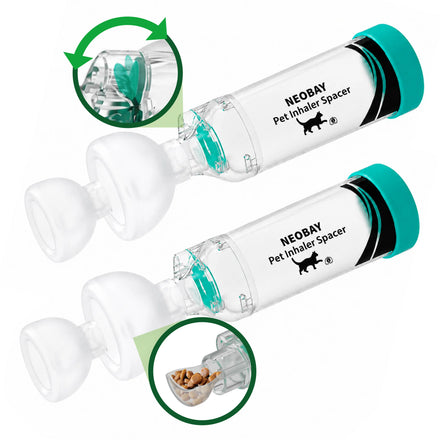
Neobay Cat Aerosol Chamber with Comfort Feeder — Green 2-Pack
- $30 per chamber vs AeroKat $61.95 — about 52% less
- One in use, one air-drying — no skipped doses on cleaning day
- Two chambers for multi-cat homes — no cross-contamination
Method 3: Pre-Puff Behind the Back (Free, Chamber-Dependent)
Trudell Animal Health (makers of AeroKat) recommends a technique that costs nothing and requires zero extra equipment: activate the inhaler before placing the mask on your cat's face.
Here's how it works. You shake the inhaler, press it into the back of the chamber while the chamber is behind your back or out of your cat's sightline, then bring the chamber to your cat's face. The medication stays suspended inside the chamber for 5–10 seconds — enough time for your cat to start breathing normally — and your cat never hears the puff.
Low-dead-space chamber — a spacer designed with minimal internal volume (typically 150–200 mL for cats) and anti-static materials that keep the medication aerosol floating longer, so the drug isn't lost to chamber walls or gravity before the cat inhales. Neobay and AeroKat both use this design.
This method only works with low-dead-space, anti-static chambers. Cheap generic spacers lose the medication cloud in 2–3 seconds — by the time you bring the mask to your cat's face, half the dose is already on the wall. Neobay and AeroKat chambers hold the cloud for 7–10 seconds, which is plenty.
The downside: this eliminates the sound problem, not the mask acceptance problem. For cats who hate the mask itself, you still need desensitization — and that's where the Comfort Feeder (which holds a squeeze-treat on the mask rim) makes a difference.

Which Method to Choose
| Your Situation | Recommended Method | Cost |
|---|---|---|
| Budget tight, cat mildly sound-sensitive | Compressed-air canister | $5–$8 |
| Vet has already prescribed albuterol | Albuterol rescue inhaler (most realistic) | $15–$50 (already budgeted) |
| Cat hates the puff sound specifically, you own a Neobay or AeroKat | Pre-puff behind the back | Free |
| Cat is highly sound-sensitive + needs realistic practice | Compressed air first (2–3 days) → then albuterol | $20–$58 total |
And if your cat takes training in stride and doesn't react to the puff at all? Skip all three — some cats genuinely don't care about the sound, and you'll know within the first day of introducing the chamber with medication.
Frequently Asked Questions
Can I just use my cat's daily Flovent for training since I'm buying it anyway?
You can, but you're throwing away $0.70–$2.50 per practice puff — $10–$60 in wasted medication over a 5–7 day training period. If your insurance covers Flovent with a flat copay, the math changes. For most cat owners paying out of pocket, it's unnecessary spending.
How do I know if my chamber is "low dead space" enough for the pre-puff method?
Look for an anti-static claim on the packaging and a visual flow indicator. If the chamber doesn't have a flow indicator, it probably wasn't designed for small-tidal-volume use. Human pediatric spacers lose the medication cloud significantly faster than cat-specific chambers.
Will my vet think I'm being cheap if I ask about this?
Quite the opposite. Vets want you to succeed with inhaled therapy — it's the gold-standard treatment for feline asthma with far fewer long-term side effects than oral steroids. A cat owner who's thinking about training logistics and cost management is an owner who's likely to stick with the treatment. Mention the albuterol training approach during your next visit; most vets will be supportive.
What if my cat regresses after training and I need to re-train later?
Regression happens — a stressful event or bad treatment experience can set a cat back. When it does, the compressed-air or albuterol method is worth revisiting for 2–3 refresher sessions. A dedicated practice chamber (2-Pack setup) means you can run impromptu re-training without touching the daily medication chamber.
Is the puff sound really the biggest training barrier?
For most cats, the mask itself is a bigger barrier than the sound — cats have highly sensitive whiskers and instinctively resist things covering their face. That said, for sound-reactive cats (common in rescues or anxious cats), the puff can be the dealbreaker that makes them bolt. If your cat flinches at sudden noises (vacuum, doorbell, dropped keys), assume the puff sound will be an issue and start with Method 1 early.
What to Do Next
- Check your medication cabinet. Do you already have an albuterol rescue inhaler? If yes, you have a free training tool. If not, ask your vet at the next visit.
- Grab a compressed-air canister. $5 at any electronics or office supply store. Start the sound-desensitization protocol today — even if you don't have the spacer yet, the sound conditioning transfers.
- If you're buying a spacer for the first time, consider the Neobay 2-Pack. One chamber for daily Flovent, one for training and rescue. Two chambers at $55 instead of $34 for a single means a backup chamber costs $21 — less than 15 wasted Flovent puffs at GoodRx pricing.
- Read the full training protocol. See our step-by-step inhaler training guide for the complete desensitization sequence from mask introduction to full medication delivery.
Have questions about your cat's specific situation? Contact us — we'll help you figure out the right training approach.
Related Reading
- What Is a Cat Inhaler Spacer? The Complete Guide — Pillar C Hub
- One Chamber for Flovent and Albuterol? Why Vets Recommend Two
- Flovent 110 vs 220 mcg for Cats: Which Dose Is Right?
- When Cats Hate the Puff Sound: Sound Desensitization for Sound-Sensitive Cats
Sources
- Class Act Cats (Joey Lusvardi CCBC). "Inhaler Training Cats: The Easy Way To Easy Breathing." Updated December 2025.
- Trudell Animal Health. "How To Use A Cat Inhaler To Treat Feline Asthma." Updated July 2026.
- Plumb's Veterinary Drug Handbook. Albuterol sulfate — Feline dosing and pharmacokinetics.
- CattleDog Publishing (Dr. Sophia Yin legacy). "Teaching Your Cat To Use an Inhaler." Updated March 2026.
Related: How Fast Can You Train a Cat to Accept an Inhaler? 5-Day Timeline — see the accelerated 5-day training protocol for cats that are food-motivated or have prior positive training history.


