

Key Takeaways
- A failing spacer can waste up to 80% of your cat's medication — sending it to the throat instead of the lungs.
- Recurring symptoms during treatment are the #1 sign something's wrong with your delivery device, not the drug.
- Mask leakage is invisible but devastating — even a small gap can halve the dose your cat receives.
- Most generic spacers need replacement every 6-12 months — static buildup, valve wear, and residue accumulation degrade performance silently.
- If your spacer lacks a visual flow indicator, you're treating blind — a Neobay spacer with Visual Flow Indicator lets you confirm every dose lands in the lungs.
You've been doing everything the vet told you. Inhaled medication twice a day. The spacer. The mask. The slow count to ten breaths.
But last night, you heard it again — that dry, hacking cough. Then again this morning while your cat was resting on the windowsill.
The symptoms you thought were under control are creeping back.
Your first instinct might be to blame the medication. Maybe the dose is too low. Maybe Flovent just isn't working for your cat.
But here's what most cat owners don't realize: the problem is often the delivery device, not the drug.
A spacer chamber that isn't functioning correctly can waste medication, under-dose your cat, and let symptoms return — even when you're administering every dose on schedule. The tough part? Spacer failure is usually invisible. You won't see it happening.
Here are the five most common signs that your cat's inhaler spacer isn't working properly — and exactly what to do about each one.
1. Your Cat's Symptoms Return Despite Consistent Treatment
This is the most obvious sign and the easiest to dismiss as "the medication stopped working."
What's happening: Asthma and respiratory medications don't typically stop working without reason. If your cat was stable on inhaled therapy and symptoms return, the medication molecules probably aren't reaching the lower airways. Something in the delivery chain is broken.
The silent culprit: valve degradation. Every spacer chamber has a one-way valve that holds the medication cloud inside the chamber, then releases it when your cat inhales. Over time — usually 6-12 months of daily use — this silicone or rubber valve stiffens, warps, or develops micro-tears. When that happens, the medication escapes through the valve instead of waiting for your cat's inhalation.
How to fix it: First, rule out other variables — confirm the inhaler canister isn't empty, and your cat hasn't developed a new trigger (seasonal pollen, dust from a renovation, a new scented product in the home). If those factors are stable, suspect the spacer. Most generic spacers and pharmacy-brand chambers have a functional lifespan of 6-12 months. If yours is older than that, it's time to replace it.
The Neobay difference: Our valve assembly is engineered for daily feline use — the same medical-grade silicone found in human pediatric spacers, rated for over 500 actuations before any measurable performance drop. More importantly, the Visual Flow Indicator lets you see the valve in motion with every breath. If the flap isn't moving, you'll know the medication isn't moving either — before symptoms ever return.

2. The Mask Won't Seal Properly Around Your Cat's Face
A spacer chamber only works if it forms a closed system between the inhaler and your cat's lungs. Any gap between the mask and your cat's face is a medication leak.
What's happening: Generic spacers ship with a one-size-fits-most mask. Cats have dramatically different face shapes — a flat-faced Persian, a narrow-faced Siamese, and a round-faced British Shorthair all place completely different demands on a mask seal. If the mask is too big, medication escapes around the edges. If it's too small, the seal breaks when your cat moves even slightly.
The test: Watch your cat during the next treatment. Is the mask flush against the fur around the nose and mouth? Do you see or hear any gaps when your cat shifts position? If you can feel air escaping around the edges of the mask, your cat is receiving a partial dose at best.
How to fix it: Check if your spacer has alternative mask sizes available. Some brands offer small/large options. If the mask design itself is the issue — rigid edges, uncomfortable pressure points, a shape that doesn't match feline facial anatomy — you need a spacer built specifically for cats, not a repurposed pediatric device.
The Neobay difference: The mask included with Neobay was designed for feline facial anatomy from the start — not adapted from human pediatrics. The Comfort Feeder attachment goes a step further: it turns the mask into a positive-reinforcement tool. You can place a tiny amount of your cat's favorite treat at the mask opening, so your cat voluntarily presses their face into the seal. A cat that chooses to engage with the mask creates a better seal than one you have to hold in place.
3. You Can't Tell If the Medication Actually Entered the Lungs
This is the anxiety every cat owner knows: you've done the puffs, you've held the mask for what felt like long enough, but you have no idea if any medication actually reached your cat's lungs.
What's happening: Without a visual indicator on the spacer, you're relying entirely on guesswork. Did your cat hold their breath? Did the valve open? Did the dose go into the lungs or just sit inside the chamber? Most spacers — including the market leader AeroKat — give you zero visual feedback during administration. You're treating blind.
The desperation move: Many owners end up actuating extra puffs "just to be safe." This wastes medication (Flovent can cost $200-400 per inhaler), increases the risk of oral thrush from throat-deposited steroids, and creates uncertainty about when the inhaler will run out.
How to fix it: If your current spacer has no visual feedback mechanism, consider upgrading to one that does. A visible breath indicator transforms each treatment from a faith-based exercise into a confirmed dose.
The Neobay difference: The Visual Flow Indicator is the only breath-confirmation system on any feline aerosol chamber. A small green flap moves with every inhalation and exhalation. You can see it flutter open when your cat inhales and close when they exhale. If the flap stops moving mid-treatment, you know your cat pulled away or broke the seal. No wondering. No wasted puffs. Just visual confirmation that the dose went where it needed to go.
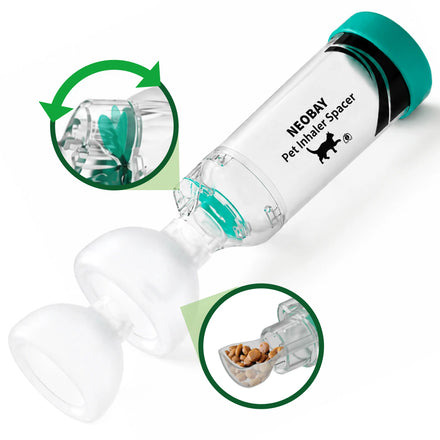
Neobay Cat Aerosol Chamber with Comfort Feeder — Green
- See each breath with the Breath Indicator
- Built-in treat holder makes mask practice easier
- Anti-static chamber helps keep medication airborne
4. The Spacer Shows Visible Wear, Discoloration, or Residue Buildup
Sometimes the problem is hiding in plain sight.
What's happening: Plastic spacer bodies degrade over time. Look for these visual red flags:
- Cloudiness or yellowing of the chamber walls — indicates plastic degradation that can create microscopic surface pits where medication adheres instead of staying aerosolized
- White powdery residue inside the chamber — this is dried medication propellant that builds up despite regular cleaning. Each layer of residue traps a percentage of subsequent doses
- Cracks or chips anywhere on the chamber body, mask rim, or adapter port — even hairline cracks disrupt the pressure balance inside the chamber
- Stiff or sticky valve flap — a valve that doesn't open and close freely means your cat has to work harder to draw medication, and may not get the full dose
How to fix it: Do a visual inspection every month. Hold the spacer up to a light. Look through the chamber. Run your finger around the mask rim — is it still smooth and pliable? Actuate a puff of air (no medication) and watch the valve — does it move freely?
If you see any of these signs, cleaning alone won't restore performance. The spacer needs replacement.
The Neobay difference: Our chamber body uses anti-static polymer — unlike standard plastics that build up a static charge and attract medication particles to the walls. Less residue buildup means longer functional life and more consistent dosing between cleanings.

5. Your Cat Has Started Fighting the Treatment
You worked so hard to get your cat comfortable with the spacer. The training took weeks. And now — suddenly — your cat is backing away, flicking their ears, and refusing the mask again.
What's happening: This isn't a behavioral regression. It's your cat telling you something about the spacer.
Cats have extraordinary sensory perception. They can detect subtle changes we can't: - A valve that takes more force to open makes breathing feel restricted. Your cat may associate the spacer with a suffocating sensation. - Static discharge from a deteriorating chamber can produce a tiny shock or tingling sensation on sensitive whiskers and nose. - Odor retention — plastic absorbs the chemical smell of medication propellants over time, creating an unpleasant taste and smell that your cat notices before you do.
When a cat that was previously cooperative suddenly resists, the problem is almost always physical, not behavioral.
How to fix it: First, try a deep clean — disassemble everything, soak in warm water with mild dish soap for 15 minutes, rinse thoroughly, and air dry (never towel-dry — towels leave lint that becomes static-charged). If your cat still resists after a clean spacer is reintroduced, the spacer itself has likely degraded beyond usability.
The Neobay difference: The Comfort Feeder fundamentally changes the dynamic. Instead of the spacer being "that thing that gets forced onto my face," it becomes "that thing that gives me treats." Even cats that have developed negative associations with other spacers can be retrained with the Comfort Feeder's positive-reinforcement approach. And because the anti-static body and smooth valve mechanism provide consistent, low-effort breathing, your cat won't develop the resistance that comes from a physically uncomfortable experience.
When to Replace Your Spacer: A Practical Timeline
| Component | Expected Lifespan | Warning Signs |
|---|---|---|
| Valve flap | 6-12 months | Stiff, curled, doesn't snap closed |
| Chamber body | 12-18 months | Cloudy, yellowed, static-prone |
| Mask | 6-12 months | Stiff edges, poor seal, residue in crevices |
| MDI adapter port | 12-18 months | Loose fit, doesn't hold inhaler securely |
The bottom line: If your spacer is more than 12 months old and your cat is showing any of the five signs above, the most effective fix is a replacement — ideally with a device that gives you the visual feedback to catch problems early next time.
Frequently Asked Questions
How often should I clean my cat's inhaler spacer?
Clean the spacer once a week with warm water and mild dish soap. Rinse thoroughly and air dry completely before next use. Never use alcohol, boiling water, or abrasive cleaners — they damage the plastic and degrade the valve.
Can a dirty spacer make my cat sick?
Yes. A spacer that isn't cleaned regularly can harbor bacteria, especially in the mask area where it contacts your cat's face. It can also accumulate mold if stored damp. This is particularly dangerous for a cat with compromised respiratory health.
My spacer looks fine but my cat is still coughing. Should I increase the dose?
Never adjust medication dosage without consulting your veterinarian. If your cat's spacer appears functional but symptoms persist, the spacer may have an invisible problem (valve degradation, static buildup) that only a replacement will solve. Ask your vet to evaluate both the medication AND the delivery device.
Is it normal for the spacer to smell like medication?
A faint smell is normal after months of use, but a strong chemical odor indicates that the plastic has absorbed propellant residue. This can irritate your cat's sensitive nose and make them resist treatment. If deep cleaning doesn't remove the smell, replacement is the only solution.
What's the difference between a pediatric spacer and one made for cats?
Pediatric spacers are designed for human children who can follow instructions ("take a deep breath and hold it"). Cats can't. Feline spacers need a valve that responds to a cat's shallower, faster breathing pattern. They also need masks shaped for feline facial anatomy — not a human child's face. Using a pediatric spacer on a cat almost guarantees a poor seal and unpredictable dosing.
How do I know if the valve is still working?
If the spacer has a visual indicator, watch it during an actuation. If it doesn't have one, listen carefully: you should hear a faint "click" or "flutter" when your cat inhales and the valve opens. If the spacer is silent and your cat seems to be breathing normally through it, the valve may be stuck open, stuck closed, or missing entirely.
Related reading: See our section on baby spacers for cats — whether Babyhaler or AeroChamber work for cats, dose delivery issues, and when a baby spacer is acceptable vs a bad idea.
What to Do Next
- Inspect your current spacer using the five signs above. Hold it up to light. Check the mask seal. Watch the valve during your next treatment.
- If you found even one red flag, the spacer is likely under-dosing your cat. Deep-clean it first, then test again. If the problem persists, replacement is the answer.
- If you're treating blind — with no visual indicator confirming each dose enters the lungs — upgrade to a Neobay Cat Aerosol Chamber. The Visual Flow Indicator gives you something no other feline spacer offers: certainty.
- If your cat fights the mask, the Comfort Feeder's positive-reinforcement design can turn treatment from a daily struggle into a moment your cat actually looks forward to.
A spacer chamber isn't a lifetime purchase — it's a medical device with a functional lifespan. When it stops working properly, your cat pays the price in symptoms.
If your cat's asthma isn't as well controlled as it was six months ago, don't question the medication. Question the delivery device.
Have questions about whether your spacer needs replacement? Contact us or visit our FAQ page.
Sources: - Trzil JE. "Feline asthma: diagnostic and treatment update." Veterinary Clinics of North America: Small Animal Practice, 2020; 50(2): 375-391. - Padrid P. "Use of inhaled medications to treat respiratory diseases in dogs and cats." Journal of the American Animal Hospital Association, 2006; 42(2): 165-169. - Cornell Feline Health Center. "Feline Asthma: What You Need to Know." Cornell University College of Veterinary Medicine. https://www.vet.cornell.edu/departments-centers-and-institutes/cornell-feline-health-center/health-information/feline-health-topics/feline-asthma-what-you-need-know
Related Reading
This article is part of our What Is a Cat Inhaler Spacer? — covering device types, how to use them, proper technique, cleaning, and troubleshooting.


