

Key Takeaways
- The AeroKat "small" mask measures about 50 mm (roughly 2 inches) across — too wide for kittens under 3.5 lb, flat-face cats, and many senior cats with facial muscle loss.
- If the mask covers your cat's eyes, leaks around the nose, or the Flow-Vu indicator stops flapping, the fit is wrong — not your cat's breathing.
- Flat-face breeds (Persian, Himalayan, Exotic Shorthair) almost never get an airtight seal with a round, hard-silicone mask because their nose sits lower than their brow.
- A leaking mask can waste half or more of each dose — meaning your cat gets less medication than prescribed even when you "do everything right."
- Workarounds like baby AeroChamber masks and homemade foam seals exist, but if your cat has already learned to hate the mask from past failed sessions, a chamber built around positive reinforcement — like the Neobay Cat Aerosol Chamber's Comfort Feeder — solves what no mask swap can.
You held the AeroCat chamber the way the vet showed you. You pressed the puff. You waited the seven to ten breaths. And the Flow-Vu indicator just sat there — not flapping. Or worse, your cat bolted the second the mask came near her face because last time it pressed against her eyes.
If that's where you are, you're not doing it wrong. You're running into a sizing problem that the manufacturer's marketing doesn't really talk about. AeroKat ships with two masks, and the smaller of the two still measures about 50 mm (close to 2 inches) across. For a lot of cats, that's simply too wide.
This guide breaks down which cats get squeezed (literally) by the standard AeroKat masks, how to test whether your mask is leaking, what workarounds actually help, and when the better move is to switch chambers entirely.
Why the AeroKat Mask Runs Large for Some Cats
AeroKat is the most-prescribed feline spacer in North America, and for good reason — it works well for average-sized adult cats. The chamber holds the medication, the Flow-Vu indicator gives you a visual cue that your cat is inhaling, and the two included masks (size 1 and size 2) cover the expected range of feline faces.
But "expected range" is doing a lot of work in that sentence. The small mask is around 50 mm wide. To put that in human terms, it's about the diameter of a tennis ball cut in half. Now picture pressing a tennis-ball-half against the face of a 3.5-pound kitten, or a Persian cat whose nose barely protrudes past her brow line.
The mask covers eyes. It presses against whiskers. It can't form a seal against a flat face because there's nothing for the rim to hook onto. And owners — reasonably — assume the problem is their technique or their cat's cooperation. It usually isn't. It's geometry.
The cats that get hit hardest
Not every cat struggles with the AeroKat masks. But four groups almost always do:
- Kittens and small-framed adults (under about 5 lb / 2.3 kg) — Singapura, small Siamese, runts, underage rescues
- Flat-face (brachycephalic) breeds — Persian, Himalayan, Exotic Shorthair, British Shorthair
- Senior cats with muscle loss — the temporal and masseter muscles thin out with age, leaving hollows the mask can't bridge
- Large-bodied but small-headed cats — long, lanky breeds like Oriental Shorthairs where the body is big but the skull is narrow
None of these cats are "abnormal." They're just outside the median face size the AeroKat was designed around.
The Real AeroKat Mask Size Chart
AeroKat doesn't publish an explicit size chart in their packaging, which is part of why owners get caught off guard. Here's what the actual measurements look like, based on the replacement masks Trudell sells and what owners have reported measuring at home:
| Mask | Approx. diameter | Cats it usually fits | Cats it usually doesn't |
|---|---|---|---|
| Size 1 (small) | ~50 mm / ~2.0" | Adult DSH 7-12 lb with average face | Kittens, flat-face breeds, seniors with muscle loss |
| Size 2 (large) | ~63 mm / ~2.5" | Large breeds: Maine Coon, Ragdoll, Norwegian Forest | Anything under 12 lb, including most adult DSH |
| Baby AeroChamber mask (workaround) | ~38 mm / ~1.5" | Kittens under 5 lb, very small seniors | Adults (too small for full seal), flat-face cats (still round) |
Notice the gap. There's no AeroKat mask sized for the 4-6 lb cat, and there's no AeroKat mask shaped for a flat face. That gap is the entire reason this article exists.
Signs Your Cat's Inhaler Mask Is Too Big
You can usually diagnose a sizing problem in under a minute at home. Look for these five signs:
- The Flow-Vu indicator isn't flapping during a dose. If your cat is alive and breathing but the indicator sits still, air is escaping somewhere — almost always at the mask seal.
- The mask rim sits on or above your cat's eyes. Eyes should be outside the mask. Always. A mask that presses on the eye is both a comfort problem and a real risk of corneal injury over time.
- You can see daylight between the mask rim and your cat's face. Any visible gap means medication is escaping.
- Your cat pulls away harder on the second breath than the first. First breath feels okay; second breath, the mask shifts, contacts an eye or whiskers, and the cat resists.
- You're going through inhalers faster than the vet predicted. A 120-puff Flovent canister should last about 60 days at one puff twice daily. If you're refilling at day 40, something is wasting medication — and a leaking mask is the most common culprit.
Any one of these is a flag. Two or more is a near-certain sizing problem.
When the AeroKat Mask Covers Your Cat's Eyes
Reddit user in r/CatAdvice said it plainly: "The large mask is too big, covers her eyes." This is one of the most common complaints about the AeroKat, and it's not just a comfort issue.
Cats have a strong palpebral reflex — anything that approaches the eye triggers a blink and a head pull. A mask rim pressing against the orbital area tells the cat, on a reflex level, that something is threatening her eye. That reflex is exactly why desensitization training can stall for weeks on cats whose masks are oversized. The cat isn't being stubborn. Her nervous system is telling her to pull away.
What helps:
- Drop down a mask size first. If you're on size 2, try size 1. The rim should clear the eyes with at least a few millimeters to spare.
- Try the baby AeroChamber mask (smaller diameter) as an interim fix. Trudell makes both products, and some cat owners report the newborn-size baby mask fits small adult cats better than either AeroKat option.
- Tilt the chamber slightly downward so the rim seals against the bridge of the nose and chin, not the brow. A small angle change can keep the rim below the eye line.
- If none of that works, the mask is the wrong shape for your cat's face — and no amount of training will fix geometry.
Flat-Face Cats: Persian, Himalayan, Exotic Shorthair
Brachycephalic cats — the flat-face breeds — are the hardest cats to fit with any round mask, and the AeroKat is no exception. Their skulls are shortened, which means their nose sits lower than the brow, their eyes are more prominent, and the natural curve where a mask rim would seal simply isn't there.
A Persian owner in the feline asthma groups put it this way: even the small AeroKat mask "covers the eyes and never seals around her nose because there's nothing for it to press against."
This isn't a quirk of one cat. It's breed-wide:
- The nose is too flat for a round rim to make continuous contact — air escapes on either side of the nasal bridge.
- The eyes are positioned more forward, so any mask wide enough to clear the nose ends up touching the eye.
- The lower jaw is often undershot, which means the chin doesn't fill out the bottom of the mask either.
- Skin folds around the face create multiple leak paths that no single rigid rim can seal.
Worse, flat-face cats are overrepresented in feline asthma caseloads. Their narrow nasal passages and altered airway anatomy make them more prone to breathing difficulty in the first place. So the cats most likely to need an inhaler are also the cats least likely to fit the most popular mask.
Workarounds that owners report:
- Using the small AeroKat mask at a downward tilt and accepting some medication loss
- Fashioning a foam or silicone gasket to fill the gap around the nose bridge (hard to clean, hard to keep sanitary)
- Switching to a chamber designed around positive reinforcement, so the cat pushes in on her own instead of being held still (more on this below)
Of these, the third is the one that solves a different dimension of the problem — not the geometry, but the cooperation.
Senior Cats and Muscle Loss Around the Jaw

As cats age — typically past 10-12 years — they lose muscle mass in the temporal region (above the eyes) and along the masseter muscles (cheeks). The skin doesn't shrink as fast as the muscle beneath it, so the face develops hollows where there used to be smooth contour.
For inhaler masks, this matters a lot. A mask that sealed fine at age 8 can start leaking at age 13 — not because the mask changed, but because the face did.
Signs the leak is age-related:
- The mask sealed well for years and started leaking recently
- You can see hollows above or below your cat's eyes
- Your senior cat has lost weight, even though the mask itself is the same size
- The Flow-Vu indicator that used to flap freely now barely moves
For these cats, going down a size often makes things worse — a smaller mask sits deeper into the hollows. The geometry problem is hard to fix with any round rigid mask. What you can change is the cooperation side: if your senior cat pushes her own face into the mask for a treat (instead of having it pressed on her), the seal she creates with voluntary pressure is often stronger than what you can hold by hand. More on that in the chamber-switching section below.
Small Cats: Kittens, Singapura, and Small-Framed Adults

Feline asthma is rarely diagnosed in very young kittens — most diagnoses happen between ages 2 and 8. But small adults (under 7 lb) are common, and they're consistently the cats that the size-1 AeroKat mask doesn't fit.
Singapura cats (the smallest breed, often 4-6 lb), small Siamese, and small-framed domestic shorthairs all run into the same issue: a 50 mm mask pressed against a face that's only 40 mm wide means the rim hits the eyes, the ears, or both.
For these cats, the baby AeroChamber mask workaround sometimes works — it's closer to 38 mm, which fits a small face without touching the eyes. But baby masks are designed for human infants, not feline anatomy, and the angle of the rim against a cat's face isn't quite right even when the diameter is.
The 30-Second Mask Leak Test
Before each dose — or at least once a week — run this 30-second check. You'll catch a sizing or seal problem before it wastes another inhaler.
- Hold the mask up to your cat's face without the chamber attached. Don't press yet — just rest it in position.
- Check the eye line. The entire rim should sit below the lower eyelid. If any part of the rim touches the eye or sits above the lower lash line, the mask is too big.
- Look for daylight. Have someone shine a phone flashlight across the seal. Any visible gap — at the nose bridge, cheeks, or chin — is a leak.
- Watch a single practice breath. With the chamber attached and no medication dispensed, let your cat take one breath. The Flow-Vu indicator should flap visibly. If it doesn't, the seal is broken.
- Check for whisker compression. Whiskers folded back against the face = stress. A correctly sized mask clears the whisker bed entirely.
- Listen for hissing or whistling sounds. Air escaping under pressure makes noise. If you hear it during a breath, that's medication escaping.
- Smell the outside of the mask after a dose. Flovent has a faintly sweet odor. If the outside of the mask smells strongly of medication, the dose is leaking out instead of going in.
Three or more failed checks = the mask is the problem. Don't keep dosing into a leaking seal.
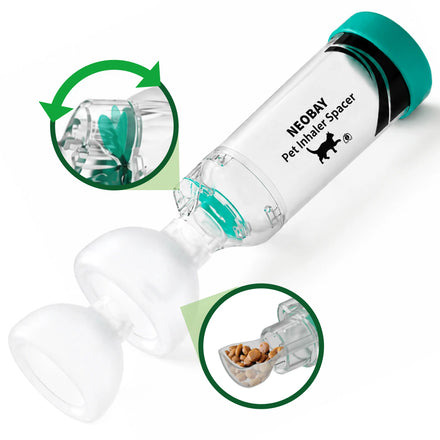
Neobay Cat Aerosol Chamber with Comfort Feeder — Green
- See each breath with the Breath Indicator
- Built-in treat holder makes mask practice easier
- Anti-static chamber helps keep medication airborne
Workarounds Real Owners Try (and Their Limits)
If you're not ready to switch chambers yet, here are the workarounds owners actually use — and the honest trade-offs of each.
Baby AeroChamber mask on an AeroKat chamber
Trudell also makes the AeroChamber for human infants, and the newborn-size mask is closer to 38 mm — small enough for kittens and small-breed adults. Some cat owners buy the baby mask separately and fit it onto the AeroKat chamber.
Works for: kittens under 5 lb, very small senior cats.
Limits: doesn't solve the flat-face problem (still round), still a rigid silicone rim, and you're paying twice for parts of the same product family.
Homemade foam gasket
Some owners cut a thin foam or silicone ring and fit it inside the mask rim to fill the gap around a flat nose or hollow cheeks.
Works for: patching a specific small leak temporarily.
Limits: foam degrades, absorbs medication residue, harbors bacteria, and is nearly impossible to keep clean over weeks of twice-daily use. Most vets would not recommend this as a long-term solution.
AeroDog small mask on a cat chamber
Trudell's AeroDog line includes a small mask that some cat owners have adapted. It's shaped a little differently from the feline mask.
Works for: specific cats whose face shape happens to match the canine mask better.
Limits: it's not designed for cats, the diameter is still relatively large, and you're mixing product lines that weren't engineered to work together.
Accepting some medication loss
Some owners end up just using the mask they have, knowing the seal isn't perfect, and asking the vet to increase the dose to compensate.
Works for: getting through the next few weeks while you decide.
Limits: it costs more in inhalers, exposes your cat to higher steroid doses than necessary, and still doesn't fix the underlying fit problem. This is a stopgap, not a solution.
When a Different Chamber Is the Better Fix
Here's the honest part. If your cat is a Persian whose face doesn't fit any round AeroKat mask, the geometry problem is real — and switching chambers won't magically change the shape of the seal. The AeroKat size 1, the baby AeroChamber mask, and a downward tilt cover most of the physical workarounds that exist. There is no perfect round mask for a flat face.
But here's what a lot of owners miss: most cats who "can't use the AeroKat" aren't failing because of fit alone. They're failing because the mask has already become a threat. A few sessions of pressed-against-the-eye, a couple of forced doses, and the cat learns that this object means stress. From that point on, no mask size in the world will fix it — your cat fights the mask before you ever get a chance to check the seal.
That's the problem the Neobay Cat Aerosol Chamber was actually built to solve. The Comfort Feeder design lets you smear a lickable treat (Churu, squeeze treats, whatever your cat loses her mind over) at the mask opening. Your cat voluntarily presses her own face into the mask to get the treat. And here's the part that matters for fit: a cat pushing in on her own creates a stronger, more consistent seal than any human holding a mask in place — because the pressure is even, voluntary, and sustained for the 7-10 breaths the dose actually takes.
This doesn't replace the size-chart logic above. If your cat's face is genuinely too small for the smallest mask on the market, you still need a smaller mask. But if your cat is one of the thousands who got sized correctly and still ended up fighting treatment, the Comfort Feeder approach is the cleanest fix we've found — and it works on cats who have already given up on the AeroKat.
If you want a deeper look at how the two chambers compare on valve response, training time, and price, read our full AeroKat vs. Neobay breakdown here.
Lost or damaged a part? See our complete guide on where to buy replacement AeroKat masks and parts without overpaying.
Related: an AeroKat Flow-Vu indicator that won't move is often a mask-seal or sizing problem in disguise — see our dedicated 5-step diagnostic.
Frequently Asked Questions
How do I know what size AeroKat mask to use?
Start with size 1 (small) for any cat under 12 lb. The mask should seal against the face without touching the eyes, ears, or folding the whiskers back. If the rim gaps at the nose bridge, cheeks, or chin, the mask is either the wrong size or the wrong shape for your cat's face. Run the 30-second leak test above to check.
Can I use a baby mask on my cat's AeroKat?
You can — the newborn-size AeroChamber mask fits onto the AeroKat chamber and works for kittens under about 5 lb. It doesn't solve flat-face fit issues because the shape is still round and rigid, and you're buying a second product from the same manufacturer to fix a problem the first one couldn't solve.
Why does the AeroKat Flow-Vu indicator stop moving sometimes?
Usually it means air is escaping at the mask seal — not that your cat has stopped breathing. Check for gaps around the nose, cheeks, or chin, and run the leak test above. If your cat is breathing normally but the indicator sits still, you have a fit problem, not a breathing problem.
Is the AeroKat mask dishwasher-safe?
The mask and chamber can be washed in warm soapy water and rinsed thoroughly. Don't put the mask in a dishwasher — the heat can warp the silicone and ruin the seal. Let everything air-dry completely before the next dose, because moisture in the chamber affects medication delivery.
My Persian cat can't get a seal with the AeroKat mask. What should I do?
Flat-face breeds almost never seal well with a round rigid mask. Try tilting the mask downward to engage the chin and nose bridge, and try the smaller of the two AeroKat sizes. If the geometry still doesn't work — or if your Persian has already started fighting the mask from past bad sessions — look at a chamber built around positive reinforcement, like the Neobay Comfort Feeder design, which lets your cat push in voluntarily for a treat. You can read more in our AeroKat vs. Neobay comparison.
Can a mask that's too big hurt my cat?
It won't injure your cat directly, but it causes two real problems. First, wasted medication — a leaking seal can mean your cat gets substantially less than the prescribed dose, which keeps asthma under-treated. Second, eye contact — a rim pressed against the eye over weeks of dosing can cause irritation or corneal abrasions. Both are reasons to fix the fit, not just live with it.
Related reading: See our guide to using baby spacers for cats — whether Babyhaler or AeroChamber work for cats, dose delivery issues, and when a baby spacer is acceptable vs a bad idea.
Still comparing brands? See our updated AeroKat vs Generic vs Neobay 3-way comparison — covers prices, flow indicators, and which spacer fits which cat.
What to Do Next
- Run the 30-second leak test on your current mask today. If two or more checks fail, the mask is the problem — not your technique.
- Try the next size down or the baby AeroChamber mask if you haven't already. Cheap to try, sometimes solves the problem entirely.
- If your cat is flat-face, senior, or small-framed and the physical workarounds aren't working, ask yourself whether the problem is really geometry — or whether your cat has just learned to fight the mask. If it's the latter, look at chambers built around positive reinforcement, like the Neobay Cat Aerosol Chamber's Comfort Feeder design.
- Talk to your vet about dosing. If you've been leaking medication for weeks, your cat may have been under-treated. Your vet may want to reassess before continuing the same prescription.
Once the mask fits, the rest of treatment gets easier — fewer wasted doses, less fighting at medication time, and a cat who actually gets the medication you're paying for. If you're early in the process and still working on getting your cat to accept the mask in the first place, our step-by-step inhaler training guide walks through desensitization in detail.
Have other questions about fit, parts, or what to use? Visit our FAQ page or contact us directly — we work with cat owners on these fit issues every day.
Sources
- Trudell Animal Health. "How to Use a Cat Inhaler to Treat Feline Asthma." Accessed 2026.
- Trudell Animal Health. "AeroKat Replacement Masks for Cats — Product Specifications." Accessed 2026.
- Cat Specialist Services (Dr. Rachel Korman, BVSc MANZCVS FANZCVS Feline Medicine). "Using an Inhalation Chamber for Medications." Accessed 2026.
- International Cat Care. Inhaler Training.
- Trzil JE. "Feline asthma: diagnostic and treatment update." Veterinary Clinics of North America: Small Animal Practice, 2020; 50(2): 375-391.
- Cornell Feline Health Center. "Feline Asthma: What You Need to Know." Cornell University College of Veterinary Medicine. https://www.vet.cornell.edu/departments-centers-and-institutes/cornell-feline-health-center/health-information/feline-health-topics/feline-asthma-what-you-need-know
Related Reading
This article is part of our What Is a Cat Inhaler Spacer? — covering device types, how to use them, proper technique, cleaning, and troubleshooting.


