

Key Takeaways
- Realistic inhaler training time ranges from 1 week to 6 weeks for a cat to reliably take 7–10 breaths per dose — not the "5 days" many training videos imply.
- A structured 5-day starter protocol (chamber-only Day 1 → first real dose Day 5) gets most food-motivated cats through the hardest phase, but full reliability usually takes 2–6 more weeks.
- Across Reddit owner reports, the most common stall point is "extending duration" — the gap between a one-second mask touch and a 5–10 second hold. Some cats spend 3–5 weeks here alone.
- Veterinary behaviorists (International Cat Care, Veterinary Partner) recommend 2–5 minute daily sessions, treat-led, never forced — one forced session can reset progress by days.
- Vets rarely prescribe a prednisolone taper alongside inhaler training. Without that bridge, you may have to dose before training is finished — which is exactly when most "force vs. wait" struggles happen.
A structured 5-day starter protocol gets most food-motivated cats from "what is that thing?" to first real dose — but full reliability (10 breaths, no struggle, twice a day) typically takes 2 to 6 weeks, based on Reddit owner reports and the phased method published by International Cat Care and Veterinary Partner. A Neobay chamber's Comfort Feeder attachment shortens Day 2–3 by letting food lure the cat's nose into the mask instead of your hands. Here's what the first 5 days actually look like — and what to do when your cat stalls on Day 3, like a lot of Reddit cats do.
Ask Reddit "how long did it take to train your cat to accept their inhaler" and the answers swing wildly. One owner wrote that her cat took his first full 10 breaths in a week. Another spent five weeks before her cat voluntarily put her nose in for longer than a second. A third said "it's a lot harder than the videos indicate." Same device, same diagnosis, same YouTube tutorials. The difference is almost never the cat — it's whether the owner had a phased plan and the patience to stick with it when Day 3 went sideways.
Why "5 Days" Is the Starter Protocol, Not the Finish Line
The 5-day timeline here covers the structured starter protocol: Day 1 chamber as treat dispenser through Day 5 first real actuated dose. It assumes three things: your cat is food-motivated, has never been forced into a mask, and you can run a 2–5 minute session every day. Hit those and behaviorist Sarah Ellis's phased protocol (published by International Cat Care, co-developed with Trudell Animal Health) reliably gets you to a first dose by Day 5.
What takes longer — sometimes a month or more — is the duration phase: 5–10 second holds, puff sound tolerance, 7–10 steady breaths. And Reddit is full of owners stuck in exactly this phase. Be honest with yourself about this before you start.
Before Day 1: Your Setup Checklist

- Treatment station: a cat bed, chair, or mat used only for training. Same spot every time.
- High-value treat: a lickable treat (Churu, Hartz Lickable), meat baby food without onion or garlic, or tuna juice. Dry treats won't work.
- Your Neobay chamber with mask detached from the spacer. Comfort Feeder attachment ready if included.
- Marker: a clicker or a consistent word like "yes."
- Pretzel stick or lick-mat to extend treat into the mask opening.
Do not introduce the actual MDI (inhaler canister) on Day 1. It stays in the drawer.
The 5-Day Starter Timeline
Day 1 — Chamber = Treat Dispenser
Place the chamber parts (mask + spacer detached) on the treatment station. Sprinkle treats around them. Don't move it, don't hold it. When the cat eats within a foot of the chamber, mark and treat. Repeat 8–10 times. Total session time: under 5 minutes. If your chamber has a Comfort Feeder attachment, smear a thin line of lickable treat inside it now.
Day 2 — Mask = Something They Choose
Smear a tiny amount of treat on a pretzel stick, extend it past the mask opening so the cat can lick without their face going in. Over 4–5 reps, gradually hold the stick farther into the mask so the cat has to push their face in. End the session the moment the cat voluntarily puts their nose in for a full second. Never push the mask toward the cat. One forced contact undoes a full day.
Day 3 — Add the Spacer, Build to 5 Seconds
Attach the mask to the spacer. Smear a tiny treat where they connect. As the cat licks, gently hold the mask in place (don't press) for 1 second, then 2, then 5. The medication stays in a Neobay-style chamber for roughly 10–15 seconds once actuated, so this duration maps directly to a real dose.
This is the day most cats stall. The spacer changes the weight, smell, and silhouette of the device — to the cat, it's a new object. If your cat freezes or refuses, drop back to Day 2 mechanics for one session: treat the spacer itself as a new object on the floor first. So if your cat's asthma is anything beyond mild, ask your vet about a prednisolone bridge so you have time to train properly.
Day 4 — Puff Sound Desensitization
Press the inhaler behind your back while the cat eats treats near (not in) the mask. Pair the hiss with food. Then press it at increasing proximity. Finally, press it into the chamber with the mask off your cat's face, treat immediately. Albuterol rescue inhalers tend to be sharper-sounding than Flovent — if your cat is sound-sensitive, ask your vet whether a "puff away, then apply mask" approach is acceptable for your drug.
Day 5 — First Real Dose
Assemble everything. Apply mask gently. Press the MDI. Count breaths by watching the visual flow indicator — each flap movement equals one breath. Remove the mask after 7–10 breaths. Treat. Wipe your cat's face with a damp cloth. If the cat pulls away at breath 4, you still gave partial medication — don't redose. Real doses are often easier than training because the cat can finally smell that the chamber isn't food.
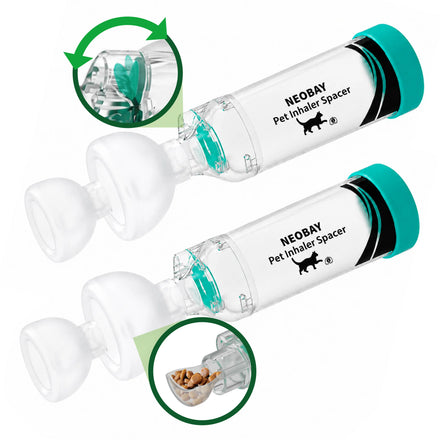
Neobay Cat Aerosol Chamber with Comfort Feeder — Green 2-Pack
- $30 per chamber vs AeroKat $61.95 — about 52% less
- One in use, one air-drying — no skipped doses on cleaning day
- Two chambers for multi-cat homes — no cross-contamination
What "After Day 5" Really Looks Like

Finishing the 5-day starter doesn't mean your cat is reliable. It means you got through the hardest part once. Most owners spend another 2–6 weeks building to "twice a day, 7–10 breaths, no fuss."
Reddit owner houshi-2 spent two weeks getting her 2-year-old Charlie to hold her nose in for half a second. Five weeks in, Charlie voluntarily put her nose in but still would not hold for 10 breaths. The owner eventually moved to gentle body-trapping — after six more weeks, the cat went from "fighting me viciously" to "just getting really annoyed." Another owner, Angeljenn8469, used restraint from Day 1 because the attacks were severe — after three weeks the cat started purring afterwards. Both ended up in roughly the same place via different paths.
The honest version: some cats nail it in a week, most take a month, a few take six. The protocol is the part you can control. Your cat's personality and history you can't — so don't compare your Day 7 to another owner's Day 7 on YouTube.
Body Q&A — What if my cat is the "2-year outlier" I saw on Reddit?
Outliers almost always have a history of forced medication, vet-trip trauma, or untreated pain. Those cats need a slower reset: drop back to Day 1 mechanics, spend a full week on it, consider a veterinary behaviorist consult. Two years isn't a training failure — it's a sign the cat needed a different starting point.
Frequently Asked Questions
How long does it really take to train a cat to use an inhaler?
With a structured phased protocol of 2–5 minute daily sessions, most cats accept the chamber within 5 to 7 days and complete a first real dose. Full reliability — 10 breaths twice a day, no struggle — typically takes 2 to 6 weeks. Cats with prior negative experiences may need 2–4 weeks of reset work first.
What do I do if my cat stalls on Day 3?
Drop back to Day 2 mechanics for one full session: treat the spacer itself as a brand new object on the floor first, then re-introduce the mask alone. Only re-attach the spacer once your cat voluntarily approaches the mask. Don't push — most Day 3 stalls resolve in 2–3 days of patience.
My vet didn't prescribe a prednisolone taper — what do I do?
Prednisolone bridges the gap between diagnosis and reliable inhaler use, buying you 2–6 weeks to train without medication emergencies. If your cat's asthma is anything beyond mild, ask your vet directly whether a taper is appropriate. Don't skip this conversation.
Should I hold my cat still during inhaler training?
Avoid restraint during the 5-day starter. Some owners with severely asthmatic cats use gentle body-trapping once basic mask acceptance is established — a personal decision based on your cat's medical urgency and temperament.
Do I really need two chambers?
One works for a single cat on a once-daily protocol with a 24-hour wash-and-dry cycle. Two (a 2-Pack) help when you're on a twice-daily schedule, when the cat is still in training and sessions need to keep running through wash cycles, or when one cat is on Flovent and another on a rescue inhaler. Separate chambers also prevent medication residue mixing.
What to Do Next
- Run Day 1 today. Five minutes. Treats around the chamber, no pressure.
- If your cat has a tough Day 3, don't push — reset and re-read the troubleshooting section above.
Want the full desensitization background behind each step? Our step-by-step guide to training a cat to accept an inhaler mask breaks down every stage in detail.
Once your cat is reliably taking doses, see our guide on how to administer inhaled medication stress-free. For the full device picture, read the spacer guide hub or compare options in AeroKat vs Neobay. Ready to stock a backup chamber? See the Neobay 2-Pack.
Have questions about training a difficult cat? Visit our FAQ page or contact us directly.
Buying a chamber in the Netherlands or Portugal? Our EU cat inhaler spacer buyer’s guide explains mask checks, purchase costs and delivery questions.
Sources
- International Cat Care. Inhaler Training.
- Veterinary Partner (VIN). "Teaching Your Cat To Use an Inhaler." Pat Koven, BA, LVT, KPACTP.
- Trudell Animal Health. "How To Use A Cat Inhaler To Treat Feline Asthma." Updated Jul 2026.


