

Key Takeaways
- The puff sound triggers an evolutionary fear response in cats. A sudden hissing noise closely resembles a snake or an aggressive cat — your cat isn't being difficult, they're following millions of years of hardwired survival instincts.
- The "actuate behind your back" technique is the fastest bridge solution. Puff the inhaler into the spacer away from your cat, then bring the mask to their face. Medication loss is minimal, and it buys you weeks to work on desensitization.
- Systematic desensitization works for nearly every cat. A structured 4-phase protocol — distance-based sound exposure paired with high-value food rewards — can transform a cat who runs and hides into one who stays calm during treatment.
- If your cat is already traumatized, you can recover. Single-event fear learning is real, but counter-conditioning can overwrite it. The fix takes longer, but the same principles apply.
- Most cats adapt within 2-4 weeks when owners follow a consistent daily protocol. The key is staying below the cat's fear threshold at every step.
Your cat was fine with the mask. You spent two weeks getting them comfortable with the spacer. Then you pressed the canister for the first time, and your cat bolted.
This is the single most common reason inhaler training stalls — and it has nothing to do with your technique.
Why Cats Fear the Puff Sound
The inhaler makes a sharp, high-frequency hiss. To a cat, that sound is biologically loaded. A sudden hiss in nature means snake or aggressive cat — both life-or-death signals. The midbrain triggers flight before conscious thought kicks in. You're not fighting stubbornness. You're working against an instinct that predates domestication.
The sound is also unpredictable. The cat is sitting calmly, then — PSSST — out of nowhere. Predictable sounds are far less threatening than unexpected ones, even without the snake association.

Is It the Sound or the Mask?
Run this two-minute diagnostic:
- Mask only (no chamber, no inhaler) near your cat. Flinch or back away? → mask aversion. Start with general inhaler mask training.
- Actuate the bare canister across the room while your cat is relaxed. Startle or hide? → sound sensitivity. This article is for you.
- Both? Fix mask acceptance first. Then add sound work.
Most cats who "hate the inhaler" actually hate the sound. The mask was just the thing on their face when the scary noise happened.
The Bridge Technique: Actuate Away
You need to give medication today while desensitization runs in parallel. Here's the bridge:
- Load and shake the inhaler + spacer in another room.
- Hold the assembly behind your back. Press the canister behind your back. The distance + your body muffles the sound.
- Immediately bring the mask to your cat's face and count breaths.
The medication stays suspended in the chamber for several seconds. You lose a negligible amount. Many cats who won't tolerate direct actuation accept the bridge technique within days — hearing the puff from a few feet away is fundamentally different from hearing it inside the mask at their face.
4-Phase Sound Desensitization Protocol
This protocol adapts systematic desensitization — the gold-standard behavioral technique for noise phobias in animals — specifically for the inhaler puff sound. Each phase builds on the last. Don't skip steps, and don't rush.
What you need: high-value lickable treats (Churu, meat baby food, wet food puree), a consistent training spot your cat already likes, and 5 minutes twice a day.
Phase 1: Sound = Treats (Distance)
Your goal: every time the cat hears the puff, a high-value treat appears.
- Have someone actuate the inhaler in another room with the door closed. The moment the sound happens, give your cat a treat.
- If you're alone, record the puff sound on your phone. Play it at minimum volume from across the room while your cat eats.
- 10-15 repetitions per session. The treat must arrive within 2 seconds of the sound.
- Ready to advance when: your cat looks toward you expectantly at the puff, instead of tensing up. Most cats reach this in 3-5 sessions.

Phase 2: Closing the Distance
Same drill, closer.
- Week 1: sound from the same room, opposite corner.
- Week 2: sound from 5-6 feet away.
- Week 3: sound from 2-3 feet away, off to the side — not directly facing the cat.
At each new distance, watch for stress signals: ears rotating back, tail twitch, dilated pupils, stopping treats. If you see any, go back to the previous distance for 2-3 more sessions.
Phase 3: Sound + Spacer (No Mask)
Now connect the sound to the equipment — but not yet to your cat's face.
- Place the empty spacer on the table near your cat's training spot.
- Actuate the inhaler into the spacer at your current working distance.
- Immediately give treats.
- Over sessions, bring the actuation closer to the spacer, until you're puffing directly into it.
Your cat should now associate: puff sound → spacer visible → treats incoming.
Phase 4: Sound + Mask (Full Sequence)
- Hold the mask to your cat's face (no puff). Treat.
- Puff into the spacer with the mask an inch away from the face. Treat.
- Over sessions, bring the mask closer until it's touching during actuation.
- Finally: mask on, puff, count breaths, remove, treat.
This phase takes the longest — 1-2 weeks. How quickly your cat progresses depends on how strongly the original fear was encoded.
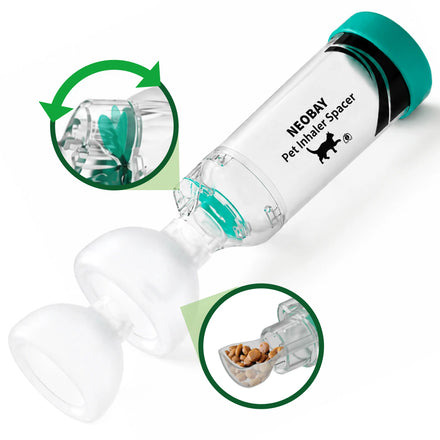
Neobay Cat Aerosol Chamber with Comfort Feeder — Green
- See each breath with the Flow Indicator
- Built-in treat holder makes mask practice easier
- Anti-static chamber helps keep medication airborne
What If Your Cat Is Already Traumatized?
If your cat has had a genuinely frightening experience — you chased them with the mask, they panicked and scratched, the whole event was stressful for both of you — you're dealing with single-event fear learning. One bad experience can create a lasting association that's stronger than dozens of neutral ones.
The protocol still works, but with two modifications:
First, take a complete break from the equipment. Put the spacer in a cupboard for 5-7 days. Continuing to push while the cat is in a heightened state strengthens the fear association.
Second, rebuild trust around the training spot. Feed meals there. Give treats there. No equipment present. Let the cat relearn that this location is safe.
When you restart, begin at Phase 1 with the sound at extremely low volume — barely audible to you. Progress will be slower than with a naive cat, but the mechanism is identical: new positive associations overwrite old fear memories through repetition.
One case from the feline asthma community: a cat who hid under the bed for an hour after every treatment eventually became a cat who trotted to her training spot when she heard the inhaler shake. It took six weeks. The owner's insight: "I stopped trying to give her the medication at first. For two weeks, all we did was associate the sound with chicken baby food. No mask, no spacer, no pressure."
When to Get Professional Help
Most cats respond to at-home desensitization. Seek a veterinary behaviorist if:
- Your cat shows generalized anxiety — they won't enter the training room even with no equipment present.
- You've been consistent for 4+ weeks with zero progress at the lowest-volume recording from across the room.
- Your cat has developed displacement behaviors: excessive grooming, refusing certain rooms, aggression.
- You need a sedation protocol — some cats need gabapentin during the training period. A vet can prescribe this.
Frequently Asked Questions
Can I muffle the puff sound by wrapping the inhaler?
No. Wrapping the canister interferes with actuation and can affect dosing. Use the bridge technique (actuate behind your back) instead.
My cat runs when she sees me pick up the inhaler, before I even puff it.
Your cat has learned the visual cue predicts the scary sound. Pick up the inhaler randomly throughout the day — without using it — and immediately give a treat. Do this 10-15 times across several days to decouple "inhaler in hand" from "puff is coming."
Do some spacer brands make a quieter puff?
The puff sound comes from the canister, not the spacer. Some chamber materials (metal, thick plastic) dampen high frequencies slightly better, but the difference is modest. Desensitization is the real solution.
How long should each training session be?
2-5 minutes. Two short sessions per day beat one long one. End every session on a success — if your cat struggles, go back to an easier step and finish there.
Can I combine clicker training with the sound protocol?
Yes. Clicker-train mask acceptance as a separate skill (nose in mask = click = treat). Sound desensitization runs on classical conditioning (sound predicts treat). The two protocols reinforce each other.
What to Do Next
- Tonight: run the two-minute diagnostic. Know whether you're dealing with sound, mask, or both.
- Tomorrow morning: start the bridge technique. Get medication into your cat while training runs in parallel.
- Record the puff sound on your phone. Phase 1 starts tonight at dinner — minimum volume across the room.
- Commit to twice-daily, 5-minute sessions. Consistency beats session length. A missed day sets you back less than a rushed session that pushes past threshold.
If you don't yet have a spacer, Neobay's aerosol chamber ($39.99) includes a visual flow indicator — useful during training because you can confirm your cat is breathing without staring at their chest. The Comfort Feeder attachment holds a small amount of wet food at the front of the mask, turning treatment time into treat time.
Have questions about your cat's specific situation? Visit our FAQ page or contact us.
Related Reading
This article is part of our Feline Asthma: The Complete Owner's Guide — everything from symptoms and diagnosis to treatment options and daily management.
Sources:
- International Cat Care / ISFM. "Inhaler Training for Cats." iCatCare.org.
- Trudell Animal Health. "Teach Any Cat AeroKat" — 5-step training program developed with certificated clinical animal behaviorists.
- Ellis S, et al. *The Trainable Cat*. Basic Books, 2016.
- Feline Asthma Inhaled Medications group (groups.io). Owner-reported training experiences and desensitization protocols.
- Overall KL. *Manual of Clinical Behavioral Medicine for Dogs and Cats*. Elsevier, 2013 — systematic desensitization and counter-conditioning principles.
Related: How Fast Can You Train a Cat to Accept an Inhaler? 5-Day Timeline — see the accelerated 5-day training protocol for cats that are food-motivated or have prior positive training history.


