

Key Takeaways
- Feline asthma and chronic bronchitis are both "feline lower airway disease," but they have different underlying mechanisms: asthma is allergic and episodic, bronchitis is inflammatory and persistent. Treatment overlaps, but the long-term management strategy differs.
- The single most important difference: asthma episodes come and go — often triggered by specific allergens like dust, perfume, or smoke — while bronchitis causes a daily cough that doesn't fully resolve between flare-ups.
- X-rays are normal in up to 40% of cats with lower airway disease. A clear chest X-ray does not rule out either condition. Airway cytology (via bronchoalveolar lavage) is the gold standard for distinguishing the two, though many vets start with a therapeutic trial instead.
- Both conditions are treated with corticosteroids to reduce airway inflammation, but inhaled medication delivered through a spacer chamber is the preferred long-term approach because it targets the lungs directly without the systemic side effects of oral steroids (weight gain, diabetes risk, increased thirst).
- If your cat is coughing regularly — even if it looks like a hairball — it needs a vet evaluation. Chronic coughing in cats is almost never "just hairballs." Early diagnosis and treatment significantly improve long-term outcomes for both conditions.
Your cat has been coughing. Not the dramatic, retching kind that produces a hairball — more like a dry, hacking sound, sometimes with a crouched, neck-extended posture. Maybe you've noticed wheezing, or breathing that seems faster than usual.
You looked it up and found two terms that sound almost interchangeable: feline asthma and chronic bronchitis. Your vet may have even used the phrase "feline lower airway disease" without being more specific. So which one does your cat have, and does the distinction even matter?
It matters — because while the treatment overlaps, the long-term management strategy, trigger avoidance approach, and prognosis are different enough that understanding the distinction will help you make better decisions for your cat.
Quick Summary: Asthma vs. Bronchitis at a Glance
| Feature | Feline Asthma | Chronic Bronchitis |
| Mechanism | Allergic airway constriction (reversible) | Chronic airway inflammation (persistent) |
| Pattern | Episodic — attacks come and go | Daily or near-daily cough, persistent |
| Triggers | Dust, smoke, perfume, pollen, cat litter dust | Long-term airway irritation, recurrent infections |
| Key symptom | Wheezing, labored breathing during attacks | Chronic dry cough, often worse in morning |
| Airway changes | Bronchoconstriction (muscles tighten) + mucus | Mucus overproduction + airway wall thickening |
| Reversibility | High — symptoms resolve between attacks | Lower — some cough usually persists |
| Prevalence | 1-5% of all cats | Less common, often overlaps with asthma |
| Diagnosis certainty | Often presumptive based on response to steroids | Requires ruling out asthma + other causes |
| Prognosis | Good with proper management | Good, but requires more consistent daily management |
What Is Feline Lower Airway Disease?
Veterinarians use the umbrella term "feline lower airway disease" (FLAD) to describe chronic conditions affecting the bronchi — the small airways deep in the lungs. Asthma and chronic bronchitis are the two main types, and in some cats, they overlap.
Feline Asthma — Allergic Airway Inflammation
Feline asthma is an immune-mediated condition. When a susceptible cat inhales an allergen (dust mites, pollen, mold spores, cigarette smoke, cat litter dust, aerosol sprays), their immune system overreacts. The airway muscles constrict, the lining swells, and mucus production increases — all three mechanisms narrow the airway at once.
This is an episodic condition. Between attacks, many asthmatic cats appear completely normal. The classic picture is a cat that suddenly starts wheezing or coughing, struggles to breathe for a few minutes to a few hours, and then recovers as if nothing happened.
Asthma typically develops in young to middle-aged cats (2-8 years old). Siamese cats appear to be overrepresented, though any breed can be affected.
Chronic Bronchitis — Non-Allergic Airway Damage
Chronic bronchitis involves persistent inflammation of the bronchial lining that leads to structural changes over time. The airway walls thicken, mucus glands enlarge, and excessive mucus is produced constantly — not just during flare-ups.
Unlike asthma, bronchitis is not primarily allergic. It can develop after repeated respiratory infections, long-term exposure to irritants, or as a progressive condition with no clear single cause. The cough is daily or near-daily rather than episodic.
Chronic bronchitis tends to affect older cats more frequently and is less common than feline asthma as a standalone diagnosis. Many cats have features of both conditions.
Why the Distinction Matters
The practical reason to distinguish them: asthma is more responsive to trigger avoidance and tends to be more reversible with medication. A cat with pure asthma may have episodes that completely resolve with the right inhaler regimen and environmental management. A cat with chronic bronchitis will likely always have some degree of daily cough, and the treatment goal shifts from "eliminate symptoms" to "minimize them and maintain quality of life."
Symptoms: How to Tell Them Apart

Shared Symptoms
Both conditions cause:
- Dry, hacking cough — the most common sign, often mistaken for a hairball
- Wheezing — a whistling sound during exhalation
- Rapid breathing — elevated resting respiratory rate (above 30 breaths per minute at rest)
- Breathing with abdominal effort — the belly moves noticeably with each breath
Asthma-Specific Signs
- Symptoms appear in episodes, with normal periods in between
- Attacks are often triggered by something identifiable — you recently cleaned with a spray, changed cat litter, or someone smoked nearby
- Severe attacks can include open-mouth breathing or panting (these are emergencies — learn more about respiratory emergency response)
- The cat may recover quickly after an attack and act completely normal
Bronchitis-Specific Signs
- Daily or near-daily cough, especially noticeable in the morning or after lying down for a while
- Symptoms are persistent rather than episodic — the cough never fully goes away
- Less dramatic than asthma attacks, but more consistent
- May have a history of recurrent respiratory infections
"Is It a Hairball?" — The Most Common Misconception
This is worth addressing directly because it's the single biggest reason diagnosis gets delayed.
Cats with lower airway disease often adopt a crouched posture with neck extended — the same posture used for retching up a hairball. Many owners (and even some vets initially) assume the coughing is hairball-related and wait months before seeking evaluation.
- A hairball produces a visible wad of fur. If your cat repeatedly assumes the posture and nothing comes up, it's not a hairball.
- Hairball-related retching is usually a one-time event. If the behavior repeats daily or weekly, it's likely respiratory.
- Cats with hairballs don't wheeze between episodes. Cats with airway disease do.
If your cat is "trying to cough up a hairball" multiple times per week and nothing comes up, it's time for a vet visit. Learn more about when hairballs are actually asthma.
Which Cats Are at Risk?
Breed, Age, and Weight Factors
- Age: Asthma typically appears between 2-8 years. Bronchitis is more common in older cats (8+).
- Breed: Siamese cats have a higher incidence of asthma. No strong breed predisposition for bronchitis.
- Weight: Overweight cats are at higher risk for both conditions — excess abdominal fat compresses the diaphragm and makes breathing harder even before airway disease develops. Read more about why weight matters for breathing.
Environmental Triggers
For asthma-prone cats, these are the most common triggers that set off episodes:
- Scented cat litter (especially clay-based with added fragrance)
- Dust mites in bedding and carpets
- Cigarette smoke and vaping aerosol
- Aerosol sprays (cleaning products, air fresheners, perfumes)
- Seasonal pollen
- Mold spores in damp environments
For cats with chronic bronchitis, triggers are less about immediate allergic reactions and more about ongoing airway irritation. Switching to low-dust cat litter and running a HEPA air purifier benefits both conditions.
How Vets Diagnose and Differentiate the Two
What to Expect at the Vet
Your vet will start with:
- Complete history — when did the coughing start? How often? Any pattern? What have you changed recently (litter, cleaning products, diet)?
- Physical exam — listening to the lungs with a stethoscope for wheezing or crackling sounds
- Resting respiratory rate — counting breaths per minute while calm
Why X-Rays Alone Aren't Enough
Chest X-rays are the first diagnostic imaging tool, but here's the critical limitation: up to 40% of cats with confirmed lower airway disease have normal-looking X-rays. The airway changes in early-stage asthma and bronchitis can be too subtle to show on film.
When X-rays do show changes, the patterns overlap:
- Asthma: May show hyperinflated lungs (trapped air), flattened diaphragm, or prominent bronchial markings
- Bronchitis: May show thickened bronchial walls ("donuts" and "tramlines" on the X-ray), but these patterns also appear in chronic asthma
Airway Cytology — The Gold Standard
The most reliable way to distinguish asthma from bronchitis is bronchoalveolar lavage (BAL) — a procedure where the vet flushes sterile saline into the airways and collects the fluid for microscopic analysis.
- Asthma: High numbers of eosinophils (allergic inflammatory cells) in the airway fluid
- Bronchitis: High numbers of neutrophils (non-allergic inflammatory cells) with fewer eosinophils
BAL requires sedation or anesthesia, so it's not always the first step. Many vets start with a therapeutic trial — give corticosteroids and see how the cat responds. A dramatic response (cough disappears completely) suggests asthma. A partial response (cough improves but doesn't resolve) suggests chronic bronchitis.
Read more about how vets diagnose feline asthma for a complete walkthrough of the diagnostic process.
Treatment Options for Both Conditions
Steroids and Bronchodilators
Both conditions are treated with corticosteroids to reduce airway inflammation. The question is how to deliver them.
Why Inhaled Medication Is Preferred Long-Term
For cats that will need medication for months or years — which is most cats with either condition — inhaled corticosteroids delivered through a spacer chamber are the standard of care recommended by veterinary pulmonologists.
The spacer holds the medication mist between the inhaler and the mask, allowing the cat to breathe it in at their own pace over several breaths. The
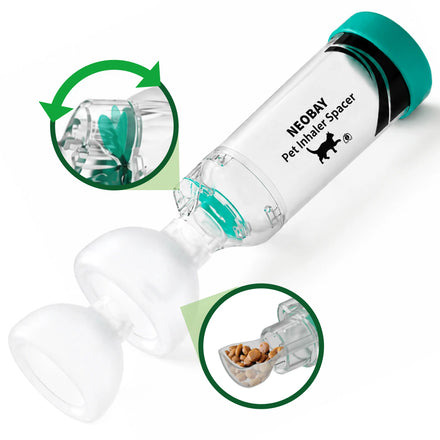
Neobay Cat Aerosol Chamber with Comfort Feeder — Green
- See each breath with the Breath Indicator
- Built-in treat holder makes mask practice easier
- Anti-static chamber helps keep medication airborne
Practical Training Tips
Getting a cat to accept a spacer mask takes patience. Most cats can be trained in 1-3 weeks with positive reinforcement:
- Leave the spacer near the cat's food bowl for a few days (smell association)
- Hold the mask near (not on) the face during treats
- Briefly touch the mask to the face, reward immediately
- Gradually increase contact time to 5-7 breaths
Full training guide: How to train your cat to accept an inhaler mask.
Home Management and Trigger Reduction
Medication alone isn't enough. Environmental management plays a significant role in reducing symptom frequency for both conditions.

Environmental Changes That Make a Difference
| Change | Impact for Asthma | Impact for Bronchitis |
| Switch to unscented, low-dust litter | High — removes a primary trigger | Moderate — reduces ongoing irritation |
| HEPA air purifier in main living areas | High — removes airborne allergens | Moderate — reduces particulate exposure |
| No smoking or vaping indoors | High | High |
| Wash bedding weekly in hot water | Moderate — reduces dust mites | Low |
| Remove aerosol sprays and plug-in air fresheners | High | Moderate |
| Keep humidity 40-50% | Moderate — prevents mold | Moderate — prevents dry airway irritation |
Diet and Weight Management
Overweight cats with airway disease benefit significantly from weight loss — even a 10% reduction in body weight can noticeably improve breathing comfort. This is especially relevant for bronchitis, where the daily cough makes breathing harder than it needs to be if the cat is also carrying extra weight.
When Is It an Emergency?
Regardless of whether your cat has asthma or bronchitis, these signs indicate a respiratory emergency that requires immediate veterinary attention:
- Open-mouth breathing or panting at rest
- Blue or pale gums (lift the upper lip to check)
- Respiratory rate above 60 breaths per minute at rest
- Cat cannot lie down comfortably — sitting with elbows out, neck extended
- Any collapse, weakness, or loss of consciousness
If you see any of these, don't wait. Head to the nearest emergency vet. For a complete guide on what to do in the first 15 minutes, see our cat asthma emergency response guide.
Prognosis: Long-Term Outlook and Quality of Life
Frequently Asked Questions
Can a cat have both asthma and bronchitis at the same time?
Yes. In practice, the two conditions overlap more often than they exist in pure form. Chronic airway inflammation from either condition can lead to structural changes characteristic of the other. Some veterinarians prefer the umbrella term "feline lower airway disease" for this reason. The treatment approach is similar regardless — reduce inflammation with steroids, minimize triggers, and monitor long-term.
My cat's X-ray was normal. Does that rule out asthma or bronchitis?
No. Up to 40% of cats with confirmed lower airway disease have normal chest X-rays. The changes can be too subtle or too diffuse to show on standard radiographs. If your cat has a chronic cough but normal X-rays, your vet may recommend a therapeutic trial with corticosteroids or proceed to airway cytology (BAL) for a more definitive answer.
Is feline bronchitis contagious to other cats or humans?
No. Neither feline asthma nor chronic bronchitis is contagious. They are inflammatory conditions, not infections. However, some of the underlying triggers (like respiratory viruses that damage airways before chronic bronchitis develops) can be contagious during the acute phase. Once the condition becomes chronic, there's no risk to other cats or people in the household.
How long does it take for inhaled medication to start working?
Inhaled corticosteroids (fluticasone) take 7-14 days of consistent daily use to reach full effectiveness. During this initial period, your vet may also prescribe oral steroids for immediate relief while the inhaled medication builds up in the airways. Albuterol (a rescue bronchodilator) works within minutes but only provides temporary relief — it doesn't treat the underlying inflammation.
Can diet changes help with feline asthma or bronchitis?
There's no specific "asthma diet" for cats, but dietary management plays a supporting role. Omega-3 fatty acid supplementation (fish oil) has mild anti-inflammatory properties that may help some cats. More importantly, if your cat is overweight, gradual weight loss reduces the mechanical burden on the respiratory system. Food allergies can sometimes contribute to airway inflammation, but this is less common than environmental triggers.
Sources and Further Reading:
- Cornell Feline Health Center. "Feline Asthma: What You Need to Know." Cornell University College of Veterinary Medicine. https://www.vet.cornell.edu/departments-centers-and-institutes/cornell-feline-health-center/health-information/feline-health-topics/feline-asthma-what-you-need-know
- iCatCare (International Cat Care) — Asthma and Chronic Bronchitis in Cats (2024, updated 2025)
- Padrid P. "Feline asthma. Diagnosis and treatment." Veterinary Clinics of North America: Small Animal Practice, 2000; 30(6): 1279-1293.
- Today's Veterinary Practice — Diagnosis of Feline Lower Airway Disease (Reinero, DACVECC)
- Veterinary Information Network (VIN) — Feline Lower Airway Disease Treatment Guidelines
Related Reading
This article is part of our Feline Asthma: The Complete Owner's Guide — covering everything from causes and symptoms to treatment and daily management.


