

Key Takeaways
- Most cats need 2–4 weeks of overlapping therapy — daily Flovent plus gradually decreasing prednisolone — before oral steroids can be safely stopped, per Today's Veterinary Practice.
- Flovent takes 10–14 days to reach full effect in the lungs, so stopping prednisolone before the inhaler is working reliably is the most common reason taper attempts fail.
- Stopping prednisolone cold turkey can trigger extreme lethargy, hiding, and rebound asthma symptoms within 24–48 hours. For a detailed comparison of cold turkey vs supervised tapering, read our vet-backed guide to stopping Flovent safely, documented across multiple owner reports on Reddit's r/CATHELP and r/SeniorCats.
- A typical taper reduces the dose by 25–50% every 1–2 weeks, then shifts to every-other-day dosing before stopping completely.
- Reliable inhaler mask acceptance is the gating factor — if your cat won't take daily Flovent, the taper can't proceed, which is why a treat-guided spacer like the Neobay chamber matters.
Most cats need 2–4 weeks of overlapping therapy — daily Flovent plus gradually decreasing prednisolone — before oral steroids can be safely stopped, according to Today's Veterinary Practice. Stopping the pills too quickly causes extreme lethargy, hiding under furniture, and rebound asthma symptoms within 24–48 hours, as one Reddit owner on r/CATHELP documented after missing a single 5 mg dose. A treat-guided spacer like the Neobay aerosol chamber is what makes the daily Flovent schedule possible in the first place. Here's what the transition actually looks like, week by week.
If your vet handed you a Flovent prescription and a taper chart that looks like hieroglyphics, you're in good company.
Why Your Vet Won't Just Stop the Pills
Prednisolone — a synthetic corticosteroid that suppresses airway inflammation systemically, used as first-line treatment for feline asthma before transitioning to inhaled medication. It works within hours. Flovent (fluticasone) — an inhaled corticosteroid delivered through a spacer chamber that acts locally in the lungs with minimal systemic absorption, reaching full effect after 10–14 days of twice-daily use.
That 10–14 day gap is why a taper exists. Stop prednisolone on day one of Flovent, and your cat has nearly two weeks of zero effective airway coverage — symptoms roar back, often worse. So vets overlap the medications: prednisolone keeps inflammation down while Flovent builds up in the airway tissue.
Why not just stay on prednisolone forever? Long-term oral steroids cause problems that compound over months. Today's Veterinary Practice lists the common adverse effects: increased urination and drinking, weight gain, **diabetes mellitus**, skin thinning, poor wound healing, and increased infection risk. Several Reddit owners reported their cats developed steroid-induced diabetes within 4–6 months of daily prednisolone — one went into diabetic remission within a week of completing the taper. The inhaled route avoids most of these systemic effects because the medication stays in the lungs.
But here's the part that catches owners off guard: even on Flovent, you can't skip the overlap. One r/CATHELP owner had their cat on 5 mg prednisolone every 72 hours, transitioned to Flovent, and figured the every-three-days schedule meant they could let one dose slide. The cat hid under the bed for 24 hours. They gave the missed 5 mg dose, and 2 hours 40 minutes later the cat was back to normal — "like someone flipped a switch."
The 2–4 Week Overlap: Why Both Medications at Once
Standard veterinary protocol, synthesized from Today's Veterinary Practice and DVM360 proceedings by Dr. Tomas Martin-Jimenez, looks like this:
- Weeks 1–2: Start Flovent 110 mcg twice daily. Continue prednisolone at the current dose. The inhaler is building up in the airways but isn't doing the heavy lifting yet.
- Weeks 2–4: Once Flovent has been running 10–14 days and symptoms are well-controlled, begin reducing prednisolone.
- Weeks 4–8: Step down prednisolone gradually. Most cats are off oral steroids by week 6–8 total from the start of Flovent.
How long does the overlap last if symptoms are stubborn?
If your cat is still coughing at the 2-week mark, the overlap extends. Some cats need 4 weeks of overlap before their airways calm down enough to taper. Don't rush — pushing the taper when symptoms haven't fully resolved is the #1 reason owners end up back at the vet with a rebound flare.
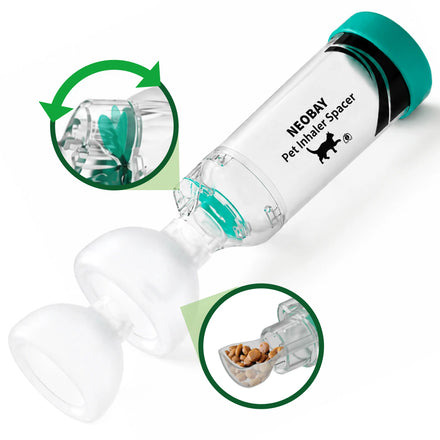
Neobay Cat Aerosol Chamber with Comfort Feeder — Green
- See each breath with the Breath Indicator
- Built-in treat holder makes mask practice easier
- Anti-static chamber helps keep medication airborne
A Sample Taper Schedule (Three Real Vets, Three Approaches)

Vets don't all use the same schedule. Here are three real protocols drawn from owner reports on Reddit and corroborated against published veterinary guidance. Your vet will pick one based on your cat's starting dose, symptom severity, and how long they've been on prednisolone.
| Starting dose | Week 1–2 | Week 3–4 | Week 5+ | Source |
|---|---|---|---|---|
| 5 mg daily | 2.5 mg daily | 2.5 mg every other day | Stop | Common TVP-aligned protocol |
| 5 mg every 72 hrs | 2.5 mg every 72 hrs × 2 wks | Stop | — | r/CATHELP (vet-prescribed) |
| 5 mg daily | 2.5 mg daily × 2 wks | 2.5 mg EOD × 2 wks | Stop | r/SeniorCats (vet-prescribed) |
The pattern is consistent even when the exact doses differ: cut the dose roughly in half, hold for 1–2 weeks, shift to every-other-day, hold again, then stop. Slower schedules (4+ weeks) are safer but harder on owners who keep splitting pills.
Why don't all vets use the same chart? Tapering speed depends on your cat's adrenal glands. Long-term prednisolone suppresses natural cortisol production, and the adrenal glands need time to "wake up" as the drug is withdrawn. Cats on prednisolone for years usually need a slower taper than cats on it for 2 weeks.
What "Tapering Too Fast" Looks Like (and When to Call Your Vet)
Side effects of tapering fall into two buckets: normal adjustment symptoms (uncomfortable but not dangerous) and red flag symptoms (call your vet today).
Normal adjustment symptoms owners commonly report in the first 1–3 days after a dose reduction:
- Mild lethargy or sleeping more than usual
- Wanting extra cuddles or being more vocal
- Mild stomach upset or loose stool (usually only after the first reduction)
- Slight decrease in appetite that recovers within 24 hours
These usually resolve within a day.
Red flag symptoms that mean the taper is too fast or Flovent isn't yet doing its job:
- Coughing returns — even one coughing episode means the lower airway is inflamed again
- Extreme lethargy — hiding under furniture, not coming out for food (the CatReelKing scenario)
- Refusal to eat for 12+ hours
- Open-mouth breathing or respiratory rate above 40 breaths per minute at rest
- Vomiting or diarrhea lasting more than 24 hours
Any one of these = call your vet. The fix is usually simple: go back up one step on the taper schedule, hold there another week, then try again. Some cats need two steps forward, one step back.
Emergency warning signs (skip the phone call, head straight to the ER) — open-mouth breathing that doesn't resolve in 5–10 minutes, gums turning pale/blue/purple, coughing so severe the cat can't catch their breath, sudden collapse. These aren't taper side effects; they're an asthma emergency. Our complete feline asthma guide covers emergency response in depth.
If you're also juggling steroid side effects like weight gain or increased thirst, our piece on long-term steroid side effects and alternatives breaks down what's reversible.
The Inhaler Acceptance Factor

Here's the part most taper guides skip: the entire transition hinges on whether your cat actually accepts the inhaler twice a day, every day. If mask acceptance is shaky, Flovent doses get missed, the 10–14 day buildup doesn't happen, and the taper fails. Many owners stay on prednisolone longer than necessary simply because their cat fights the mask.
The good news: most cats learn to accept — and even approach — the inhaler within 5–7 days using food-based positive reinforcement. Our 5-day inhaler training timeline walks through the protocol. A treat-guided spacer accelerates this — the cat learns to push their face into the mask for the treat.
Frequently Asked Questions
Can I just stop prednisolone once my cat is doing well on Flovent?
No. Stopping abruptly can cause severe lethargy, hiding, loss of appetite, and rebound asthma symptoms within 24–48 hours because the adrenal glands haven't resumed natural cortisol production. Always taper on your vet's schedule, even if your cat seems stable on Flovent.
How long does the full taper take?
Most cats need 4–8 weeks total from the day Flovent starts. Cats on prednisolone for years may need 8–12 weeks; short tapers (2–3 weeks) work for cats only on it briefly.
What if my cat's symptoms come back during the taper?
Usually the taper moved too fast or Flovent hasn't fully kicked in. Go back up one step, hold an extra week, then retry. If symptoms keep returning at the same dose point, your cat may need a higher Flovent dose — talk to your vet.
My cat won't take the inhaler. What do I do?
Don't taper until mask acceptance is reliable. Spend 5–7 days on food-based training first — the cat learns to put their face in the mask for a treat. Continuing the taper with a cat who fights the inhaler sets up failed doses and rebound symptoms.
Is it dangerous to split prednisolone pills myself?
Pill-splitting is standard for tapering and most vets expect you to do it. Use a proper pill splitter, not a knife. If your cat's dose requires quartering a small pill, ask about a liquid formulation instead — easier to measure at very low doses.
What to Do Next
- Talk to your vet before changing anything. The taper schedule should be theirs, not ours.
- Commit to twice-daily Flovent for at least 2 weeks before touching the prednisolone dose. Build the inhaler habit first.
- If mask acceptance is the blocker, invest a week in training with a treat-guided spacer chamber before starting the taper.
Have questions about the transition? Visit our FAQ page or contact us directly.
Sources:
- Verschoor-Kirss M, et al. "Treatment of naturally occurring asthma with inhaled fluticasone or oral prednisolone." Canadian Journal of Veterinary Research, 2021. (PMC7747657)
- "Treatment of Feline Lower Airway Disease." Today's Veterinary Practice, March/April 2014.
- Martin-Jimenez T. "Medical therapy of feline asthma (Proceedings)." DVM360, October 2011.
- Reinero CR. "Advances in the understanding of pathogenesis, and diagnostics and therapeutics for feline allergic asthma." The Veterinary Journal, 2011; 190(1): 28-33.
- Owner reports and veterinarian-directed taper protocols documented on r/CATHELP, r/AskVet, and r/SeniorCats (accessed July 2026).
Related Reading
This article is part of our Feline Asthma: The Complete Owner's Guide — a parent hub covering symptoms, diagnosis, treatment, and costs in one place.


