

Key Takeaways
- Feline asthma is a chronic condition — the absence of coughing does not mean the underlying airway inflammation is gone (a 2011 study found inflammation persisted even after clinical signs resolved).
- Stopping inhaled fluticasone cold turkey can trigger rebound airway inflammation within 7–14 days, potentially causing a severe asthma attack that requires emergency care.
- Veterinary protocols recommend tapering the dose gradually over 2–3 months under vet supervision, not stopping abruptly on your own.
- Fluticasone takes 7–10 days to build up to full therapeutic effect — if you stop for a week and restart, your cat goes unprotected during the gap.
- Some cats with truly mild, seasonal asthma may be candidates for step-down dosing — but only with a vet-approved monitoring plan that includes daily sleeping respiratory rate tracking.
No — stopping your cat's fluticasone (Flovent) cold turkey is not safe, even if your cat hasn't coughed in months. A 2011 study in the Journal of Feline Medicine and Surgery found that airway inflammation can persist even when clinical signs have completely resolved, meaning an apparently healthy cat is still at risk. The standard approach is a vet-supervised dose reduction over 2–3 months with at-home respiratory rate monitoring — and for owners struggling with daily mask wrestling, switching to a Neobay spacer with a Comfort Feeder often makes the difference between sticking with treatment and giving up.
Why Cat Owners Consider Stopping Flovent
The reasons are practical. Twice-daily mask sessions with a resistant cat are draining. The $30–60 monthly refill adds up. And a cat who hasn't coughed or wheezed in six months genuinely looks cured. On feline asthma support groups, three drivers come up repeatedly: cost fatigue, administration burnout, and false confidence from being symptom-free. The third one is the most dangerous — because in feline asthma, the absence of symptoms does not mean the absence of disease.
Cold Turkey: What Actually Happens
Inhaled corticosteroid — a steroid medication delivered directly to the lungs via a spacer chamber, used to reduce airway inflammation in feline asthma. Unlike rescue bronchodilators (albuterol), it targets the underlying inflammation — and takes 7–10 days of consistent dosing to reach full effect.
When you stop fluticasone abruptly, there's a deceptive quiet period. Days 1–5: nothing changes — the drug's effects linger and your cat seems fine. Days 7–14: mild symptoms creep back — an occasional cough, slightly faster breathing at rest. Many owners miss these signals. Weeks 2–4: full inflammatory rebound. Airway eosinophils — the immune cells driving asthma — return at higher levels than before treatment. This is when cats show up at emergency vets with open-mouth breathing and blue-tinged gums.
The Cocayne 2011 study (JFMS) confirmed what vets long suspected: cats whose coughing stopped on high-dose steroids still had "subclinical airway inflammation" on bronchoalveolar lavage. You cannot judge airway health by watching for coughs. The inflammation — and the risk of permanent airway remodeling — continues silently.

So my cat's been symptom-free for a year — doesn't that mean the asthma is gone?
It means the medication is working. Feline asthma is an inflammatory condition, not an infection — there's no cure point where the immune system stops overreacting to triggers. Think of it like managing hypothyroidism: you don't stop the levothyroxine because lab values normalized. If you want to test a lower dose, do it with vet supervision and daily respiratory rate monitoring — not as a DIY experiment. Learn more about how to determine the right Flovent dose for your cat.
Tapering: The Vet-Backed Alternative

The standard veterinary tapering protocol, drawn from the Padrid/VIN guidelines and DVM360 proceedings, is straightforward: reduce the dose gradually while monitoring for symptom return. If symptoms come back at a lower dose, you return to the last effective dose — and that's your cat's maintenance level.
The 2–3 Month Taper Protocol
| Phase | Duration | What Happens |
|---|---|---|
| Step 1: Baseline | 4 weeks | Cat stable on current dose. Document sleeping respiratory rate (normal: <30 breaths/min) for at least 2 weeks. |
| Step 2: Reduce | 4–6 weeks per step | Vet reduces dose — e.g., from 220 mcg BID to 110 mcg BID, or 2 puffs BID to 1. Monitor sleeping RR daily. |
| Step 3: Observe | 4–6 weeks | No dose change. Watch for: cough after activity, increased sleeping RR (>30), wheezing, any respiratory distress. |
| Step 4: Decide | After observation | If stable: consider another step down. If symptoms return: go back to last effective dose and stay. |
This takes 2–3 months minimum per dose reduction. For cats on 220 mcg BID, stepping down to the lowest effective dose — or, rarely, off entirely — can take 6+ months. Skipping every other day is not tapering: fluticasone's duration is roughly 12 hours, so alternate-day dosing leaves your cat unprotected half the time.
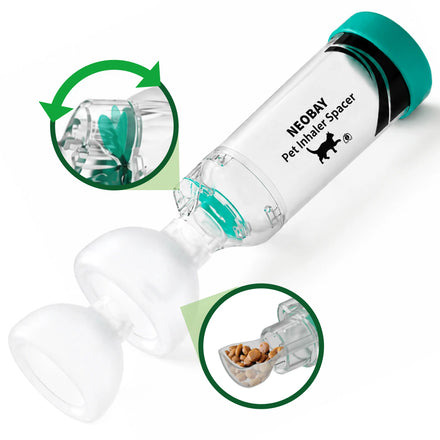
Neobay Cat Aerosol Chamber with Comfort Feeder — Green
- See each breath with the Breath Indicator
- Built-in treat holder makes mask practice easier
- Anti-static chamber helps keep medication airborne
When Tapering Might Actually Be Safe
Veterinarians may consider a supervised taper in these scenarios:
- Seasonal asthma. Cats who only flare during pollen or wildfire smoke season may be candidates for a full-dose-in-season, reduced-dose-off-season protocol.
- Mild intermittent asthma. Cats with 1–2 mild episodes per year may not need daily fluticasone — they might be managed with albuterol rescue-only. But this is determined at diagnosis, not something you self-decide after months of daily treatment.
- Trigger permanently removed. If a known trigger is gone (smoker moved out, clay litter replaced with dust-free, relocation away from high-pollen area), your vet may agree to a cautious taper.
Every scenario requires the same tool: daily monitoring of sleeping respiratory rate — breaths per minute while your cat is fully asleep (normal: 15–30; consistent readings above 30 = call your vet). It's the most reliable early warning of worsening inflammation, trackable at home with a phone timer.
If Administration Burnout Is the Real Problem
If mask wrestling — not cost or clinical judgment — is why you want to quit, fix that directly. Two things make the daily session faster and less stressful:
A spacer with a Comfort Feeder — a treat attachment that turns medication time into food time — often changes the dynamic within days. Dab of wet food on the attachment, cat licks while breathing through the mask, done in 30 seconds. A Visual Flow Indicator — a visible valve that moves with each breath — tells you exactly when 7–10 breaths are complete. No guessing, no holding the mask longer than needed. Faster sessions mean less stress for both of you, which means you're less likely to burn out and consider stopping.
Frequently Asked Questions
Can I skip my cat's Flovent for a few days if I run out?
A missed day or two isn't ideal, but it won't trigger an emergency in a stable cat. Get the refill fast. If you'll be without medication for 5+ days, call your vet — they may prescribe a temporary oral steroid bridge. Never let the gap stretch past a week.
What if my cat's symptoms went away after starting Flovent — can I try stopping to see what happens?
Symptoms disappearing means the treatment is working, not that the disease resolved. The Cocayne 2011 study showed cats with zero visible symptoms can still have significant airway inflammation. If you want to test a lower dose, do it with vet supervision and daily sleeping respiratory rate monitoring — not as a DIY stop-and-see experiment.
Can I taper my cat's Flovent dose on my own?
No. Dose adjustments require a vet who can assess current status, review your monitoring logs, and rule out conditions that mimic asthma (heart disease, heartworm, chronic bronchitis). Self-tapering is dangerous because the first sign of failure may not be a mild cough — it could be severe dyspnea requiring oxygen therapy.
What if my cat absolutely won't tolerate the inhaler — are there alternatives?
Yes, but they're trade-offs. Oral prednisolone at the lowest effective dose is the most common fallback, though it carries higher long-term risks (diabetes, weight gain, adrenal suppression). Some cats respond to injectable long-acting corticosteroids. A few specialist centers offer nebulized budesonide. None are as targeted or side-effect-sparing as inhaled fluticasone via a spacer chamber — which is why investing in mask training with a Comfort Feeder is usually worth it before exploring fallback options.
What to Do Next
- Track sleeping respiratory rate for 2 weeks. Count breaths for 30 seconds with a phone timer while your cat is fully asleep, multiply by 2. Normal is 15–30. This data is what your vet needs to make a tapering decision.
- Schedule a vet visit specifically to discuss tapering. Bring your log and be specific: "We've been stable for X months at Y dose. Is there room to try a step down?"
- If mask stress is the real issue, fix that first. A Neobay spacer with Comfort Feeder and Visual Flow Indicator makes sessions faster and less stressful — most cats adjust within a week. When every dose matters, you want to know the full puff went in.
- Never stop cold turkey. If cost is forcing you to stop, ask your vet for a bridge plan — temporary oral prednisolone taper, generic fluticasone switch, or Canadian pharmacy — not an abrupt halt.
Have questions? Visit our FAQ page or contact us. This guide is education — not a substitute for your vet's clinical judgment.
Related reading: What Is a Cat Inhaler Spacer? · Why Does My Cat Cough After Running? · How to Taper Off Oral Steroids After Starting Flovent
Sources:
- Cocayne CG, Reinero CR, DeClue AE. "Subclinical airway inflammation despite high-dose oral corticosteroid therapy in cats with lower airway disease." Journal of Feline Medicine and Surgery, 2011;13(8):558-563.
- Cohn LA, DeClue AE, Cohen RL, Reinero CR. "Effects of fluticasone propionate dosage in an experimental model of feline asthma." Journal of Feline Medicine and Surgery, 2010;12(2):91-96.
- Padrid P. "Inhaled Drugs for Feline Asthma." WSAVA World Congress Proceedings, 2001. VIN.
- Martin-Jimenez T. "Medical Therapy of Feline Asthma (Proceedings)." DVM360, October 2011.
- Lee-Fowler T. "Asthma in Cats: Acute and Long-Term Management Guidelines." Today's Veterinary Practice, May/June 2018 (Updated August 2022).
- Cornell Feline Health Center. "Feline Asthma: What You Need to Know." Cornell University College of Veterinary Medicine. https://www.vet.cornell.edu/departments-centers-and-institutes/cornell-feline-health-center/health-information/feline-health-topics/feline-asthma-what-you-need-know
- VCA Animal Hospitals. "Treatment Instructions for Asthma and Bronchitis in Cats." Updated October 2025.


