Key Takeaways
- Record your cat's breathing rate, a video of symptoms, and a trigger log before the appointment — these three things give your vet more diagnostic information than a verbal description alone.
- The most important question to ask is "Which conditions are you ruling out, and how?" — breathing problems can stem from asthma, heart disease, infections, or anatomical issues, and each requires a completely different treatment path.
- If asthma is the likely diagnosis, ask specifically about inhaled medication with a spacer chamber versus oral steroids — the treatment decision you make at this point affects your cat's long-term health more than anything else.
- Leave the appointment with three clear answers: what the most likely diagnosis is, what the treatment plan is, and exactly which signs mean you need to come back immediately.
- If your cat is open-mouth breathing, has blue or pale gums, or cannot settle down, skip the checklist and go directly to an emergency vet.
You notice your cat's breathing looks off. Maybe their sides are moving more than usual when they rest. Maybe there's a wheeze you haven't heard before. Or maybe you caught them coughing — not a hairball cough, but something different.
You book the vet appointment. Then, sitting in the waiting room, you realize: you have no idea what to ask.
This is the article I wish every cat owner had before that appointment. It's a practical, organized checklist of the questions that actually matter — organized by what stage you're at, from the first vet visit through long-term management. No fluff, no generic "ask your vet about your pet's health" advice. Just the specific questions that can change how your cat gets diagnosed and treated.
Before the Vet Visit: Three Things to Record
The quality of the answers you get from your vet depends heavily on the quality of the information you bring in. Cats are notorious for hiding symptoms the moment they're in a carrier, and "my cat was breathing weird at home" doesn't give your vet much to work with.
Record these three things before you go:
1. Resting Breathing Rate
Wait until your cat is truly resting — ideally sleeping, not purring. Count how many times their chest rises in 15 seconds, then multiply by 4. Do this two or three times and average the results.
A normal resting respiratory rate is 15 to 30 breaths per minute. Consistently above 30 at rest is a red flag. Above 40 is urgent.
Write down the number and the time of day you measured it. Bring this to the appointment.
2. A Video of the Episode
If your cat has coughing fits, wheezing episodes, or periods of labored breathing, record a 15-30 second video on your phone. This is often the single most useful piece of diagnostic information you can provide. Vets routinely say they diagnose differently — and faster — when they see the actual episode versus hearing a description of it.
Don't worry about video quality. Worry about capturing the sound.
3. A Trigger and Symptom Log
For the 3-5 days before your appointment, jot down quick notes:
- When does the symptom happen? (After running? During sleep? After using the litter box? When visitors come over?)
- What does it look like? (Coughing with neck extended? Fast shallow breathing? Wheezing on exhale?)
- What changed recently? (New litter brand? New cleaning product? Candles? Home renovation dust? New food?)
- Has your cat's behavior changed? (Hiding more? Eating less? Less active? Sleeping in different spots?)
This log doesn't need to be detailed. A notes app entry or a piece of paper with bullet points is enough.
What to Bring
- Your cat in a secure carrier. Cover the carrier with a light towel — it reduces visual stress.
- A list of all current medications, supplements, and flea/tick preventatives.
- Previous medical records if this is a new vet.
- Your breathing rate numbers and symptom log.
- Your charged phone with the video ready to play.
- Do not sedate your cat before the visit unless your vet specifically instructed you to. Sedation can mask symptoms and interfere with diagnostics.

During the Vet Visit: Questions Organized by Stage

Vet visits for breathing issues tend to follow a pattern: stabilization (if needed) → physical exam → diagnostics → discussion → treatment plan. The questions below are organized to match that flow, so you know what to ask at each point.
Stage 1: Sharing What You've Observed
Before the vet starts the exam, clearly communicate your three pieces of data:
- "Here's the video of the episode I recorded on Tuesday."
- "His resting breathing rate at home has been 34-38 breaths per minute the last three nights."
- "The coughing seems to happen mainly after he runs around in the evening."
Then ask: "Based on what I'm describing, what are the top two or three possible causes you're considering?"
This question does two things: it gives you a framework for the rest of the visit, and it tells you whether the vet is leaning toward a respiratory cause (asthma, bronchitis, infection), a cardiac cause (heart disease, fluid buildup), or something else entirely.
Stage 2: During the Physical Exam
While the vet is examining your cat, ask:
- "What are you hearing in his lungs?" — Normal lung sounds are quiet and clear. Wheezes suggest narrowed airways (asthma or bronchitis). Crackles suggest fluid (pneumonia, edema, or infection). Absent lung sounds in one area can indicate pleural effusion or a mass.
- "Are his heart sounds normal?" — A heart murmur or gallop rhythm can shift the diagnostic focus toward cardiac causes rather than respiratory ones.
- "How do his gums look?" — Gum color is a quick window into oxygenation. Pink is normal. Pale, blue, grey, or brick-red are all abnormal.
Stage 3: Diagnostic Testing
This is where many owners get lost. Vets may recommend a range of tests, and it helps to understand what each one tells you.
Ask: "What's the minimum set of tests needed to distinguish between the likely causes, and what will each one tell us?"
| Test | What It Reveals |
|---|---|
| Chest X-rays (radiographs) | Lung pattern (bronchial, interstitial, alveolar), heart size and shape, presence of fluid, masses, or airway thickening. The single most informative first-line test. |
| Blood work (CBC + chemistry) | Signs of infection (increased white blood cell count), anemia, organ function, and general health status. |
| Heartworm test | Heartworm-associated respiratory disease (HARD) can mimic asthma exactly. |
| Echocardiogram (heart ultrasound) | Rules in or out heart disease — critical if X-rays show an enlarged heart or if a murmur is present. |
| Bronchoscopy + BAL (bronchoalveolar lavage) | The definitive test for feline asthma. A small camera is passed into the airways, and a fluid sample is collected to identify the type of inflammatory cells present. This confirms whether it's eosinophilic (allergic) asthma versus another airway disease. |
| Thoracocentesis | If fluid is found around the lungs, a needle is used to sample it. The fluid type (clear, milky, bloody, purulent) points to the underlying cause. |
Follow up with: "Which tests should we prioritize given what you've seen so far, and which can wait?"
If cost is a concern, say so directly: "If we have limited budget, which two tests give us the most diagnostic value?" Most vets will work with you on this.
Stage 4: The Differential Diagnosis Discussion
After the initial exam and any immediate test results, ask the vet to walk through their differential diagnosis list:
"What specific conditions are you ruling out or ruling in right now?"
The most common causes of abnormal breathing in cats, and the key questions to ask for each:
| Possible Diagnosis | Key Questions to Ask |
|---|---|
| Feline asthma / allergic bronchitis | How confident are you in this diagnosis? Do we need a BAL to confirm? What's the standard treatment protocol? |
| Congestive heart failure | Is the heart enlarged on X-ray? Should we do an echocardiogram? Will my cat need diuretics and cardiac medications? |
| Pleural effusion (fluid around lungs) | What type of fluid is it? Does it need to be drained now? What's causing the fluid buildup? |
| Upper respiratory infection (URI) | Is this viral or bacterial? Do we need antibiotics? How long until we see improvement? |
| Pneumonia | Is hospitalization needed? What organism is likely causing it? How will we monitor response to treatment? |
| Laryngeal paralysis or nasopharyngeal polyp | Can you see any obstruction on exam? Is sedation needed for a better look? Is surgery required? |
| Lungworm or other parasites | Should we run a Baermann fecal test? Is heartworm-associated respiratory disease a possibility in our area? |
Ask: "Is it possible that more than one of these is happening at the same time?" — An older cat can have both asthma and early heart disease. A cat with asthma can also develop a secondary respiratory infection.
If It's Likely Asthma: The Treatment Questions That Matter Most
If your vet's assessment points toward feline asthma or chronic bronchitis, the treatment conversation you have next is arguably the most important one. The decisions made here affect your cat's quality of life, your daily routine, and the long-term side effect profile your cat lives with.
The Central Decision: Oral Steroids vs. Inhaled Medication
Ask: "Are you recommending oral steroids, inhaled medication, or both — and why?"
Here's why this question matters:
For decades, the standard treatment for feline asthma was oral prednisolone — a systemic corticosteroid that suppresses airway inflammation throughout the body. It works. But because it affects every system in the body, not just the lungs, it comes with significant long-term risks: diabetes mellitus, weight gain, increased thirst and urination, muscle wasting, skin thinning, and increased susceptibility to infections.
The alternative is inhaled medication delivered through a metered-dose inhaler with a spacer chamber designed for cats. The medication — typically fluticasone (Flovent) for daily control and albuterol for rescue — goes directly to the lungs, where it's needed. Very little enters the bloodstream. This means the same anti-inflammatory effect with dramatically fewer systemic side effects.
This is the current gold standard of care recommended in veterinary internal medicine textbooks and by the International Society of Feline Medicine.
If your vet recommends oral steroids, ask:
- "What's the tapering plan? How long will my cat be on the full dose before we try to reduce?"
- "What blood work should we monitor and how often? (Specifically: blood glucose for diabetes risk)"
- "Are there early signs of steroid side effects I should watch for?"
- "Is there a reason we're not starting with inhaled medication instead?"
If your vet recommends inhaled medication, ask:
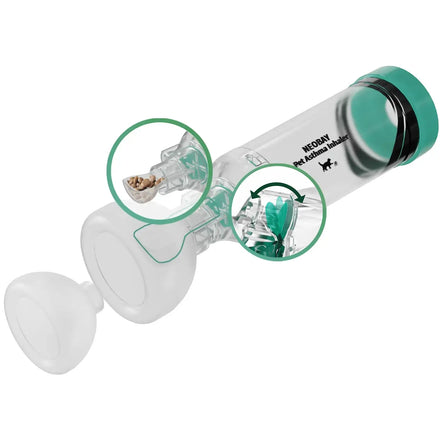
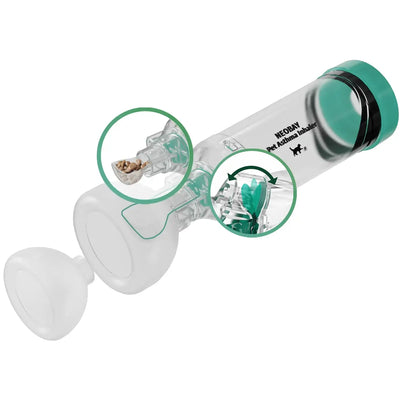
Neobay Cat Aerosol Chamber with Comfort Feeder — Green
- Visual Flow Indicator
- Comfort Feeder Design
- One-Way Valve
- "Can you demonstrate the correct technique with the spacer chamber and mask?"
- "What dose of fluticasone should we start with, and how do we know if it needs to be increased?"
- "When should I use the rescue inhaler (albuterol) versus just giving the daily controller medication?"
- "How long does it typically take to see improvement after starting inhaled steroids? (Usually 7-14 days)"
- "How do I clean and maintain the spacer chamber?"
A quality spacer chamber designed for cats will have two things that make a real difference for owners: a visual flow indicator that shows you the medication is actually being delivered (so you're not guessing whether your cat inhaled it), and a comfort-fit mask that your cat is more likely to tolerate during treatment. Without those, the learning curve for both you and your cat is steeper than it needs to be.
Other Asthma-Specific Questions
- "What environmental changes should I make?" — HEPA air purifiers, dust-free cat litter, removing scented candles and air fresheners, banning smoking indoors, and minimizing aerosol cleaning products are all evidence-supported interventions.
- "How do we distinguish an asthma flare-up from a true emergency?"
- "Should I keep a rescue inhaler at home even if my cat is stable on daily medication?"
- "How often do we need follow-up chest X-rays?"
After the Diagnosis: Home Management and Follow-Up
Once you have a diagnosis and a treatment plan, the conversation shifts to what happens at home — which is where the majority of management actually takes place.
Monitoring Questions
- "What's the target resting respiratory rate for my cat on treatment?" — A well-controlled asthmatic cat should breathe at a normal rate (under 30 breaths per minute at rest). If the rate stays above normal, the treatment plan needs adjustment.
- "How should I track symptoms day to day?" — Some vets recommend a simple calendar where you log breathing rate, coughing episodes, and any medication given. This becomes invaluable for follow-up visits.
- "What specifically should prompt a phone call versus an emergency visit?"
Medication and Routine Questions
- "What happens if I miss a dose?"
- "Are there any drug interactions I should know about?" — If your cat is on other medications or supplements, mention them.
- "How should I handle medication when I travel or board my cat?"
- "Can my cat still go outside, play normally, and live a full life?" — For most cats with well-managed asthma, the answer is yes, with some common-sense modifications.
Follow-Up Questions
- "When should we schedule the first follow-up, and what will we evaluate at that visit?"
- "How will we know if the treatment is working, and what's Plan B if it's not?"
- "Over the long term, will my cat's medication needs change? Do cats typically stay on the same dose for life?"

Emergency Red Flags: When to Skip the Checklist and Go Straight to the ER
Not every breathing issue allows time for a scheduled appointment. Some signs require immediate emergency care — meaning you don't call ahead, you don't prepare a checklist, you just go.
Go to an emergency vet immediately if your cat shows any of these:
- Open-mouth breathing. Cats are obligate nasal breathers. An open mouth while breathing — especially if not associated with recent exercise or heat — means the cat is in severe oxygen distress.
- Blue, grey, purple, or white gums or tongue (cyanosis). This indicates critically low oxygen levels in the blood.
- Abdominal or "belly" breathing. If you can see the cat's abdomen contracting hard with each breath while the chest barely moves, the cat is using accessory muscles to breathe. This is a sign of exhaustion and decompensation.
- Resting respiratory rate consistently above 40-60 breaths per minute.
- Neck extended, elbows pointed outward, in a "tripod" or orthopneic posture. This is the cat's desperate attempt to open the airway.
- Collapse, inability to stand, or extreme lethargy with labored breathing.
- Audible gurgling, crackling, or fluid sounds with breathing.
- Sudden inability to make any sound (silent attempt to meow).
If you're unsure whether it's an emergency, call your nearest 24-hour emergency vet and describe what you're seeing. They will tell you whether to come in.
How to transport a cat in respiratory distress:
- Minimize handling. Every time you pick up or reposition a distressed cat, their oxygen demand spikes.
- Use a carrier with the top removed or with good ventilation. Cover it lightly with a towel.
- Keep the car cool and quiet. No music, no sudden noises.
- Do not force anything into the cat's mouth — no food, water, or medication.
- Call ahead so the ER team is ready when you arrive.
Frequently Asked Questions
What is a normal breathing rate for a cat at rest?
A normal resting respiratory rate for a cat is 15 to 30 breaths per minute. To measure it, wait until your cat is sleeping (not purring), watch their chest rise and fall, count for 15 seconds, and multiply by 4. Rates consistently above 30 at rest warrant a vet visit. Rates above 40 at rest are an emergency.
Should I show my vet a video of my cat's breathing episode?
Yes. A smartphone video of your cat's coughing, wheezing, or labored breathing episode is one of the most valuable diagnostic tools you can provide. Cats often show no symptoms during the exam itself, and hearing a verbal description is not the same as seeing the actual breathing pattern and hearing the sound. Most vets actively encourage this.
Why would a vet choose oral steroids over an inhaler for feline asthma?
Oral prednisolone is sometimes chosen initially because it's less expensive upfront, requires no training or equipment, and works quickly. However, long-term oral steroid use carries significant risks including diabetes, weight gain, and immune suppression. Inhaled steroids (fluticasone) delivered through a spacer chamber deposit medication directly in the lungs with minimal systemic absorption. The American Association of Feline Practitioners and the International Society of Feline Medicine both recognize inhaled therapy as the preferred long-term management approach when owners are able to administer it.
How do I know if my cat's breathing problem is asthma or heart disease?
You can't tell from observation alone — the symptoms overlap significantly. Both can cause rapid breathing, reduced activity, and coughing. The distinction requires diagnostic testing, typically starting with chest X-rays and often including an echocardiogram. This is why asking your vet "Which conditions are you ruling out, and how?" is so important.
What should I bring to a vet appointment for breathing problems?
Bring your cat in a secure carrier covered with a light towel, a list of current medications and supplements, your breathing rate log, a charged phone with a video of the symptoms ready to play, and any previous medical records if this is a new vet. Do not sedate your cat before the visit unless your vet instructed you to — sedation can mask symptoms and interfere with diagnostics.
How often should a cat with asthma have follow-up vet visits?
For a newly diagnosed cat, the first follow-up is typically 2 to 4 weeks after starting treatment to assess whether the medication and dose are working. Once the cat is stable, follow-ups every 6 to 12 months are standard, with repeat chest X-rays once a year or as needed if symptoms change. If your cat is on long-term oral steroids, more frequent blood work (every 3-6 months) is recommended to monitor for diabetes and other side effects.
What to Do Next
- Start your symptom log today. Count your cat's resting breathing rate tonight. Make a quick note in your phone. If you catch a coughing episode on video this week, you're already ahead of 90% of owners who walk into the vet with nothing but a verbal description.
- Book the vet appointment if you haven't already. If your cat has had unexplained coughing, wheezing, or labored breathing more than once — even if it seems mild — it needs to be evaluated. Respiratory conditions in cats don't self-resolve.
- Bring this checklist. Print it, screenshot it, or just have it open on your phone. The questions are organized in the order a typical vet visit flows. Use the ones that apply to your situation.
- If your vet diagnoses asthma, ask about the inhaled treatment option. It's the standard of care for a reason — same anti-inflammatory effect with dramatically fewer long-term risks. A spacer chamber designed specifically for cats, like the Neobay Cat Aerosol Chamber, makes the transition from pills to inhaled medication straightforward for both you and your cat.
Explore the Neobay Cat Aerosol Chamber →
Have questions about using a spacer chamber with your cat? Visit our FAQ page or contact us.
Sources:
- Cohn, L. A. "Feline Respiratory Disease Complex." *Veterinary Clinics of North America: Small Animal Practice*, vol. 52, no. 3, 2022, pp. 625-647.
- Reinero, C. R., et al. "Inhaled Corticosteroids in Feline Asthma: What Is the Evidence?" *Journal of Feline Medicine and Surgery*, vol. 23, no. 11, 2021, pp. 1024-1032.
- Trzil, J. E. "Feline Asthma: Diagnostic and Treatment Update." *Veterinary Clinics of North America: Small Animal Practice*, vol. 50, no. 2, 2020, pp. 375-391.
- Cornell Feline Health Center. "Feline Asthma: What You Need to Know." Cornell University College of Veterinary Medicine.
- International Cat Care / International Society of Feline Medicine. "Feline Asthma." *ISFM Guidelines*, 2022.
- BSAVA. "Triage of the Dyspnoeic Cat." *BSAVA Manual of Canine and Feline Emergency and Critical Care*, 3rd ed.
Related Reading
This article is part of our How Vets Diagnose Feline Asthma — covering tests, X-rays, at-home monitoring, and what to expect at every step of the diagnostic process.