Key Takeaways
- Most cats can learn to accept puffer (inhaler) treatment — it takes patience, positive reinforcement and a gradual approach, never force.
- Training usually takes 1–3 weeks of short daily sessions, around 2–5 minutes each.
- Start with mask desensitisation before any medication is involved. Your cat needs to learn that the mask predicts good things.
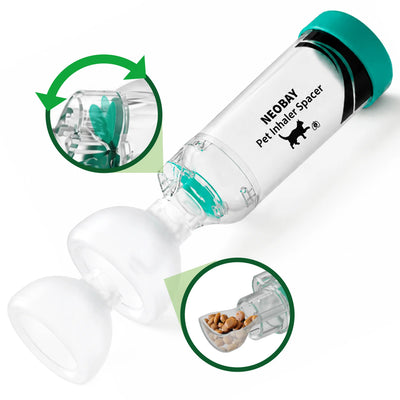
- A spacer with a Comfort Feeder rim holds a squeeze treat, so your cat chooses to press its face into the mask to reach the food.
- A Visual Flow Indicator shows each breath moving through the chamber, so you can tell when training has actually worked.
Most cats can be trained to accept a puffer mask within 1–3 weeks using 2–5 minute daily sessions of gradual desensitisation, and it is the training stage, not the medication, that most treatment plans come unstuck on. A Neobay spacer chamber with a Comfort Feeder rim and a Visual Flow Indicator shortens that timeline: your cat presses its face in to reach a squeeze treat, and the flow indicator shows you every breath. Below is a day-by-day protocol built around your cat's instincts, plus what to do when training stalls.

Understanding Why Cats Resist the Mask
Before you start, it helps to understand what your cat experiences when a mask comes towards their face.
- Face sensitivity: a cat's face is packed with whiskers (vibrissae) that work as highly sensitive touch sensors, so anything covering or pressing on the face triggers a strong instinctive pull-away.
- Loss of control: cats are both predator and prey, so restricting their movement or covering their face flips them into a fight-or-flight response.
- Novelty aversion: cats are neophobic and instinctively avoid new objects. This is a survival trait, not stubbornness.
- Negative association: if the first experience with the mask is stressful — being held down, hearing a loud puffer hiss — your cat will remember it and resist harder next time.
The training principle: you are overwriting an instinctive "this is scary" response with a learned "this means good things happen". That takes repetition, patience and the right equipment.
What You'll Need Before You Start
- Spacer chamber with mask — ideally one with a Comfort Feeder rim (more on why below)
- Puffer (metered-dose inhaler) — prescribed by your vet and dispensed through your local pharmacy. It may be a reliever such as salbutamol (Ventolin) or a preventer such as fluticasone (Flixotide); your vet decides. Do NOT use it during the early training stages.
- High-value treats — something your cat loves and does not get otherwise (cooked chicken, tuna, lickable treats)
- A quiet, familiar space — somewhere your cat already feels safe, with no distractions
- A consistent time — the same time each day, so it becomes routine
- Patience — the most important item on the list
The Step-by-Step Training Process
Work through these stages in order; don't move on until your cat is comfortable with the current one.
Stage 1: Introduce the Spacer (Days 1–3)
Goal: your cat is comfortable having the spacer in the same space.
- Place the spacer (mask detached) on the floor near your cat's favourite resting spot.
- Don't try to interact with your cat — just let the spacer sit there.
- Put a few treats around the spacer so your cat approaches on their own terms.
- If your cat sniffs or touches the spacer, give a treat and quiet praise.
- Repeat 2–3 times a day for 2–3 minutes each time.
Success signal: your cat approaches the spacer without hesitating.
Stage 2: Introduce the Mask (Days 3–5)
Goal: your cat is comfortable with the mask as a separate object.
- Attach the mask to the spacer and set it on the floor.
- Let your cat investigate — sniff, paw at it, even shove it around.
- Reward any interaction with a treat.
- Hold the spacer in your hand and let your cat come to it.
- Gently touch your cat's face with the mask for just 1–2 seconds, then give a treat immediately.
- If your cat pulls away, that's fine — don't chase, just try again later.
Success signal: your cat doesn't flinch or pull away when the mask briefly touches their face.

Stage 3: Brief Mask Contact (Days 5–8)
Goal: your cat accepts the mask resting on their face for a few seconds.
- Settle your cat somewhere comfortable — your lap, a favourite perch, wherever they relax.
- Hold a treat in one hand and the spacer in the other.
- Rest the mask gently over your cat's nose and mouth — resting, not pressing.
- Count to two, remove the mask and give the treat immediately.
- Repeat 3–5 times per session.
- Build the contact time slowly: 2 seconds, then 3, then 5.
Pro tip: if your cat resists, drop back to a shorter duration. Never force the mask on — one bad experience can set training back days.
Success signal: your cat holds the mask for 5 seconds without pulling away, and may even start looking for the treat as it comes off.
Stage 4: Add the Puffer Sound (Days 8–11)
Goal: your cat is not alarmed by the puffer's hiss while the mask is on their face.
This is where a lot of owners come unstuck: they introduce the mask and the puffer sound together for the first time, and the sudden sharp "pssh" frightens the cat. Introduce them separately.
- With the spacer on the floor, away from your cat's face, actuate the puffer once so your cat hears the sound, then give a treat immediately.
- Repeat 2–3 times per session, so your cat learns the sound predicts a treat.
- Once your cat stops reacting to the sound, combine it with Stage 3: rest the mask on your cat's face for 3–5 seconds, actuate the puffer pointed away from the mask, then give a treat.
- The only goal here is sound desensitisation — no medication goes into the chamber yet.
Success signal: your cat doesn't flinch or try to leave when the puffer fires, even with the mask on their face.
Stage 5: First Real Treatment (Days 11–14)
Goal: your cat receives their first full dose of prescribed inhaled medication.
- Prepare the puffer and spacer, then actuate the puffer into the chamber.
- Rest the mask over your cat's nose and mouth.
- Hold gently but securely — position your cat so they can't easily back out, but never pin them down.
- Count 7–10 breaths. Watch the Visual Flow Indicator (if your spacer has one) to confirm your cat is breathing in.
- Remove the mask and give a high-value treat straight away.
- Praise your cat calmly.
If your cat struggles here: don't force it. Go back to Stage 4 and try again tomorrow. Rushing now creates a negative association that is hard to undo.
Success signal: your cat completes a full 7–10 breath treatment without significant resistance.
Stage 6: Build the Routine (Week 3 and Beyond)
Goal: treatment becomes an ordinary part of your cat's day.
- Stick to a consistent schedule — same time, same place, every day.
- Keep sessions short and positive. Always finish with a treat.
- Over time you can reduce the treats, but don't remove them entirely — a small reward after each session keeps the association positive.
- If your cat starts turning up at the treatment spot on their own, you have succeeded.
Why Your Spacer Choice Matters for Training Success
Not all spacer chambers are equal for training — the design decides whether you get a smooth few weeks or months of frustration.
Comfort Feeder Design
The biggest factor in whether your cat accepts the mask is how it is introduced — a mask that arrives with food attached is a very different proposition from one that simply appears over the face.
A spacer with a Comfort Feeder rim holds a squeeze treat right at the mask opening. Your cat presses their face into the mask to reach the food, so the mask gets linked to a reward from the very first session and your cat stays in position for the dose. Stages 2 and 3 tend to move faster as a result.
Visual Flow Indicator
One worry looms largest during and after training: is my cat actually breathing the medication in? With a basic spacer you are guessing. With a Visual Flow Indicator — a valve or flap that moves with each breath — you can see in real time that air is moving through the chamber, count the breaths and confirm the dose has gone in.
This matters for training because:
- You can tell straight away whether your cat is breathing calmly (a sign of acceptance) or holding their breath (a sign of stress)
- You can end the session once you have counted enough breaths, rather than holding your cat there longer than needed
- You build confidence as an owner, and your cat picks up on that
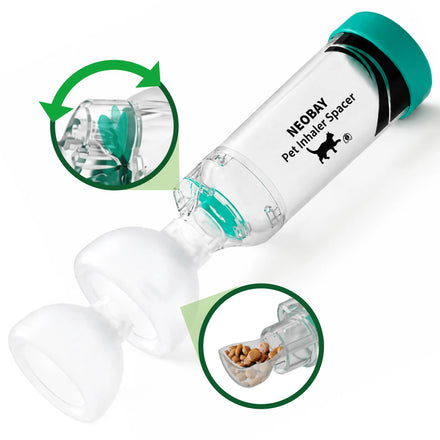
Neobay Cat Inhaler Spacer with Breath Indicator in Australia
- See each breath with the Breath Indicator
- Built-in treat holder makes mask practice easier
- Anti-static chamber helps keep medication airborne

Common Training Mistakes to Avoid
1. Rushing the Process
The most common mistake is moving too fast. If your cat isn't comfortable at Stage 2, don't jump to Stage 3 — each stage builds on the last, and going back a step is smart training, not failure.
2. Using Force or Restraint
Never pin your cat down, grab them roughly or force the mask onto their face. That creates a negative association which can take weeks to undo. If your cat is fighting you, that session is over — stop and try again tomorrow.
3. Skipping the Sound Desensitisation
A puffer makes a sharp, loud hiss. If your cat first hears it with the mask already on their face, they will link the mask to something frightening. Always introduce the sound separately (Stage 4).
4. Inconsistent Timing
Cats thrive on routine. If you train at random times, your cat can't build a predictable association. Pick a time and keep to it, even on days you don't feel like it.
5. Using Low-Value Treats
Kibble or ordinary biscuits won't cut it. You need something your cat finds irresistible — something that makes wearing the mask worth tolerating. Keep these treats for inhaler training only, so they stay high value.
6. Training When Your Cat Is Stressed
Don't train straight after a vet visit, during a summer thunderstorm, or while your cat is clearly wound up. On a hazy day with heavy bushfire smoke, your cat may already be breathing harder than usual, so pick another time.
How Long Does Training Really Take?
Every cat differs, but here is a general guide:
| Cat temperament | Typical training duration | Notes |
|---|---|---|
| Relaxed and food-motivated | 7–10 days | May skip some early stages |
| Average | 2–3 weeks | Most cats fall here |
| Anxious or previously traumatised | 3–6 weeks | Go slow, keep sessions very short |
| Senior cat with health issues | 2–4 weeks | May need gentler handling |
Signs your cat is progressing well:
- Approaches the spacer voluntarily
- Doesn't flinch at mask contact
- Accepts the mask for longer each session
- Stays calm when the puffer sound occurs
- Breathes normally (not holding their breath) with the mask on
Signs you need to slow down:
- Your cat runs away when they see the spacer
- Dilated pupils, flattened ears or hissing during sessions
- Your cat holds their breath with the mask on (check the Visual Flow Indicator)
- You feel frustrated or tempted to force the mask
Troubleshooting: When Training Gets Stuck
"My cat won't let me anywhere near them with the mask"
Go back to Stage 1. Put treats on top of it and let your cat discover it entirely on their own terms. This can take a week — that's fine.
"My cat was doing well, but now suddenly refuses"
This is a training regression and it's normal. Possible causes:
- A stressful event disrupted the routine (visitors, loud noise, a vet visit)
- Your cat isn't feeling well (check for other symptoms, especially coughing or faster breathing)
- You moved a little too fast in the previous session
Solution: go back one stage and rebuild. Don't get frustrated — your cat will notice.
"My cat tolerates the mask but holds their breath"
This is where a Visual Flow Indicator earns its place. If it isn't moving, your cat is holding their breath. Try:
- Gently blowing on your cat's face, which often triggers an involuntary breath
- Briefly lifting the mask and re-seating it, as the change often prompts a breath
- Keeping sessions very short, so your cat doesn't wait it out
Learn how feline asthma is confirmed: How Vets Diagnose Feline Asthma: Tests, X-Rays, and What to Expect
"I've been training for a month and my cat still fights it"
Some cats are genuinely harder to train. Ask yourself:
- Are you being consistent with timing and treats?
- Is there a higher-value treat you haven't tried yet?
- Would a mask with a Comfort Feeder rim reduce the face aversion?
- Is your cat in pain or discomfort that is making them irritable?
Talk to your vet if training stalls for more than four weeks — they may have behaviour suggestions, or can check whether something else is going on.
Making Long-Term Treatment Sustainable
Training is only the beginning. Keeping your cat on their prescribed routine long-term needs a sustainable habit:
- Same time, every day. Cats are creatures of habit — a predictable schedule makes treatment feel normal, not an interruption.
- Always finish with a reward. Even after training is done, a small treat after each session keeps the association positive.
- Watch the breathing quality. Use the Visual Flow Indicator to confirm 7–10 good breaths each session, so you know the medication is being delivered.
- Track symptoms. Keep a simple log of coughing episodes, breathing rate and energy. This helps your vet judge whether the prescribed medication is working.
- Stay calm yourself. Cats read their owner's mood closely — if you're anxious or frustrated, your cat will pick it up. Approach each session matter-of-factly.
Managing triggers at home matters too — see Common Triggers That Make Your Cat's Asthma Worse for bushfire smoke, dry winter heating dust and spring pollen.
Once training is done, technique keeps doses on track — our guide to administering inhaled medication stress-free covers handling that keeps a cat settled.
If you are comparing local availability, price and delivery, see our AeroKat Australia: Availability, Price Checks & Cat Spacer Alternatives.
Frequently Asked Questions
How long does it take to train a cat to use a puffer?
Most cats can be trained in 2–3 weeks with short daily sessions. Relaxed, food-motivated cats may accept it in as little as 7–10 days, while anxious cats or those with a bad past experience may need 4–6 weeks.
Can every cat learn to accept a puffer mask?
The vast majority can. With patient, step-by-step training and positive reinforcement, even initially resistant cats usually learn to tolerate treatment. The key is never forcing the process and always making it rewarding.
What if my cat is terrified of the mask?
Start with the mask nowhere near your cat — just sitting in the same room with treats around it. This desensitisation stage can take a week or more, but it is essential. A spacer with a Comfort Feeder rim can help too, because the rim holds a squeeze treat and your cat presses their face in to reach the food.
Should I restrain my cat during puffer treatment?
Minimal, gentle restraint is fine — your cat should be comfortable and unable to back away easily, but never pin your cat down or use force. If your cat is fighting you, the session is over. Force creates negative associations that make the next session harder.
How do I know if my cat is actually breathing in the medication?
Use a spacer with a Visual Flow Indicator, which is a valve or flap that moves with each breath. It gives you real-time confirmation that your cat is inhaling. Without one you are guessing. If your cat seems to hold their breath, try gently blowing on their face to trigger a breath.
How many breaths should my cat take through the spacer?
Most veterinarians recommend 7–10 breaths per dose. The Visual Flow Indicator helps you count accurately, and after 7–10 visible breath movements you can remove the mask.
Related: Cat Scared of the Inhaler Puff Sound? Desensitization Guide — a four-phase protocol for cats who fear the hissing noise, plus a technique to keep medication going during training.
Choosing equipment before you begin? Our Australia cat inhaler spacer buyer's guide covers the practical product, delivery and support checks.
What to Do Next
Just diagnosed? Before training, work through our complete owner's guide to feline asthma — it covers what the diagnosis means, how medication is set up and the home changes that help most.
Once you're ready, here's your plan:
- Gather your supplies: spacer chamber, high-value treats and a quiet space.
- Start Stage 1 today — even two minutes with the spacer near your cat and treats is progress.
- Be patient and consistent — short daily sessions get you further than occasional long ones.
- Choose the right spacer: a chamber with a Comfort Feeder rim and a Visual Flow Indicator gives you the best chance of success — your cat resists less, and you can confirm the medication is going in. But if the resistance is really about mask fit — a small head, a flat face or senior muscle loss — more training won't fix it; read our AeroKat mask sizing guide first.
The Neobay cat inhaler spacer is designed with both features built in, to make inhaler training easier for cats and their owners.
Have questions about the training process? Visit our FAQ page or contact us.
Sources:
- For realistic timing, see how long it really takes to train a cat to use an inhaler.
- Trzil JE. "Feline Asthma: Diagnostic and Treatment Update." Veterinary Clinics of North America: Small Animal Practice, 2020;50(2):375–391. PubMed
- Fernández-Parra R, Pey P, Reinero C, Malvè M. "Salbutamol Transport and Deposition in the Upper and Lower Airway with Different Devices in Cats: A Computational Fluid Dynamics Approach." Animals (Basel), 2021;11(8). PubMed
- Reinero CR, Masseau I, Grobman M, Vientos-Plotts A, Williams K. "Perspectives in veterinary medicine: Description and classification of bronchiolar disorders in cats." Journal of Veterinary Internal Medicine, 2019;33(3):1201–1221. PubMed
- Padrid P. "Use of inhaled medications to treat respiratory diseases in dogs and cats." Journal of the American Animal Hospital Association, 2006;42(2):165–169. PubMed
- RSPCA Australia Knowledgebase. "Health Issues" (companion animals — cats). kb.rspca.org.au Accessed 2026.
- Sydney School of Veterinary Science, University of Sydney. "Sydney School of Veterinary Science." sydney.edu.au Accessed 2026.
- Asthma Australia. "Smoke & Bushfires as Asthma Triggers." asthma.org.au Accessed 2026.
Related Reading
This article is part of our What Is a Cat Inhaler Spacer? pillar — covering device types, how to use them, technique, cleaning and troubleshooting.
Asthma in cats often shows up first as a noise rather than a cough. Our guide to why your cat is wheezing explains what different breathing sounds mean and when to book a vet visit.
Related: How Fast Can You Train a Cat to Accept an Inhaler? 5-Day Timeline — the accelerated protocol for food-motivated cats or those with prior positive training.