Key Takeaways
- A short video of your cat coughing is worth more to your vet than any description you can give over the phone. Film one before the appointment — it may shortcut several hundred dollars of testing.
- Chest X-rays are the single most useful diagnostic tool, yet a normal X-ray does not rule out feline asthma. Early and mild cases can look completely clean on film.
- Diagnosis works by elimination — your vet needs to exclude heartworm, lungworm, pneumonia, heart disease and other conditions that copy asthma symptoms. Heartworm deserves real attention in tropical parts of Australia such as North Queensland.
- A bronchoalveolar lavage (BAL) gives the strongest evidence when X-rays and bloods are inconclusive, but it needs a general anaesthetic and is never a first-line test.
- In Australia, expect the basic workup (consult, X-rays, bloods) to run into the hundreds of dollars. Published clinic schedules put standard consults around $85–$100, with imaging and pathology billed on top; specialist procedures such as BAL and CT are quoted individually.

No single test can confirm feline asthma on the spot. Australian vets build the diagnosis by stacking evidence: a physical exam, chest X-rays that look for the classic "donut-shaped" bronchi and over-inflated lungs, blood and faecal panels that exclude heartworm and lungworm, and — only when those first rounds don't settle it — a bronchoalveolar lavage under anaesthesia. Getting a clear answer early matters, because every untreated flare-up drives airway remodelling, permanent damage that makes future attacks harder to control. The encouraging part: once asthma is confirmed, most cats live full, normal lives on daily inhaled medication delivered through a spacer chamber such as the Neobay chamber with Visual Flow Indicator. Here is what each step involves, roughly what it costs in Australia, and how to prepare so the vet visit produces an answer instead of another round of uncertainty.
What to Do Before the Vet Visit
Preparation changes the quality of the appointment. Before you go:
-
Film your cat coughing. Nothing you say at the clinic will match the value of a 20-second video. The posture, sound and breathing pattern tell your vet more in seconds than a verbal description can in minutes. If you haven't caught an episode yet, keep your phone within reach — even a short clip helps.
-
Write down the pattern. How often does the coughing happen? After running, eating, dust or smoke exposure? How long does each episode last? Does anything appear to set it off?
-
List every medication and supplement your cat currently takes, including flea and heartworm preventives — these matter for the rule-out process below.
-
Note any other symptoms, even ones that seem unrelated. Vomiting, sneezing, lethargy, weight loss or appetite changes can all be relevant clues.
If you're still working out whether the sounds you're hearing are asthma or something else, our guide to why cats cough after running or playing covers the exercise-linked pattern vets ask about most.

Step 1: Physical Examination
The consult starts with a thorough physical exam — not a formality, but a source of critical clues.
What your vet is listening for:
- Wheezing or crackles through the stethoscope. A high-pitched whistle suggests narrowed airways, a hallmark of asthma.
- Increased respiratory effort. A cat working harder than normal to breathe while at rest is a significant finding.
- Heart sounds. Heart disease can also cause coughing and breathing difficulty in cats, so your vet needs to confirm the heart sounds normal before chasing the lungs.
What your vet is looking for:
- Posture. A cat in respiratory distress often sits with elbows out and neck extended — a position that maximises airflow.
- Gum colour. Pale or bluish gums point to oxygen deprivation and a more serious problem.
- Nasal discharge or eye inflammation. These lean toward an upper respiratory infection rather than asthma.
The exam alone can't confirm asthma, but it narrows the field and tells your vet which tests to prioritise. Australian clinic schedules put a standard consultation around $85–$100 — for example, Walkerville Vet in Adelaide charges $84.90 (Forbes Advisor Australia), Brisbane Pet Surgery lists consults from $86.90, and Lort Smith in Melbourne publishes a weekday standard consult at $98.

Step 2: Chest X-Rays (Radiographs)
When a respiratory problem is suspected, chest X-rays are almost always the next step — the most important single diagnostic tool for feline asthma.
What X-rays can reveal:
- Over-inflated lungs. Narrowed small airways trap air inside the lungs, which then look larger and darker on film than they should, sometimes with a flattened diaphragm.
- "Donut-shaped" bronchi. Chronically inflamed bronchial walls thicken and show up as ring-shaped shadows — one of the most characteristic signs of feline asthma on a radiograph.
- A diffuse bronchial pattern. Branching airways visible right across the lung fields are typical of asthma and other bronchial diseases.
What X-rays can rule out:
- Pneumonia (white patches in the lungs)
- Pleural effusion (fluid in the chest cavity compressing the lungs)
- Heart enlargement (which points to heart disease instead)
- Tumours or masses in the chest
Important: not every asthmatic cat has abnormal films. In early or mild cases the X-ray can look completely normal — a clean image rules nothing out; it just means your vet needs to look further.
Most cats tolerate X-rays well. The procedure takes minutes, and sedation is usually only needed for extremely stressed cats or cats in severe distress. Australian clinics vary widely on imaging pricing and most quote only after the consult — Lort Smith, for one, states plainly that it cannot give X-ray or CT quotes over the phone — so ask for a written estimate before the procedure.
Step 3: Blood Work
Blood tests don't diagnose asthma directly. They serve two purposes: excluding other conditions and adding supporting evidence.
Complete blood count (CBC):
- A raised eosinophil count (one type of white blood cell) is common in asthmatic cats, because eosinophils are involved in allergic and parasitic responses. On its own it doesn't confirm asthma, but combined with other findings it adds weight.
- A normal count doesn't exclude asthma either — plenty of asthmatic cats have unremarkable bloods.
Heartworm testing:
- Heartworm disease produces coughing and breathing difficulty that looks almost identical to feline asthma, and it demands a completely different plan — so ruling it out is critical where the parasite is present.
- This is where geography matters in Australia. Heartworm is genuinely prevalent in the tropical north: a 2021 study of cats in Townsville, North Queensland, found heartworm antigen in 6 of 77 sick cats tested (Adagra et al., 2021), and Queensland accounts for the large majority of Australian heartworm reports. Your vet may recommend both an antigen and an antibody test, since no single test catches every feline infection.
Faecal examination:
- Lungworm (Aelurostrongylus abstrusus) is a parasite that causes coughing and respiratory signs and is diagnosed with a faecal flotation or Baermann test. Like heartworm, it needs anti-parasitic treatment, not asthma medication.
Australian vet chains such as Greencross note the same principle on their client information: asthma-like symptoms can stem from heartworm, parasites or heart conditions, which is exactly why the testing sequence exists. To reduce the load on already-irritated airways while you wait for answers, our common asthma triggers guide lists the household culprits worth auditing first.
Step 4: Bronchoalveolar Lavage (BAL)
If X-rays and bloods don't produce a clear answer — or your vet wants more certainty — the next option is a bronchoalveolar lavage.
What it is: a small volume of sterile saline is flushed into the lungs through a tube and suctioned back out. The returned fluid carries cells from the lower airways and alveoli (air sacs), which are examined under a microscope.
What it reveals:
- A high percentage of eosinophils in the fluid strongly supports a diagnosis of feline asthma.
- Bacteria, fungi or parasites in the sample point to infection instead.
- High numbers of neutrophils (another white blood cell) suggest bronchitis or infection rather than pure asthma.
What to expect:
- The procedure requires general anaesthesia or heavy sedation, because a tube must be passed into your cat's airway.
- It's generally safe, but it carries the usual anaesthetic risks — a real consideration for a cat whose breathing is already compromised.
- The procedure itself takes 15–30 minutes and most cats recover quickly.
On cost: Australian specialist and referral centres don't publish BAL schedule pricing, because the total depends on anaesthesia, whether bronchoscopy is used, and laboratory fees. Get a written quote before booking — and if your cat is insured, check whether the procedure needs pre-approval.
Your vet will only suggest a BAL when the less invasive tests haven't delivered an answer. It isn't a first-line test, but it can be decisive when the diagnosis is genuinely uncertain.
Step 5: Additional Tests (When Needed)
Some cases need more investigation. Your vet may recommend one of these if the standard workup doesn't resolve things:
Tracheal wash:
- Similar to a BAL but collects cells from the upper airways (trachea). Less invasive, sometimes done under mild sedation alone — though it tells your vet less about what's happening deep in the lungs.
CT scan:
- Computed tomography builds a detailed 3D image of the lungs and airways, detecting subtle changes that plain X-rays miss — small areas of airway thickening, early mucus plugging. It requires a general anaesthetic (the cat must hold perfectly still), costs considerably more than radiographs, and is typically reserved for complicated or unclear cases at referral centres.
Response to treatment (therapeutic trial):
- When results are ambiguous, your vet may start your cat on asthma medication and monitor the response. If the coughing resolves or clearly improves with inhaled corticosteroids and/or bronchodilators, that response itself becomes diagnostic evidence — an approach more common in mild or early cases where the risks of a BAL or CT aren't justified.
Allergy testing:
- Intradermal skin testing or serum IgE testing can identify specific allergens your cat reacts to, but it isn't used to diagnose asthma. It's occasionally used after diagnosis to pinpoint triggers worth removing from your home environment.
Ruling Out Other Conditions
Half the diagnostic process is excluding the conditions that imitate feline asthma:
| Condition | Key Difference | How It's Ruled Out |
|---|---|---|
| Heartworm disease | Similar coughing and wheezing; higher risk in tropical Australia | Heartworm antigen/antibody test |
| Lungworm | Similar coughing and respiratory signs | Faecal flotation or Baermann test |
| Bacterial pneumonia | Fever, productive cough, white patches on X-ray | X-ray, CBC, BAL culture |
| Heart disease | Heart enlargement, fluid in or around the lungs | X-ray, cardiac ultrasound (echocardiogram) |
| Upper respiratory infection | Nasal discharge, sneezing, conjunctivitis | Physical exam, history |
| Foreign body in airway | Sudden onset, often one-sided | X-ray, bronchoscopy |
| Lung cancer | Mass visible on X-ray, weight loss | X-ray, CT scan, biopsy |
The distinctions matter because the treatments are completely different. Asthma medication given to a cat with heartworm or pneumonia won't help — and can make things worse.

What Happens After Diagnosis
If your vet confirms feline asthma, the conversation moves to management — and the news is good. Feline asthma is very manageable, and most cats live full, normal lives with proper treatment.
The standard approach uses two inhaled medications, both prescribed by your vet:
- Rescue inhaler (salbutamol, sold as Ventolin in Australia): opens the airways during an active coughing episode, working within minutes. Not for daily use — only as needed.
- Controller inhaler (fluticasone, commonly Flixotide in Australia): reduces airway inflammation day to day, is used daily to prevent attacks, and takes 1–2 weeks to reach full effect.
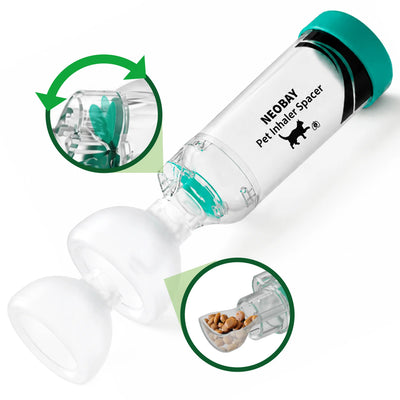
Both are delivered through a spacer chamber — a device that holds the medication so your cat can breathe it in slowly through a mask, rather than trying to coordinate a quick puff straight from the puffer (which cats can't do).
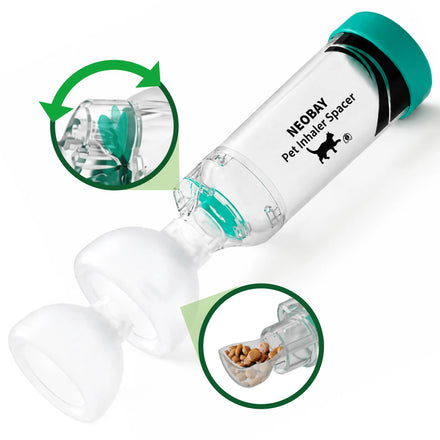
Neobay Cat Inhaler Spacer with Breath Indicator in Australia
- See each breath with the Breath Indicator
- Built-in treat holder makes mask practice easier
- Anti-static chamber helps keep medication airborne
This is where spacer design decides whether daily treatment actually works:
Visual Flow Indicator. You need to know your cat is genuinely inhaling the dose. A flow indicator moves with each breath, giving real-time confirmation — instead of holding a mask on a squirming face and hoping for the best.
Comfort Feeder design. The hardest part of inhaled treatment isn't the medication; it's getting your cat to accept the mask. A Comfort Feeder holds a squeeze treat at the mask rim so the cat voluntarily presses their face in for the food, which lowers panic and resistance — especially during the first 1–2 weeks while the routine is still new.
For the technique itself, see how to administer inhaled medication stress-free.
How to Prepare Your Cat for Vet Visits
Vet visits stress most cats. A few practical steps help:
- Use a carrier your cat already knows. Leave it out at home with a blanket inside so it isn't only associated with vet trips.
- Cover the carrier with a towel in transit to cut down visual triggers.
- Ask your vet about anti-anxiety medication if your cat gets extremely worked up. A small dose of gabapentin 1–2 hours before the visit can make a real difference.
- Book a quieter time of day — early morning or mid-afternoon is often calmer at Australian clinics.
- Bring favourite treats. Positive associations count, even at the vet.
Related: our article on why your vet may recommend inhaled over oral steroids covers the research on efficacy and side effects.
Frequently Asked Questions
How much does feline asthma diagnosis cost in Australia?
Published clinic schedules put a standard consultation around $85–$100 — Walkerville Vet in Adelaide charges $84.90 (Forbes Advisor Australia), Brisbane Pet Surgery lists consults from $86.90, and Lort Smith in Melbourne publishes $98 for a weekday standard consult, with complex 30-minute consults at $156. X-rays, bloods and pathology are billed on top, and most Australian clinics quote imaging only after examining your cat, so a full basic workup typically runs into the hundreds of dollars. BAL and CT are specialist procedures quoted individually — always ask for a written estimate before booking. If budget is tight, say so upfront; most vets can prioritise tests and stagger them across visits.
Does pet insurance cover the diagnostic workup?
There's no Medicare for animals in Australia, as Forbes Advisor Australia puts it — but accident-and-illness pet insurance does exist, and diagnostic testing for a condition like feline asthma is generally claimable under those policies. Two caveats matter: waiting periods apply when a policy starts, and conditions that showed symptoms before the policy began are usually excluded as pre-existing. Some clinics can process claims on the spot through GapOnly, so you only pay the gap. Read the product disclosure statement (PDS) before relying on cover for a diagnostic workup.
Can a vet diagnose asthma from just an X-ray?
An X-ray can provide strong evidence — especially with the classic "donut" bronchi and over-inflated lungs — but other conditions can produce similar films. Most vets combine X-ray results with blood work, and sometimes a BAL or a therapeutic trial, before calling it definitively.
What if my cat's X-rays are normal?
A normal X-ray does not rule out feline asthma. Early and mild cases can look completely clean on film. If your vet still suspects asthma based on symptoms and the physical exam, the next steps are a BAL, a therapeutic trial, or monitoring over time with repeat X-rays.
Is the BAL procedure safe?
BAL is generally safe in experienced hands. It does require general anaesthesia, which always carries some risk — particularly for a cat whose breathing is already compromised. Your vet will weigh the benefits against the risks for your specific cat, and in most cases the information gained is well worth the small added risk.
Will I need to see a veterinary specialist?
Most general practice vets can diagnose and manage feline asthma. Referral makes sense if the diagnosis stays unclear after standard testing, if symptoms don't respond to treatment, or if your cat has other health complications. Cat-only and specialist referral practices operate in most Australian capital cities — for complicated airway cases they offer bronchoscopy, BAL and CT under one roof.
Related: how to monitor your cat's breathing rate at home — the single most useful number to bring to every follow-up visit after diagnosis.
What to Do Next
- Film the next coughing episode. It's the most valuable evidence you can hand your vet.
- Book a vet visit and mention feline asthma specifically when you call — it helps the clinic allocate enough time and prepare for the right tests.
- Organise your observations: frequency, triggers, episode duration, and any other symptoms you've noticed.
- If asthma is diagnosed, ask about inhaled medication delivered through a spacer chamber — the safest long-term approach for most cats. Our Australian cat inhaler spacer buyer's guide compares the options available locally, including pricing and what to look for.
The Neobay Cat Inhaler Spacer is designed specifically for cats, with a Visual Flow Indicator so you can confirm every dose and a Comfort Feeder design that helps cats accept the mask faster.
Have questions? Visit our FAQ page or contact us — we're here to help.
Related Reading
This article is part of our Feline Asthma: The Complete Owner's Guide — symptoms, diagnosis, treatment and long-term management in one place. Once you have a diagnosis, the complete guide to buying a spacer chamber in Australia is the practical next step.
Sources:
- Reinero CR. "Advances in the understanding of pathogenesis, and diagnostics and therapeutics for feline allergic asthma." The Veterinary Journal, 2011; 190(1): 28-33.
- Padrid P. "Feline asthma. Diagnosis and treatment." Veterinary Clinics of North America: Small Animal Practice, 2000; 30(6): 1279-1293.
- Cornell Feline Health Center, Cornell University College of Veterinary Medicine. "Feline Asthma: What You Need to Know." Accessed 2026.
- Ybarra WL, Johnson LR, Drazenovich TL. "Interpretation of multisegment bronchoalveolar lavage in cats (1/2001-1/2011)." Journal of Veterinary Internal Medicine, 2012; 26(6): 1281-1287.
- Traversa D, Di Cesare A. "Feline lungworms: what a dilemma." Trends in Parasitology, 2013; 29(9): 423-430.
- Adagra C, et al. "Prevalence of infection with Dirofilaria immitis in cats from a tropical region of Australia" (Townsville, Queensland antigen/antibody study). Australian Veterinary Journal-indexed, PubMed 34024396, 2021. https://pubmed.ncbi.nlm.nih.gov/34024396/ — accessed 14 Sep 2026.
- Greencross Vets (Australia). "Cat Asthma" — client information on triggers and asthma-mimicking conditions. https://www.greencrossvets.com.au/pet-library/articles-of-interest/feline-asthma/ — accessed 14 Sep 2026.
- Forbes Advisor Australia. "Vet Fees In Australia Explained" — published Australian clinic fee schedules (Walkerville Vet $84.90 standard consult; check-ups $70–$100; "no Medicare for animals"). https://www.forbes.com/advisor/au/pet-insurance/vet-fees/ — accessed 14 Sep 2026.
- Lort Smith Animal Hospital, Melbourne. "Fees & Payments" — published consult fee schedule ($98 standard weekday, $156 complex, $195 emergency). https://lortsmith.com/vet-services/fees/ — accessed 14 Sep 2026.
- Brisbane Pet Surgery. "Vet and Pet Pricing Guide" — consultation from $86.90. https://www.brisbanepetsurgery.com.au/pricing-guide/ — accessed 14 Sep 2026.