Key Takeaways
- Inhaled corticosteroids are the gold standard for feline asthma, but they need a spacer chamber and face mask to reach the lungs — firing a puffer straight at your cat's face wastes up to 80% of the medication.
- Mask training takes 1-2 weeks using gradual desensitisation. Rushing this step is the #1 reason cats reject inhaled therapy. A slow, treat-led protocol works for the vast majority of cats.
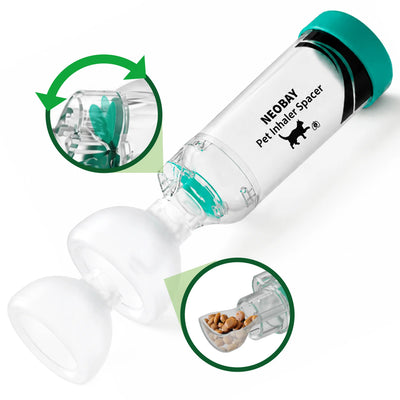
- A spacer with a Visual Flow Indicator removes the guesswork — you can see each breath your cat takes, so you know the medication was actually inhaled rather than lost around the mask.
- Consistency beats perfection. Missing one dose occasionally is less harmful than turning treatment into a daily wrestling match. A calm 5-second session is better than a stressful 30-second struggle.
- The biggest mistake owners make is skipping desensitisation. Starting the full routine — mask, puff, countdown — before your cat accepts the mask guarantees resistance.
Giving your cat a puffer without the stress comes down to two things: a cat-specific spacer chamber (cats can't coordinate press-and-inhale, so spraying a puffer directly at their face wastes up to 80% of the dose), and a 7-day mask desensitisation plan before the first real puff. With a Neobay spacer chamber with Visual Flow Indicator and this protocol, the overwhelming majority of cats settle into the full daily routine within 1-2 weeks. Below is the equipment list with Australian pricing, the day-by-day training plan, and the 7-step routine that keeps every session short and low-stress.
Why Inhaled Medication Needs a Spacer Chamber
If you've ever used a puffer yourself, you know it takes a specific technique: press, breathe in deeply, hold. Cats simply can't do this.
Without a spacer, pressing a puffer near your cat's face delivers almost no medication to the lungs.
 Here's what actually happens:
| Method | Medication Reaching Lungs | What Happens to the Rest |
|---|---|---|
| Direct spray (no spacer) | Less than 20% | Hits the back of the throat; swallowed and destroyed by stomach acid |
| Spacer chamber + mask | 40-60% | Held in the chamber; your cat breathes it in over 7-10 natural breaths |
That difference isn't small — it's the difference between effective treatment and wasted medication. A spacer slows the propellant so medication particles hang in a breathable cloud your cat can inhale through normal, gentle breathing. Australian cat-only hospitals describe the same principle: an aerosol chamber designed for a cat's face, breath volume and specific medications is the most efficient way to deliver the drug to the small airways.
This is why international guidelines from the Journal of Feline Medicine and Surgery consistently recommend inhaled corticosteroids delivered via spacer as the preferred long-term treatment for feline asthma — they target the lungs directly with minimal systemic side effects.
Related: for a deeper explanation of how these devices work, see our guide on what a cat inhaler spacer is and why your vet recommends one.
The Equipment You Need
Before you start training, get everything ready:
| Item | What It Does | Cost in Australia |
|---|---|---|
| Spacer chamber (Neobay or AeroKat) | Holds medication in a breathable cloud | Neobay A$69; AeroKat typically around A$112 on Amazon AU (price checked September 2026 — always compare before you buy) |
| Face mask (attached to spacer) | Seals over your cat's nose and mouth | Included with the chamber |
| Fluticasone puffer (Flixotide in Australia — vet prescription) | Daily anti-inflammatory preventer | Dispensed per prescription — your vet or pharmacy will quote current pricing |
| Salbutamol puffer (Ventolin — vet prescription) | Emergency bronchodilator for attacks | Dispensed per prescription |
| Cat treats or lickable puree | Positive reinforcement during training | A$3-A$10 |
Choosing a Spacer Chamber
Two features make a real practical difference in daily use:
Visual Flow Indicator — the small valve on the spacer that moves with each breath your cat takes. Without it, you're guessing: did they inhale? how many breaths? is the medication gone? With it, you can see exactly when your cat has taken enough breaths (7-10 is the target). It removes the most common source of owner anxiety.
Comfort Feeder design — the Neobay chamber integrates a treat dispenser directly above the mask. Your cat licks the treat while the mask is on their face, so the whole experience is treat-guided positive reinforcement rather than forced restraint. That's the difference between a cat that fights the mask and one that walks toward it voluntarily.
For a full rundown of local pricing, availability and what to check before you buy, see our Australian cat inhaler spacer buyer's guide.
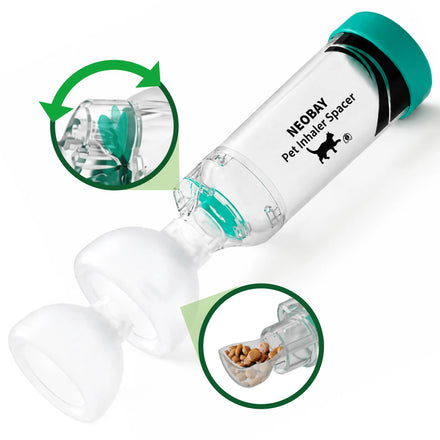
Neobay Cat Inhaler Spacer with Breath Indicator in Australia
- See each breath with the Breath Indicator
- Built-in treat holder makes mask practice easier
- Anti-static chamber helps keep medication airborne

Phase 1: Desensitisation Training (Days 1-7)
Do not skip this phase. It's the single biggest factor in whether inhaled therapy succeeds or fails. Starting with the full routine — mask on, puff, wait for breaths — before your cat is comfortable with the mask guarantees a negative experience that's hard to undo.
The goal: your cat willingly approaches the spacer and accepts the mask on their face for 10-15 seconds without struggling, before you ever press the puffer.
Day 1-2: Introduce the Spacer as Furniture
- Place the spacer (no puffer attached) near your cat's favourite resting spot
- Dab a small amount of lickable treat on the mask edge
- Let your cat investigate and lick on their own terms
- Don't put the mask on their face yet
- Repeat 2-3 times a day, always with treats
Day 3-4: Brief Mask Contact
- While your cat licks the treat on the mask, gently lift it to briefly touch their nose
- Hold for 1-2 seconds, then remove immediately
- Give a high-value treat straight after
- Build up to 3-5 seconds of contact over these two days
- If your cat pulls away at any point, let them — never force it
Day 5-7: Build Duration
- Apply treat to the Comfort Feeder or the mask edge
- Place the mask over your cat's nose and mouth for 5-10 seconds
- Watch the Visual Flow Indicator — your cat's natural breathing will make it flutter
- Slowly build to 15-20 seconds of mask-on time
- Keep sessions to 2-3 per day, always ending on a win
Success checkpoint: by the end of Day 7, your cat should tolerate the mask for 15+ seconds without struggling. If not, stay at the Day 5-7 pace for another week before moving on. Some cats — especially older or previously traumatised cats — need 2-3 weeks, and that's completely normal.
Want the condensed version? Our five-day inhaler training timeline breaks the same process into quick daily sessions.
Phase 2: The Administration Routine (Days 8+)
Once your cat accepts the mask for 15+ seconds without resistance, you're ready to add the puffer. Here's the complete daily routine:
Step 1: Shake the Puffer
Remove the cap and shake the fluticasone puffer vigorously — Australian cat hospitals recommend a good 10-15 second shake. This mixes the medication and propellant; skipping it delivers an inconsistent dose.
Step 2: Attach and Prime (First Use Only)
If the puffer is brand new, spray it into the air 3-4 times away from your cat's face. This "primes" it so the first dose your cat receives is a full one.
Step 3: Apply Treat to the Feeder
Smear a lickable treat on the Comfort Feeder or mask edge. This is the positive reinforcement that makes the whole process work.
Step 4: Place the Mask
Gently place the mask over your cat's nose and mouth. Check the seal — you should see the Visual Flow Indicator respond to their breathing within seconds.
Step 5: Press the Puffer
Steady the spacer with one hand and press the puffer once with the other. You'll hear a soft puff — the medication is now suspended in the chamber.
Step 6: Count 7-10 Breaths
Watch the Visual Flow Indicator. Each flutter = one breath. Count 7-10 breaths; that takes roughly 10-15 seconds for most cats.
No flow indicator? Hold a mirror near the exhalation valve — condensation from your cat's breath confirms airflow. Or watch for the subtle chest rise of each breath.
Step 7: Remove and Reward
Remove the mask and immediately give a treat or praise. End every session positively — it reinforces that the routine is pleasant, not punishing.
If Your Cat Needs Two Puffs
If your vet prescribed two puffs per session:
- Give the first puff and count 7-10 breaths
- Remove the mask for 30-60 seconds
- Shake the puffer again
- Repeat Steps 4-7 for the second puff
Never press the puffer twice without letting your cat breathe between puffs. The medication needs time to be inhaled from the chamber.
Common Mistakes That Sabotage Success
Mistake 1: Skipping Desensitisation
The most common reason cats reject inhaled therapy is owners rushing. If your cat's first experience involves a loud puff and a mask forced onto their face, they'll associate the equipment with fear — and that association is extremely hard to undo.
Fix: follow the 7-day protocol above, even if it feels slow. It saves weeks of struggle later.
Mistake 2: Chasing Your Cat
If your cat bolts when they see the spacer, don't chase them. That turns the routine into a predator-prey game that amplifies fear.
Fix: leave the spacer out permanently so it becomes part of the furniture. Only approach when your cat is relaxed. If they walk away, let them go and try again later.
Mistake 3: Forcing the Mask Seal
A mask that doesn't seal lets medication escape. But pressing too hard against your cat's face causes discomfort and resistance.
Fix: use gentle, even pressure — snug but never digging in. Flat-faced breeds (Persians, Himalayans) usually fit the smaller mask better.
Mistake 4: Not Cleaning the Spacer
Static builds up on chamber walls over time, so medication particles stick instead of staying airborne. A dirty spacer delivers noticeably less medication.
Fix: soak the spacer in warm, soapy water once a week. Rinse well and air dry completely — never wipe the inside with a towel or scrub it, as this damages the anti-static coating. Our cleaning and maintenance guide has the full routine.
Mistake 5: Inconsistent Timing
Cats thrive on routine. Dosing at random times each day makes treatment unpredictable and stressful.
Fix: pick two consistent times (say 8am and 8pm) and stick to them. Cats quickly learn "the spacer comes out after breakfast" and accept it as part of daily life.
Managing Setbacks
Even well-trained cats occasionally resist the mask. Here's how to handle the common ones:
| Situation | What to Do |
|---|---|
| Cat suddenly refuses after weeks of compliance | Check for mask irritation, ear infection or mouth pain — discomfort makes mask contact hurt |
| Cat swats at the spacer | Pause the session, offer treats, end on a positive note. Try again at the next scheduled time |
| You missed 2-3 days of treatment | Resume the normal routine. Don't double-dose. Call your vet if symptoms worsen |
| Cat only tolerates 5 breaths instead of 10 | 5 breaths with medication beats 0. Gradually rebuild duration over the next week |
When to call your vet: if your cat's symptoms (coughing, wheezing, laboured breathing) worsen despite inhaled medication, or they refuse the mask for more than 3 days straight, contact your veterinary clinic. They may adjust the dose, switch medications, or add oral steroids temporarily while you retrain. If you're weighing up whether a symptom is an emergency or a wait-and-watch situation, our guide to the first 24 hours after a cat asthma attack covers the warning signs.
Frequently Asked Questions
Can I buy a spacer chamber without a script in Australia?
Yes. A spacer chamber like the Neobay is a non-medicated, pet-only accessory — it holds and delivers medication but contains none itself, so no prescription is required to buy one. The medication is a different story: puffers such as Flixotide (fluticasone) and Ventolin (salbutamol) are prescription-only medicines and must be dispensed under your veterinarian's authorisation. So you can get the chamber sorted today, but the medication itself always goes through your vet.
Can I just use my own Ventolin puffer on my cat?
No. Ventolin for humans and veterinary-prescribed salbutamol contain the same active drug, but the strength, dose and treatment plan for your cat must be set by your veterinarian. Using your own prescription for your cat means no veterinary oversight, no correct dosing, and no diagnosis confirming that a bronchodilator is even the right treatment. Book a consult and get a proper plan — most Australian clinics dispense or order in feline-appropriate puffers.
Can I use a human asthma spacer for my cat?
No. Human spacers aren't designed for feline facial anatomy — the masks don't seal against a cat's face, so medication leaks out before it's inhaled. The one-way valves in human spacers also need more force to open than a cat's gentle breathing provides. Australian feline specialists make the same point: a chamber designed for a cat's face, breath volume and medications is by far the most efficient delivery method.
How long does it take for inhaled medication to work?
Daily fluticasone (the preventer, sold in Australia as Flixotide) takes 7-14 days of consistent use to reach full effect. You may see gradual improvement within the first few days, but the anti-inflammatory effect builds over time. Salbutamol (Ventolin), the reliever, works within minutes to open constricted airways during an acute attack.
My cat absolutely won't accept the mask. What are my options?
If structured desensitisation fails after 2-3 weeks, talk to your vet about: (1) oral prednisolone short-term while you continue slower mask training, (2) a different mask size or spacer design — some cats accept a smaller mask or a different chamber shape, or (3) a compounding pharmacy, which can flavour liquid medication. Oral steroids carry more long-term side effects, so they're usually a bridge rather than the destination.
How often should I clean the spacer chamber?
Once a week: soak in warm, soapy water, rinse thoroughly, and let it air dry completely before the next use. Never wipe the inside with a towel or scrub with a brush — that destroys the anti-static coating that keeps medication particles suspended. Replace the chamber if you notice cracks, a loose mask seal, or a sticky valve.
What to Do Next
- If you haven't started mask training yet, begin today with Days 1-2 of the protocol. Place the spacer near your cat's resting spot with a treat on the mask. The sooner you start, the sooner your cat gets consistent medication.
- If you already have a spacer but your cat fights it, go back to the desensitisation phase. It feels like a step backwards, but rebuilding the positive association is faster than pushing through resistance.
- If you're still on oral steroids, ask your vet about transitioning to inhaled medication. Long-term oral steroids carry risks — weight gain, diabetes and immune suppression — that inhaled therapy largely avoids.
Shopping in Australia? Compare chambers, local pricing and delivery options in our cat spacer buyer's guide for Australian owners, or go straight to the Neobay Cat Inhaler Spacer — it ships locally with the Visual Flow Indicator and Comfort Feeder built in. For the bigger picture on your cat's condition, start with our complete feline asthma owner's guide.
Have questions? Visit our FAQ page or contact us directly.
Sources:
- Perth Cat Hospital (WA). "Feline Bronchial Disease (Feline Asthma)." perthcathospital.com.au — Australian feline-specialist clinic guidance on preventer and reliever puffers, aerosol chamber use, and step-by-step inhaled medication administration.
- Greencross Vets. "Cat Asthma." greencrossvets.com.au — Australian national veterinary group on feline asthma symptoms and household triggers including cigarette smoke, dust, pollens and some cat litters.
- Barchilon M, Reinero CR. "Breathe easy: inhalational therapy for feline inflammatory airway disease." Journal of Feline Medicine and Surgery, 2023; 25(9).
- Trzil, J.E. "Feline Asthma: Diagnostic and Treatment Update." Veterinary Clinics of North America: Small Animal Practice, 2020.
- Cornell Feline Health Center. "Feline Asthma: A Risky Business for Many Cats." Cornell University College of Veterinary Medicine.
- For realistic timing expectations, see our five-day training timeline — day-by-day starter protocol plus real owner reports.
Related Reading
This article is part of our Feline Asthma: The Complete Owner's Guide — covering everything from causes and symptoms to treatment and daily management. Buying in Australia? Start with our Cat Inhaler Spacer Australia Buyer's Guide for local pricing, availability and AeroKat alternatives.