Key Takeaways
- A prednisolone taper after starting fluticasone must come from the veterinarian treating your cat.
- Oral and inhaled corticosteroids may both appear in one plan; there is no timetable here to copy.
- Keep 2 records together: the current written prescription and what actually happened at each administration.
- New coughing, poor appetite or unusual lethargy needs veterinary advice rather than an owner-led dose change.
- A spacer and mask support a prescribed inhaler routine, but indicator movement cannot prove how much medicine reached the lungs.
Only your treating vet can set a prednisolone taper after starting inhaled fluticasone: keep 2 records, the current prescription and actual administrations. Neobay is a non-medicated spacer accessory, not a way to determine doses or decide when to stop medicine. Open-mouth breathing or obvious breathing difficulty needs emergency veterinary care immediately.
The useful next step is a clear conversation with the clinic. Searching for another cat’s taper can leave you comparing charts without knowing why those charts were chosen. Your cat’s diagnosis, medication history, other illnesses and current response matter more than matching a week number.
Make the Australian puffer plan explicit
Your vet may call an inhaler a puffer and distinguish a preventer from a reliever. Perth Cat Hospital describes these as different parts of asthma management. Ask the clinic to write the medicine name beside its role, rather than identifying it by the colour of the canister.
If you have seen Flovent mentioned in an overseas article, show your vet the name on your actual prescription. Do not substitute a different brand, formulation or device because the ingredient sounds familiar. The practice should confirm which prescribed puffer fits the chosen chamber and demonstrate the setup.
For after-hours care in Australia, find a local emergency hospital before a problem occurs. If your usual clinic does not provide overnight care, ask where its patients are referred and keep the address with your cat’s records. A longer drive is a reason to prepare transport, not a reason to wait during breathing distress.
Understand why the medicines have different roles
Prednisolone is a corticosteroid given by mouth in many feline treatment plans. Fluticasone is a corticosteroid that may be prescribed in an inhaled formulation. A bronchodilator is a different medicine used to open narrowed airways. Ask which role each item has in your cat’s specific plan.
Perth Cat Hospital describes veterinary-directed medication use. The aim of choosing an inhaled route is to target the airways and reduce unwanted whole-body exposure, but it is not a promise of no side effects. Do not treat an inhaler as proof that oral medicine is suddenly unnecessary.
Why might the clinic prescribe both medicines? A veterinarian may use more than one treatment during a transition while assessing response and the practical inhaler routine. That clinical decision does not create a safe universal overlap period. Ask why both are included for your cat and which clinician will review the plan.
Get the plan into a form you can follow
Bring the prescription, packages and any previous written directions to the conversation. Read back the names of the medicines and ask the team to resolve anything that conflicts. If two caregivers heard different instructions, contact the practice rather than choosing the version that seems easier.
- Which written instructions are current, and do they replace an earlier plan?
- What should I do if a dose is missed, spat out, vomited or uncertain?
- What changes mean the clinic needs to hear from me?
- Who should review the log, and how should I send it?
- Which signs require immediate emergency care?
The VCA Canada prednisolone medicine information specifically warns against abrupt stopping; the treating veterinarian must set the reduction instructions. A photograph of the label can help during a phone call. Keep the original packaging available, too. If you cannot follow a direction, say so before the next planned administration; do not create your own workaround by splitting, diluting or substituting medication.
Track observations without turning the log into a taper chart

Record when prescribed medicines were actually given and what happened during the session. A short note such as “mask removed before we finished” is more useful than a tick that hides an uncertain administration. Let the clinic decide what that uncertainty means for the prescription.
Also record coughing, breathing effort, appetite, drinking, energy and unusual behaviour. Compare with your cat’s normal routine rather than with a different cat in a video. A brief recording can help the vet understand an episode when filming is safe, but never delay care to capture it.
Agree who writes the entry and where it is kept. A paper sheet next to the medicines can work as well as a shared note. Do not leave a bowl being refilled by several people as the only record of drinking or food intake.

The drinking and feeding photographs show ordinary routines to observe; they do not demonstrate a medication response. A cat approaching a bowl is not the same as eating a meaningful amount. Share reduced intake or unusual thirst with the veterinary team rather than interpreting it yourself.
Check the inhaler routine with the veterinary team
A metered-dose inhaler (MDI) releases an aerosol from a compatible prescribed device. A spacer chamber holds that aerosol for inhalation through a mask. Ask the clinic to watch your technique with the actual equipment and show you how to assemble, inspect and clean it.
Paddington Cat Hospital discusses feline asthma management. Equipment familiarisation is a practical part of care, but cooperation does not measure disease control. Report resistance, leaks, damaged components or uncertainty instead of assuming the treatment succeeded because the device was held nearby.
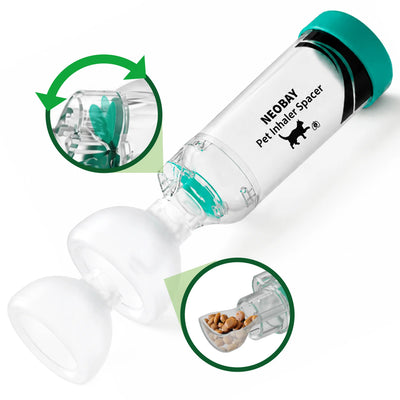
The Neobay cat inhaler spacer is a non-medicated accessory for a compatible veterinary-prescribed inhaler. Its Comfort Feeder uses food guidance to encourage voluntary mask acceptance; it does not change the prescription or guarantee acceptance within a set number of days. The Visual Flow Indicator is a visible breathing cue, not a measurement of lung deposition or a full delivered dose.
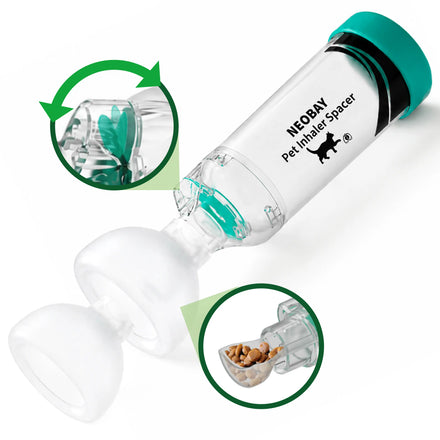
Neobay Cat Inhaler Spacer with Breath Indicator in Australia
- See each breath with the Breath Indicator
- Built-in treat holder makes mask practice easier
- Anti-static chamber helps keep medication airborne
For a cat that is stable enough for practice, use short, calm sessions and ask the team how to respond to resistance. Stop a practice session if your cat becomes distressed. Our mask-familiarisation guide offers background for that conversation, without setting a medication plan.
Report changes rather than adjusting the taper yourself
What if coughing returns after a change? Contact the prescribing clinic and report when it started, what you observed and which medicines were actually given. Do not step back up, skip ahead or add another inhaler dose on your own. The team may need to reassess the cause as well as the plan.
Do not label hiding, reduced appetite, weakness, vomiting or unusual lethargy as normal steroid withdrawal. These signs deserve veterinary advice. A symptom log can support the assessment, but neither a log nor a home breathing count is permission to change medication.
Open-mouth breathing, obvious breathing distress, blue or pale gums or collapse requires emergency care immediately. Keep your cat calm and minimise handling while arranging transport. If possible, have someone call the receiving hospital. Do not wait several minutes to see whether an unprescribed adjustment helps.
Frequently Asked Questions
Can I stop prednisolone once the puffer seems to work?
Only follow the stopping or reduction instructions written by your treating vet. A good day or a quieter cough does not set a taper. Ask the clinic to clarify the plan before making a change.
Is a preventer puffer the same as a reliever?
No. These medicines have different roles, and your vet should identify each prescribed product for your cat. Do not swap them or use a reliever instead of the anti-inflammatory medicine.
What if I cannot give the puffer before the clinic closes?
Tell the clinic promptly and describe what happened during administration. Ask for instructions for the prescribed medicines and the after-hours contact. Do not compensate with extra doses yourself.
Does indicator movement mean the taper can go ahead?
No. A chamber indicator is a visible breathing cue and cannot measure the medication deposited in the lungs. Your vet decides whether the clinical response and administration routine support the next step.
Should I increase prednisolone if coughing returns?
Contact your vet for assessment and instructions instead of changing the dose yourself. Report the cough, breathing effort, appetite and actual administrations. Difficulty breathing or mouth breathing needs emergency care immediately.
Can my Australian vet use a schedule I found online?
You can bring the question to your vet, but another cat’s schedule is not a prescription for yours. The treating team needs the diagnosis, treatment history and current response before deciding the plan.
What to do next
Confirm the current written plan with your vet, keep an accurate administration record and report any change you cannot explain. Ask for a technique check before treating mask cooperation as a solved problem. For broader background, read the feline asthma overview.
When your clinic has prescribed an inhaler and you are comparing equipment, use our Australia spacer buyer’s guide. The equipment choice supports the prescribed routine; the treating team remains responsible for medication decisions.
Sources
- Perth Cat Hospital. Feline bronchial disease (feline asthma). Accessed 20 October 2026.
- Paddington Cat Hospital. Common Conditions. Accessed 20 October 2026.
- VCA Canada Animal Hospitals. Prednisolone/Prednisone. Accessed 20 October 2026.