

Key Takeaways
- Cats should take 7–10 breaths per dose through a spacer to receive the full medication — counting without watching the flow indicator is the most common owner error.
- Press the MDI after the mask seals, not before. A puff fired into open air triggers startle and wastes up to 30% of the dose.
- Cats can and do hold their breath when a mask covers their face. Waiting them out works better than forcing.
- One chamber for both Flovent and albuterol leaves residue — many vets recommend a dedicated rescue chamber.
- Shake 5 seconds and wait 30 seconds between puffs. Stacking puffs into one breath sequence wastes the second dose.
The seven mistakes below send 20–80% of an inhaled dose into the air, the fur, or the throat instead of the lungs. The fixes are small, fast, and they're the difference between a Neobay chamber working the way your vet intended and a cat that keeps coughing despite "doing everything right."
If you're new to inhaled medication, our Cat Inhaler Spacer guide covers device choice and setup. This article assumes you've done the first session and want to fix technique issues fast.

Mistake 1: Pressing the Inhaler Before the Mask Is Sealed
This is the mistake vets teach first — and the one most owners get backwards. The classic instruction is "press the MDI into the chamber, then place the mask on your cat." That works in theory. In practice, many cats panic at the puff sound and break the seal before the first breath starts.
One Reddit owner (r/CatAdvice) documented it exactly: "My vet told me to press the inhaler before putting it on my cat's face, but that freaked him out. I think he registered the noise as a hiss. Once I started putting it on his face and then pressing the inhaler, he was a lot more comfortable."
Fix: Place the mask over nose and mouth first. Confirm a seal by watching the flow indicator flutter with one normal breath. Then press the MDI. Modern chambers hold medication in suspension for up to 12–15 seconds, so you're not racing the clock. A spooked cat pulls away, the dose exits into the room, and you're out $4–$8 of medication with nothing delivered.
Mistake 2: Counting Breaths Without Watching the Flow Indicator
Most owners count "one thousand one, one thousand two" and assume ten breaths happened. They didn't. Cats breathe 20–30 times per minute at rest, which means one breath every 2–3 seconds — but only when calm. A nervous cat drops to 8–10 breaths per minute, and a stubborn one holds breath entirely (see Mistake 3).
The fix is mechanical: watch the flow indicator. On a Neobay Blue chamber, the colored valve moves visibly with each inhale and exhale. One full open-close cycle = one breath. Count those cycles, not seconds. Vets at Trudell Animal Health and Cornell Feline Health Center both recommend 7–10 counted breaths per puff as the standard.
If your chamber doesn't have a flow indicator, you're counting by guess. That's the single biggest argument for upgrading — you cannot optimize what you can't see.
Mistake 3: Letting the Cat Win the Breath-Holding Contest
This is the mistake that surprises every new owner. Cats figure out, usually within the first week, that they can hold their breath when the mask goes on. It's not pathological — it's a negotiation tactic.
The original r/CatAdvice thread lays it out: "She seems to have realized she can control her breathing and stops breathing when the mask is on her face. The breathing valve will move like two or three times but then just stops."
The owners who solved it didn't force. They waited. The most upvoted advice: "Scratch her face/neck/head and she'll breathe. She can't stop breathing forever." The valve will move when she has to gasp. Hold the mask steady, keep it sealed, and count from the first real breath.
A slight chin-up tilt helps. "Tipping their head up slightly and keeping the inhaler at a slight raised angle helps with getting them to breathe deeply. If I have it straight or tipped down, the little breathing flap will barely move."
Mistake 4: Tilting the Mask Downward or Flat
Gravity matters inside a spacer chamber. The MDI sprays medication as a fine aerosol that suspends for 10–15 seconds, then starts to settle. If the chamber angles downward, the aerosol drifts toward the floor of the chamber and sticks to the wall instead of exiting through the valve.
The correct angle: your cat's chin slightly raised, the chamber roughly horizontal or tilted 10–15° upward. You'll see the flow indicator move further with each breath — proof the aerosol is reaching the lungs instead of pooling inside the device.
If your cat lowers her head mid-treatment, pause briefly, lift her chin with a finger under the jaw, and resume counting from the next visible breath. Don't muscle through.
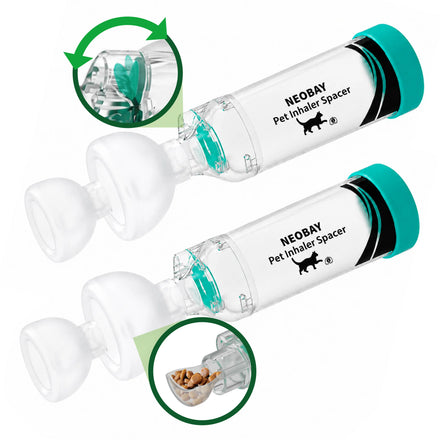
Neobay Cat Aerosol Chamber with Comfort Feeder — Green 2-Pack
- $30 per chamber vs AeroKat $61.95 — about 52% less
- One in use, one air-drying — no skipped doses on cleaning day
- Two chambers for multi-cat homes — no cross-contamination
Mistake 5: Using One Chamber for Both Flovent and Albuterol
But this is the mistake your vet probably didn't mention. Most owners buy one chamber, use it for daily Flovent (fluticasone) in the morning, then attach the rescue inhaler (albuterol) during an attack that evening. Seems efficient. It isn't.
Corticosteroid residue clings to the chamber walls and valve. When you fire albuterol into the same chamber hours later, the rescue dose mixes with leftover Flovent particles — enough that the albuterol's fast-acting bronchodilation is partially blocked by steroid residue on the valve membrane. You also can't tell which inhaler's "smell" the cat is reacting to when resistance builds.
Many vets now recommend a dedicated rescue chamber for albuterol — especially for cats on twice-daily Flovent. A separate chamber stays clean and deploys faster in an emergency. For the full breakdown, read our guide to using separate chambers for Flovent and albuterol.
Mistake 6: Stacking Puffs (No Shake, No 30-Second Wait)
If your vet prescribed two puffs per session, the second puff is not a continuation of the first. Pressing the MDI twice in five seconds delivers roughly one effective dose, not two.
Inside the canister, medication is suspended in propellant. Shaking 5 seconds redistributes particles evenly; the metered valve then releases one accurate dose. Press again too soon and you get propellant with almost no active drug.
Correct sequence for two puffs: Shake 5 seconds → press → count 7–10 breaths → remove mask → wait 30 seconds → shake again → press → count 7–10 breaths → done. About 90 seconds longer than stacking. Worth it.
Mistake 7: Forcing the Mask When the Cat Panics
This mistake costs you the most — not in medication, but in trust. Forcing a panicking cat through a treatment works once. The second session is harder. By session five, the cat runs when the chamber comes out of the drawer.
The Veterinary Partner (VIN) protocol makes this explicit: "Never force the mask or medication. This can cause fear." Their 8-phase cooperative care method takes anywhere from a few days to a few weeks, and it starts before the inhaler ever enters the picture. Phase 1 is just a treatment station. Phase 3 is a lickable treat smeared near the mask opening. The actual puff doesn't happen until Phase 8.
If your cat still fights, you skipped a phase. Go back two steps. Smear a Churu or lickable treat on the mask edge and let her approach voluntarily for a few days. Several owners reported this single change recovered cooperative behavior within a week.

Frequently Asked Questions
How do I know if my cat actually got the medication?
Watch the flow indicator. One full open-close cycle equals one counted breath. Aim for 7–10 cycles per puff. If the indicator doesn't move, the mask isn't sealed, the valve is stuck, or your cat is holding her breath — pause and troubleshoot before pressing the MDI again.
My cat holds her breath when the mask goes on. What should I do?
Wait. Don't remove the mask, don't force it. Scratch her chin or the base of her ears to trigger a swallow, which forces a breath. Tilt her chin slightly upward. Count from the first real breath in the indicator. Most cats give up the hold within 15–20 seconds.
Can I press the inhaler before putting the mask on my cat?
You can, but it often backfires. The puff sound startles many cats and breaks the seal before the first breath. Pressing after the mask is sealed is more reliable for nervous cats. Modern chambers hold the aerosol for 10–15 seconds, so the timing pressure is low either way.
Do I really need two chambers for Flovent and albuterol?
Not strictly required, but strongly recommended if your cat is on twice-daily Flovent. Steroid residue builds up inside the chamber and can interfere with the rescue dose. A separate rescue chamber also deploys faster in an emergency.
How many breaths count as a full dose?
7–10 breaths per puff is the veterinary standard (Trudell, Cornell). Fewer risks under-dosing. More than 10 is fine but unnecessary — most medication is inhaled within the first 7 breaths.
What to Do Next
1. Audit your next session. Film 30 seconds of a normal dose and check the flow indicator against your breath count.
2. Decide on one chamber or two. If your cat is on Flovent only, one is fine. If albuterol is in the mix, a dedicated rescue chamber pays for itself — see the Neobay 2-Pack option.
3. Refresh cooperative care if resistance has crept in. One week of lickable-treat training usually rebuilds trust that months of forced sessions erode.
For device troubleshooting, our 5 Signs Your Spacer Isn't Working covers what to check when the chamber itself may be the problem. Have questions? Visit our FAQ page or contact us directly.
Related Reading
This article is part of our Cat Inhaler Spacer — Complete Treatment & Device Guide — the central hub covering device choice, training, cleaning, and the full spacer ecosystem for asthmatic cats.
Sources:
- Trudell Animal Health. "How To Use A Cat Inhaler To Treat Feline Asthma." 2026.
- Veterinary Partner (VIN). "Teaching Your Cat To Use an Inhaler." Pat Koven, BA, LVT, KPACTP.
- Cornell Feline Health Center. "Feline Asthma: A Risky Business for Many Cats."
- Reddit r/CatAdvice community threads on inhaler breath-holding and training (2023–2024).


