

Key Takeaways
- Cats cannot use human inhalers directly. Pressing a human inhaler into a cat's face delivers medication at high velocity into the wrong area — it won't reach the lungs and can cause panic, injury, or a dangerous overdose.
- The active ingredients in many human inhalers (albuterol, fluticasone) are the same ones vets prescribe for cats — but the delivery method must change completely.
- Cats need a spacer chamber (aerosol chamber) to receive inhaled medication safely. The inhaler fires medication into the chamber, and the cat breathes it in slowly through a fitted mask.
- Using the wrong inhaler medication on a cat — especially combination products with long-acting bronchodilators — can cause serious toxicity, including elevated heart rate, tremors, and collapse.
- If your vet has prescribed inhaled medication for your cat, always use a cat-specific spacer chamber with a Visual Flow Indicator to confirm your cat is actually inhaling the medication.
You're reaching for your inhaler during an asthma flare-up, and you glance at your cat — who's been coughing and wheezing too. It's a natural thought: Can I just give my cat a puff from my inhaler?
It's one of the most common questions cat owners ask when they first learn about feline asthma. And the answer isn't a simple yes or no — it's more important than that. The medication inside your inhaler might be exactly what your cat needs. But the way you deliver it could be dangerous if done wrong.
This article explains why cats can't use human inhalers the way humans do, what happens if you try, which medications are safe (and which aren't), and the correct setup every cat owner needs for inhaled asthma treatment.
Why Cats Can't Use Human Inhalers Directly
A metered-dose inhaler (MDI) is designed for human anatomy. When you press the canister, it releases a precise burst of medication at high speed. A human inhales deeply and holds their breath, pulling the medication deep into the lungs.
Cats can't do any of that. Here's what goes wrong:
1. The Medication Doesn't Reach the Lungs
A cat's airway is far smaller than a human's. When an inhaler is fired directly at or near a cat's face, the medication particle stream is too fast and too forceful. Most of it hits the back of the throat, lands on the fur, or disperses into the air. Very little — if any — reaches the lower airways where it's needed.
2. It Terrifies the Cat
The sudden loud hiss and cold blast of propellant from an MDI is startling enough for humans who know it's coming. For a cat, it's a frightening experience. A direct blast to the face can cause the cat to panic, bolt, and develop a lasting aversion to any future treatment attempts. This makes ongoing asthma management far more difficult.
3. Risk of Overdose or Incorrect Dosing
Human inhalers deliver a standard dose per puff — typically 90 mcg of albuterol or 44–220 mcg of fluticasone. Without a spacer, you have no way to know how much medication your cat actually inhaled. They might get almost nothing (treatment failure), or they might get a concentrated local dose to the back of the throat (potential irritation or systemic absorption through mucous membranes).
4. Physical Harm
The forceful propellant blast can irritate the cat's eyes, nasal passages, and throat. In worst cases, a struggling cat could inhale the propellant abruptly, causing coughing spasms that worsen the very asthma attack you're trying to treat.
The Right Way: Spacer Chamber + Face Mask
Veterinary medicine solved this problem decades ago. Cats receive inhaled medication through a spacer chamber (also called an aerosol chamber) connected to a soft face mask.
Here's how it works:
- The inhaler is pressed into the back of the spacer chamber, releasing medication inside.
- The medication mixes with air in the chamber, slowing down and becoming fine droplets.
- The cat wears a fitted mask attached to the front of the chamber.
- As the cat breathes normally through the mask, they slowly inhale the medication from the chamber.
- Each breath pulls medication deep into the lungs — no force, no panic, no waste.

This delivery method achieves lung deposition rates of 10–15% in cats using a properly designed spacer — comparable to what humans achieve with standard inhaler technique. Without a spacer, lung deposition in a cat is negligible.
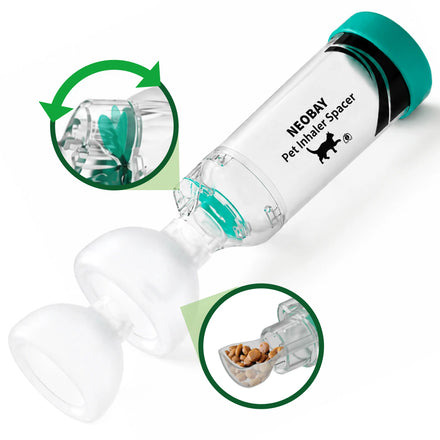
Neobay Cat Aerosol Chamber with Comfort Feeder — Green
- See each breath with the Breath Indicator
- Built-in treat holder makes mask practice easier
- Anti-static chamber helps keep medication airborne
Which Human Inhaler Medications Are Safe for Cats?
This is where the answer gets nuanced. Some of the same medications used in human inhalers are prescribed for cats — but not all of them, and never at the same dose without veterinary guidance.
Generally Safe (When Prescribed by Your Vet)
| Medication | Type | Human Brand Examples | Use in Cats |
|---|---|---|---|
| Albuterol (Salbutamol) | Short-acting bronchodilator | ProAir, Ventolin, Proventil | Rescue medication — used during acute asthma attacks to open airways quickly |
| Fluticasone propionate | Inhaled corticosteroid | Flovent HFA | Controller medication — used daily to reduce airway inflammation and prevent attacks |
These two medications are the most commonly prescribed inhaled treatments for feline asthma worldwide. If your vet prescribes one of these, you can use the human-brand inhaler — but only with a cat spacer chamber, never directly.
Potentially Dangerous for Cats
| Medication | Type | Risk |
|---|---|---|
| Salmeterol | Long-acting bronchodilator (LABA) | Cats are highly sensitive — can cause elevated heart rate, tremors, and cardiovascular stress |
| Formoterol | Long-acting bronchodilator (LABA) | Similar risks as salmeterol |
| Combination inhalers (fluticasone/salmeterol — Advair; budesonide/formoterol — Symbicort) | Corticosteroid + LABA | The LABA component is dangerous for cats; these should never be used |
| Ipratropium | Anticholinergic | Limited data in cats; not routinely recommended |
| Over-the-counter "primatene mist" (epinephrine) | Sympathomimetic | Extremely dangerous — can cause dangerous heart rate elevation, hypertension, and anxiety in cats |
Critical rule: Never use any inhaler on your cat unless your veterinarian has specifically prescribed it. Even if the active ingredient is the same, the dose, frequency, and delivery method must be determined by your vet based on your cat's weight, condition severity, and overall health.
What Happens If You Give Your Cat the Wrong Inhaler?
If your cat is accidentally exposed to the wrong inhaler medication — especially a long-acting bronchodilator or epinephrine — watch for these signs:
- Rapid heart rate (you can feel this by placing your hand on your cat's chest)
- Restlessness or agitation
- Tremors or muscle twitching
- Dilated pupils
- Vomiting or drooling
- Collapse
If any of these occur after inhaler exposure, contact your vet or an emergency animal hospital immediately. Bring the inhaler with you so the vet knows exactly what medication and dose was involved.
Can You Use Your Own Albuterol Inhaler With a Cat Spacer?
If your vet has prescribed albuterol for your cat, and you already have a prescription albuterol inhaler at home, you may be able to use the same inhaler — with these important conditions:
- Your vet confirmed the medication and dose. Don't assume your inhaler is the same strength or formulation your cat needs.
- You use a cat-specific spacer chamber. Never fire the inhaler directly at your cat.
- You dedicate a separate inhaler for your cat. Cross-contamination between human and pet use isn't worth the risk, and you need to track how many puffs remain for your cat's treatment schedule.
- You follow your vet's dosing instructions exactly. The typical rescue dose for a cat is 1 puff of albuterol (90 mcg) administered through a spacer — but your vet may adjust this.
The Cost Question: Why Some Owners Try Human Inhalers
Let's address the real reason many cat owners consider using their own inhaler: cost.
Feline asthma is a chronic condition. Daily inhaled corticosteroids (like fluticasone) are expensive, especially Flovent HFA, which has seen significant price increases in recent years. A single Flovent inhaler can cost $200–$350 without insurance.
This leads some owners to look for shortcuts — using their own inhaler, skipping doses, or trying alternatives. Here's what you should know:
- Generic fluticasone propionate inhalers are available at significantly lower cost than Flovent HFA. Ask your vet if a generic option is appropriate.
- Online pet pharmacies (certified ones like Chewy Pharmacy) sometimes offer competitive pricing on prescribed medications.
- Skipping controller medication to save money almost always costs more in the long run — emergency vet visits for asthma attacks are far more expensive than daily prevention.
- The spacer chamber itself is a one-time purchase (typically $40–$60) and works with any standard MDI inhaler your vet prescribes.
How to Give Your Cat an Inhaler Treatment: Step by Step
If your vet has prescribed inhaled medication, here's the correct process:
- Shake the inhaler and prime it if it's new or hasn't been used recently (follow the inhaler's instructions for priming).
- Insert the inhaler into the back port of the spacer chamber.
- Gently place the mask over your cat's nose and mouth. The mask should form a soft seal.
- Press the inhaler once to release one puff of medication into the chamber.
- Hold the mask in place and let your cat take 7–10 breaths. A Visual Flow Indicator on the spacer will move with each breath, showing you the medication is being inhaled.
- Remove the mask and reward your cat with a treat or affection.
- Wait 30 seconds if a second puff is prescribed, then repeat.
For detailed training advice: How to Train Your Cat to Accept an Inhaler Mask
What Makes a Good Cat Spacer Chamber?
Not all spacer chambers are equal. When choosing a spacer for your cat, look for:
Visual Flow Indicator
This is non-negotiable. Without a flow indicator, you're guessing whether your cat is actually inhaling the medication. A Visual Flow Indicator — typically a valve or flap that moves with each breath — gives you real-time confirmation. You can count breaths. You can see when your cat stops inhaling. You know the treatment worked.
Comfort Feeder Design
The hardest part of inhaled therapy isn't the medication — it's getting your cat to accept the mask. A spacer with a Comfort Feeder design holds a squeeze treat at the mask rim, so your cat voluntarily presses their face in to reach the food. When early sessions are paired with food, your cat is far more likely to accept the routine long-term.
Proper Mask Fit
The mask should seal softly around your cat's muzzle without gaps. Look for a spacer that comes with appropriately sized masks or has a flexible mask design that adapts to different cat face shapes.
One-Way Valve
A one-way valve prevents exhaled air from flowing back into the chamber, ensuring your cat only breathes in freshly medicated air. This improves medication delivery efficiency.
For a detailed comparison: AeroKat vs Neobay: Which Cat Inhaler Spacer Is Right for You?
Frequently Asked Questions
Can I give my cat a puff from my inhaler?
No. Never fire an inhaler directly at or into your cat's face. The medication won't reach the lungs, it can terrify your cat, and it may cause physical irritation. If your vet has prescribed the same medication for your cat, you must deliver it through a cat-specific spacer chamber with a fitted mask.
Is albuterol safe for cats?
Yes, when prescribed by a veterinarian and delivered through a spacer chamber. Albuterol is the standard rescue medication for feline asthma attacks. However, the dose must be determined by your vet, and it must never be given directly from the inhaler.
Can I use my Flovent inhaler for my cat?
Only if your vet has specifically prescribed fluticasone for your cat and confirmed the dose is appropriate. You must use a cat spacer chamber. Dedicate a separate inhaler for your cat to avoid cross-contamination and track remaining doses.
What inhaler medications are dangerous for cats?
Long-acting bronchodilators (salmeterol, formoterol) and combination inhalers that contain them (Advair, Symbicort) are dangerous for cats. Over-the-counter epinephrine inhalers (Primatene Mist) are extremely dangerous. Always check with your vet before using any medication not specifically prescribed for your cat.
Do I really need a spacer chamber for my cat's inhaler?
Yes — absolutely. A spacer chamber is not optional for cats. It's the only way to deliver inhaled medication effectively and safely. Without a spacer, the medication essentially can't reach your cat's lungs.
How much does a cat inhaler spacer cost?
A quality cat spacer chamber typically costs $40–$60. This is a one-time purchase that works with any standard MDI inhaler your vet prescribes. Compared to the cost of emergency vet visits for uncontrolled asthma, a spacer is a small investment with a significant return.
What to Do Next

If your cat has been diagnosed with feline asthma — or you suspect they might have it — here's what to do:
- Talk to your vet about whether inhaled medication is right for your cat. It's increasingly the preferred long-term treatment because it delivers medication directly to the lungs with minimal systemic side effects.
- Get a cat-specific spacer chamber. This is not optional — it's the only safe and effective way to deliver inhaled medication to a cat.
- Choose a spacer with a Visual Flow Indicator and Comfort Feeder design. These features solve the two biggest problems in feline inhaled therapy: knowing the medication is being delivered, and getting your cat to accept the mask.
- Train your cat gradually. Don't wait for an asthma attack to introduce the spacer. Start with short, positive sessions so your cat associates the mask with treats and calm.
The Neobay Cat Aerosol Chamber is designed specifically for cats, with a Visual Flow Indicator, Comfort Feeder design, and one-way valve — everything you need to deliver inhaled medication safely and effectively.
Have questions? Visit our FAQ page or contact us directly.
Sources: - Padrid P. "Feline asthma. Diagnosis and treatment." Veterinary Clinics of North America: Small Animal Practice, 2000; 30(6): 1279-1293. - Reinero CR. "Advances in the understanding of pathogenesis, and diagnostics and therapeutics for feline allergic asthma." The Veterinary Journal, 2011; 190(1): 28-33. - Cohn LA, DeClue AE, Cohen RL, Reinero CR. "Effects of fluticasone propionate dosage in an experimental model of feline asthma." Journal of Feline Medicine and Surgery, 2010; 12(2): 91-96. - Leemans J, Kirschvink N, Bernaerts F, Clercx C. "A pilot study comparing the antispasmodic effects of inhaled salmeterol, salbutamol and ipratropium bromide using different aerosol devices on muscarinic bronchoconstriction in healthy cats." The Veterinary Journal, 2009; 180(2): 236-245. - Cornell Feline Health Center. "Feline Asthma: What You Need to Know." Cornell University College of Veterinary Medicine. https://www.vet.cornell.edu/departments-centers-and-institutes/cornell-feline-health-center/health-information/feline-health-topics/feline-asthma-what-you-need-know
Related Reading
This article is part of our What Is a Cat Inhaler Spacer? — covering device types, how to use them, proper technique, cleaning, and troubleshooting.
Related: Prednisolone vs. Inhaled Steroids: Which Is Better for Your Cat? — our detailed comparison of efficacy, side effects, cost, and transition protocol.


