

Key Takeaways
- Flovent (fluticasone) needs 7–14 days of twice-daily use to reach full anti-inflammatory effect, so a lack of improvement in the first week is usually normal—not a treatment failure.
- Most cats need 5 to 7 breaths through a sealed mask to receive a full dose; anything less and the medication stays in the spacer chamber.
- Up to 23% of asthmatic cats have completely normal chest X-rays, meaning misdiagnosis is common and conditions like heart disease, lungworm, or chronic bronchitis can mimic asthma.
- Under-dosing is a frequent cause of treatment failure—many cats eventually need the 220 mcg dose, not the 110 mcg starting dose.
- Uncontrolled environmental triggers (cigarette smoke, dusty litter, scented candles) can overpower daily Flovent, no matter how perfect your technique is.
- Flovent is a controller medication, not a rescue inhaler—albuterol is the rescue. If your cat is still coughing daily on Flovent, the controller plan needs adjusting.
You held the mask to your cat's face for the 14th morning in a row. You primed the inhaler, counted the breaths, gave a treat. And last night, the coughing came back anyway.
It's incredibly frustrating. Flovent (the brand name for fluticasone propionate) is the gold-standard long-term medication for feline asthma. But it doesn't work the way rescue inhalers do, and it rarely works the same week you start. Here are the seven reasons vets look at first when an asthmatic cat isn't improving on Flovent, roughly in the order you should investigate them.
1. It hasn't been long enough yet
This is the most common reason, and the easiest to fix. Just keep going.
Flovent is an inhaled corticosteroid. Its job is to quiet the chronic inflammation inside your cat's airways, not to open them up on contact. That inflammation took months or years to build. So it takes time to wind down. Most cats show clear improvement within 7 to 14 days of consistent twice-daily use. Some need three to four weeks before the medication reaches full effect, especially if their airways were severely inflamed at the start.
If you're on day 5 and your cat still coughs once a day, that is not a Flovent failure. That is the medication doing exactly what the timeline predicts. Mark the calendar for the 14-day mark before you call your vet about a dose change.
2. Your cat isn't actually getting the medication
A working inhaler means nothing if the medication never reaches your cat's lungs. The spacer chamber (AeroKat, Neobay, or similar) is designed to hold the puff in suspension for a few seconds while your cat breathes it in. If any of these are happening, your cat is getting less medication than you think:
- The mask isn't sealed against your cat's face—air leaks out the side, and medication leaks with it
- Your cat holds their breath or breathes shallowly the moment the mask goes on
- You remove the mask too soon after pressing the inhaler
- Your cat fights the mask, so most of the dose escapes before they inhale
The standard target is 5 to 7 full breaths through the sealed mask after you actuate the puff—roughly 7 to 10 seconds. Less than that, and a meaningful percentage of the dose stays in the chamber, never making it into the lungs.
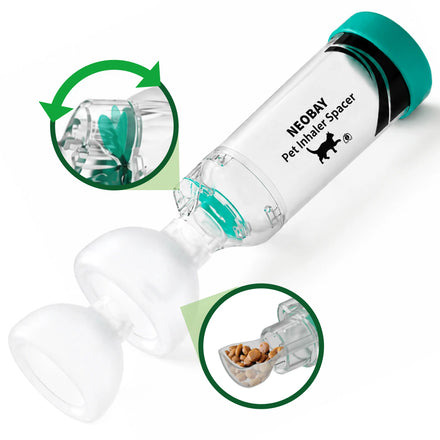
Neobay Cat Aerosol Chamber with Comfort Feeder — Green
- See each breath with the Breath Indicator
- Built-in treat holder makes mask practice easier
- Anti-static chamber helps keep medication airborne
A spacer with a visual flow indicator takes the guesswork out. You can actually see each breath your cat takes, which matters most for cats that hold their breath when they're nervous. If you've been guessing whether the dose went in, an indicator will tell you in five seconds.
For the training side—getting a nervous cat to actually accept the mask without a fight—our step-by-step inhaler training guide walks through a 7-day desensitization plan that works for most cats.
3. The dose is too low
Flovent comes in two strengths commonly used for cats: 110 mcg and 220 mcg (labeled 125 mcg and 250 mcg in some countries). Vets usually start cats on the lower dose and step up if needed. That's good medicine—start low, escalate only if necessary—but it also means a meaningful number of cats are under-dosed at the start.
If your cat has been on 110 mcg twice daily for two to three weeks and is still coughing, the next conversation with your vet should be about moving to 220 mcg twice daily. This is not a sign that the medication "doesn't work for your cat." It usually means the airway inflammation was more severe than the starting dose could handle. Once the dose matches the disease, most cats respond.
This is a dose conversation to have with your vet, not on your own. Doubling an inhaled steroid on your own initiative can cause side effects—most commonly increased thirst and urination, and over the long term, a real risk of triggering diabetes—that your vet will want to monitor.
4. The dosing schedule is inconsistent
Flovent only works if it's given every day, twice a day, roughly 12 hours apart. It is not a "when symptoms flare" medication. The anti-inflammatory effect is cumulative, and it drops off fast when doses are missed.
Real talk: cat owners are busy, and twice-daily inhaler administration is one of the hardest medication schedules to sustain. Veterinarians consistently report that owner adherence to twice-daily inhaled medication is the most common reason for poor control. People forget. Cats hide. Life happens.
If you've been giving Flovent once a day on weekdays and twice on weekends, that is the most likely explanation for a cat that "isn't responding." Set a phone alarm for the same two times every day. Track doses on a paper calendar stuck to the fridge. Build it into a routine you already do, like morning coffee and evening feeding. Consistency, not heroics, is what gets asthma under control.
5. Environmental triggers are overpowering the medication
Flovent reduces airway inflammation. But it can't keep up with a constant daily assault of new irritants. If your cat's airways are being re-inflamed faster than the steroid can quiet them, the medication will look like it's failing—when really, it's being asked to do an impossible job.
Common culprits vets see again and again:
- Cigarette or vape smoke anywhere in the home (even in another room)
- Scented candles, plug-in air fresheners, incense, essential oil diffusers
- Perfumed cleaning sprays, especially furniture polish and fabric refreshers
- Dusty clay litter—consider switching to an unscented paper, wood, or grass-seed litter
- Fireplace or wood-stove smoke in winter
- Renovation dust, paint fumes, new carpet off-gassing
Removing triggers doesn't replace Flovent. But if your cat has been on a correct dose for a month with no improvement, removing every fragrance and scented product from your home for 30 days is one of the highest-leverage things you can do. Our common asthma triggers guide goes deeper on which household products cause the most problems for asthmatic cats.
6. It might not actually be asthma
This is the one most owners don't want to hear, but it's more common than people think. Feline asthma is famously hard to diagnose definitively. According to the Veterinary Information Network (VIN), up to 23% of cats with confirmed asthma have completely normal chest X-rays—which means X-rays alone aren't enough to rule asthma in or out. The reverse is also true: X-rays that "look like asthma" can actually be caused by other conditions.
Conditions that frequently mimic asthma in cats include:
- Feline heart disease (hypertrophic cardiomyopathy, or HCM)—can cause coughing and breathing difficulty that sounds exactly like asthma
- Lungworms—often missed unless a fecal test specifically looks for them
- Chronic bronchitis—similar inflammation, different long-term management
- Bacterial or fungal respiratory infections
- Heartworm disease—even a single worm can cause asthma-like symptoms in cats
- A foreign body in the airway
If your cat "has asthma" but has never responded to steroids—even high-dose oral prednisolone—the diagnosis deserves a second look. This usually means working with your vet on additional diagnostics: an echocardiogram (heart ultrasound), fecal tests for lungworm, heartworm antigen testing, or in some cases a bronchoscopy. Our guide on how vets diagnose feline asthma walks through what each test actually tells your vet.
7. Your cat may need additional or different medication
Some cats need more than Flovent alone. This isn't a Flovent failure—it's just how feline asthma management works. Common adjustments vets make:
- Adding a bronchodilator (albuterol, also called salbutamol) as a rescue inhaler for acute coughing episodes
- A short course of oral prednisolone during the first 1–2 weeks while Flovent builds up in the lungs
- Adding theophylline or terbutaline for cats that need extra airway dilation around the clock
- Allergen-specific immunotherapy (allergy shots) if allergy testing identifies specific triggers
- Cyclosporine for severe cases, or for cats that can't tolerate corticosteroids (for example, cats with diabetes)
A common veterinary recommendation is to re-evaluate any asthmatic cat whose symptoms aren't controlled within 2 to 4 weeks of starting an appropriate-dose inhaled steroid. If you're past that window and your cat is still coughing, go back to your vet with a symptom log and ask about adding or adjusting medication.
Related reading: For the full dosing breakdown — Flovent 110 vs 220 mcg for cats covers when 110 mcg is enough, when 220 is needed, 2026 costs, and a tapering protocol.
Frequently Asked Questions
How long does Flovent take to work in cats?
Most cats show improvement within 7 to 14 days of consistent twice-daily use, with full effect at 3 to 4 weeks. If your cat is still coughing daily after 14 days on a correct dose with good technique, contact your vet to discuss a dose adjustment or fresh look at the diagnosis.
Can Flovent stop working after years of helping?
Yes. Some cats develop what vets call steroid resistance over time, especially after long-term high-dose use. If your cat was controlled for years and is now flaring again, the answer is usually adding a different medication class (like a bronchodilator or cyclosporine)—not just pushing the Flovent dose higher.
Should I give Flovent when my cat is actively coughing?
Flovent is a controller medication, not a rescue inhaler. It won't stop a cough that's already happening. For acute coughing or wheezing, your vet may prescribe a separate albuterol inhaler to use as needed. Flovent should be given on schedule every day, regardless of whether your cat coughed that day.
What's the difference between Flovent and albuterol for cats?
Flovent (fluticasone) is an inhaled corticosteroid that prevents inflammation over time—it's used twice daily long-term. Albuterol is a bronchodilator that opens airways within minutes—it's used as needed for coughing or wheezing episodes. Most asthmatic cats need both: Flovent daily, albuterol on standby for flares.
Can Flovent make my cat's breathing worse?
Not directly. But two things can look like that. First, if your cat gets highly stressed by the inhaler routine, the stress itself can trigger panting or coughing during administration. Second, if Flovent is being given without a rescue medication during a severe flare, the underlying inflammation can worsen while you wait for the Flovent to take effect. Talk to your vet if either sounds familiar.
When should I take my cat to the ER instead of waiting?
Go to an emergency vet immediately if your cat is breathing with an open mouth, breathing faster than 40 breaths per minute at rest, or has blue or gray gums or tongue. These are signs of a respiratory crisis, not something Flovent will fix in time.
What to Do Next
- Mark your calendar for the 14-day mark since your cat's first Flovent dose. Before that, lack of improvement is usually just timing.
- Audit your technique. Check for a sealed mask, 5–7 breaths per dose, and consistent twice-daily timing. Try a flow-indicator spacer if you're not sure your cat is inhaling the full dose.
- Strip your home of triggers for 30 days—fragrances, scented candles, dusty litter, smoke. This single change resolves a surprising number of "Flovent isn't working" cases.
- Call your vet if you're past 2–3 weeks with no improvement, or if your cat's coughing is getting worse. Bring a symptom log.
If you're ready to upgrade your cat's inhaler setup, the Neobay Cat Aerosol Chamber is built specifically for feline asthma, with a visual flow indicator so you can see every breath your cat takes. Have questions? Visit our FAQ page or contact us directly—we read every message.
Sources:
- Veterinary Information Network (VIN). "Asthma in Cats." Veterinary Partner, revised July 31, 2024.
- Cornell Feline Health Center. "Feline Asthma: What You Need to Know." Cornell University College of Veterinary Medicine. https://www.vet.cornell.edu/departments-centers-and-institutes/cornell-feline-health-center/health-information/feline-health-topics/feline-asthma-what-you-need-know
- Trzil JE. "Feline asthma: diagnostic and treatment update." Veterinary Clinics of North America: Small Animal Practice, 2020; 50(2): 375-391.
- Trzil JE. "Feline asthma: diagnostic and treatment update." Veterinary Clinics of North America: Small Animal Practice, 2020; 50(2): 375-391.
- VCA Animal Hospitals. "Treatment Instructions for Asthma and Bronchitis in Cats."
- Cat Sleeping Respiratory Rate: The 2025 Veterinary Benchmark
Related Reading
This article is part of our Feline Asthma: The Complete Owner's Guide — covering everything from causes and symptoms to treatment and daily management.


