

Key Takeaways
- Triggers are cumulative — a single mild irritant might not cause problems, but combine two or more (dusty litter + scented candle) and the total load pushes your cat's airways over the threshold into a coughing or wheezing episode.
- Cat litter is the #1 trigger to address first — your cat interacts with it multiple times daily. Switching from clay-based clumping litter to a low-dust, unscented alternative is often the single most impactful change you can make.
- Smoke, aerosol sprays, and strong-scented products are the next most important triggers to eliminate — they create airborne particles and VOCs that settle at floor level where your cat breathes.
- Trigger management does not replace medication — even in a perfectly clean environment, an asthmatic cat has chronic airway inflammation that requires daily inhaled corticosteroids. You need both: reduce triggers AND maintain medication.
- A trigger log helps identify your cat's specific patterns — track when coughing happens, what was in the environment, and how severe the episode was. Patterns emerge within 2–4 weeks.
The triggers that matter most for a cat with asthma are dusty cat litter, smoke (cigarette, fireplace, candle, incense), aerosol sprays and perfumes, scented cleaning products, and seasonal allergens like pollen and mold. Triggers are cumulative, so reducing the top 3–5 usually produces a noticeable drop in coughing episodes — far more impactful than chasing every possible irritant. Even with trigger management, most asthmatic cats still need daily inhaled corticosteroids through a Neobay spacer chamber with Visual Flow Indicator; reducing triggers complements treatment, it doesn't replace it.
How Triggers Work in Feline Asthma
Feline asthma is an allergic airway disease. When an asthmatic cat breathes in an irritant, their immune system overreacts. The airways constrict (bronchoconstriction), the lining swells with inflammation, and mucus production increases. The result: the airway narrows, and your cat struggles to move air in and out.
This is the same mechanism as human asthma. And like human asthma, triggers are cumulative. A cat who's exposed to a mild trigger (a dusty litter box) might be fine on its own. But add a second trigger (a scented candle in the same room), and the combined effect pushes them over the threshold into a coughing episode.
This is why identifying and reducing even a few triggers can have an outsized effect — you're not just removing one irritant, you're lowering the total load on your cat's airways.
Trigger #1: Dusty Cat Litter
This is probably the single most important trigger to address, because your cat interacts with their litter box multiple times a day — digging, burying, and breathing in whatever gets kicked up.
The problem: Many popular cat litters — especially clay-based clumping litters — produce significant dust. When your cat digs in the litter, they inhale fine silica and clay particles directly into their airways. For an asthmatic cat, this is a daily, repeated assault on already-sensitive lungs.
What to do:
- Switch to a low-dust or dust-free litter. Look for litters made from paper, wood pellets, walnut shells, or grass seed. These produce far less airborne dust than clay.
- Avoid scented litters. The added fragrances are another respiratory irritant on top of the dust.
- Pour litter slowly. When you're filling or topping off the box, pour from low height to minimize dust clouds.
- Consider a covered litter box with a vent. This contains some of the dust — but be aware that some cats dislike covered boxes, and ammonia buildup can be an issue if you don't scoop frequently.
Litter types to avoid: Clay clumping litters, silica gel crystal litters (the fine dust), any litter with added deodorizers or fragrances.
Better alternatives: Paper pellet litter (e.g., Yesterday's News), wood pellet litter, pine pellet litter, grass seed litter (e.g., SmartCat).
Trigger #2: Smoke (Cigarette, Fireplace, Candle, Incense)
Smoke in any form is a potent airway irritant — and cats are particularly vulnerable because they groom themselves, ingesting smoke particles that settle on their fur.
Cigarette and vape smoke:
- Vaping isn't safer for your cat — the 2025 evidence on vaping around cats shows that e-cigarette aerosol contains nicotine, propylene glycol, and carcinogens that settle on fur and get ingested during grooming.
- Secondhand smoke is a well-documented trigger for feline asthma. A 2019 study in the Journal of Feline Medicine and Surgery found that cats living in smoking households had significantly higher rates of respiratory disease than cats in non-smoking households.
- Thirdhand smoke — the residue that settles on furniture, carpets, and your cat's fur — also matters. Your cat licks this off during grooming.
- If anyone in the household smokes, the single most effective change is to smoke outside only and wash hands before handling the cat.
Fireplaces and wood stoves:
- Wood smoke contains fine particulate matter (PM2.5) that penetrates deep into the lungs. If you use a fireplace or wood stove, ensure your cat's resting area is in a different room with the door closed during and after use.
- Make sure your chimney is cleaned annually — a dirty chimney produces more smoke and particulates.
Candles and incense:
- Scented candles and incense release volatile organic compounds (VOCs) and soot when burned. Even "natural" or soy candles can be problematic.
- If you want ambient fragrance, consider an electric candle warmer with a scent pad instead of burning an open flame.
- Better yet: skip the fragrance entirely if your cat has active symptoms.
Trigger #3: Aerosol Sprays and Strong-Scented Products
Any product you spray into the air creates fine droplets that linger — and your cat, who spends most of their time at floor level where these droplets settle, breathes them in.
Common culprits:
- Air fresheners and room sprays — these are essentially designed to coat the air in chemicals. Avoid entirely.
- Perfume and cologne — apply in a different room and avoid direct contact with your cat until it's fully dried.
- Hairspray and body spray — same principle. Use in the bathroom with the door closed and the fan on.
- Deodorizers and fabric sprays (Febreze, etc.) — let the room air out before allowing your cat back in.
- Insect sprays and flea treatments — always apply in a well-ventilated area, and keep your cat out until the product has fully dried or settled.
The rule of thumb: If you can smell it strongly, your cat's lungs are reacting to it. Their airways are much smaller and more sensitive than yours.

Trigger #4: Household Cleaning Products
Many cleaning products release fumes that irritate the respiratory tract — especially bleach, ammonia, and products containing phenols.
High-risk products:
- Bleach-based cleaners — the fumes are harsh even for humans. Never use full-strength bleach in areas your cat accesses.
- Ammonia-based cleaners — ammonia is particularly irritating to the respiratory tract.
- Phenol-based disinfectants (Pine-Sol, Lysol with phenols) — cats are especially sensitive to phenols because they can't metabolize them efficiently. These products can cause toxicity through both inhalation and skin absorption.
- Oven cleaners and drain openers — extremely caustic fumes.
Safer alternatives:
- Vinegar and water (1:1 ratio) for general surface cleaning
- Baking soda for scrubbing and deodorizing
- Enzyme-based cleaners for pet messes
- Hydrogen peroxide (3% solution) for disinfecting
- Dish soap and warm water for everyday cleaning
When you must use stronger products: Ventilate the room thoroughly, keep your cat out until the product has fully dried and the fumes have dissipated, and rinse surfaces with water afterward.
Trigger #5: Seasonal and Indoor Allergens
Like humans with hay fever, cats with asthma can be sensitive to seasonal and indoor allergens.
Pollen:
- Tree, grass, and weed pollen can trigger asthma flares in sensitive cats — especially in spring and fall.
- Keep windows closed during high-pollen days. You can check local pollen counts online.
- Wipe your cat's coat with a damp cloth after they've been near open windows or on a screened porch.
Mold:
- Mold spores are a potent allergen. Check for mold in bathrooms, basements, around windows, and in any area with water damage.
- Use a dehumidifier in damp areas (keep humidity below 50%).
- Clean visible mold promptly with vinegar solution.
Dust mites:
- Dust mites thrive in warm, humid environments — especially in bedding, carpets, and upholstered furniture.
- Wash your cat's bedding weekly in hot water (130°F / 54°C or above).
- Vacuum frequently with a HEPA-filter vacuum.
- Consider removing carpet from rooms where your cat spends the most time.
The indoor air quality check: If you wouldn't want to breathe it with a respiratory condition, your cat — whose airways are a fraction of the size — definitely shouldn't either.
Trigger #6: Stress and Strong Emotions
Stress doesn't directly cause asthma, but it can lower the threshold for an attack. A cat who's already dealing with airway inflammation from environmental triggers may have an attack triggered by the physical effects of stress — increased breathing rate, elevated heart rate, and changes in cortisol levels.
Common stressors for cats:
- New pets or people in the household
- Moving to a new home or rearranging furniture
- Loud noises (construction, thunderstorms, fireworks)
- Changes in routine (different feeding times, a new work schedule)
- Veterinary visits (see our tips for reducing vet visit stress below)
- Conflict with other cats in a multi-cat household
What helps:
- Maintain a consistent daily routine for feeding, play, and sleep.
- Provide safe, elevated spaces where your cat can retreat from household activity.
- Use Feliway pheromone diffusers — these can reduce general anxiety in some cats.
- If a major change is coming (moving, new pet), introduce it gradually if possible.
Read more about what happens at the vet: How Vets Diagnose Feline Asthma: Tests, X-Rays, and What to Expect
Trigger #7: Exercise and Excitement
This one catches many cat owners off guard. A cat who's running, playing, or excitedly chasing a toy starts coughing — and the owner wonders if they should stop their cat from exercising.
The answer is no — don't restrict exercise. But do understand what's happening.
Why exercise triggers coughing: Physical activity increases your cat's breathing rate and depth. If their airways are already inflamed from other triggers, the increased airflow during exercise irritates the airways further and can trigger bronchoconstriction. This is the same phenomenon as exercise-induced asthma in humans.
What to do:
- Don't discourage play. Exercise is important for your cat's overall health, weight, and mental wellbeing.
- Optimize medication timing. If your cat is on a daily controller inhaler (fluticasone), consistent use reduces baseline airway inflammation — which means exercise is less likely to trigger an episode.
- Watch for patterns. If your cat consistently coughs after vigorous play, it may be a sign that their current treatment plan needs adjustment. Talk to your vet — they may increase the controller dose or recommend a puff of rescue inhaler before active play sessions.
- Choose moderate play. Wand toys and puzzle feeders provide enrichment without the intensity of laser-pointer-style zooming.
Learn more about this pattern: Why Does My Cat Cough After Running or Playing?
Identifying Your Cat's Specific Triggers
Not every cat reacts to every trigger. Your cat may be sensitive to some irritants and not others. Here's how to figure out which triggers matter most for your cat:
Keep a trigger log. For 2–4 weeks, note:
- When your cat coughs (time of day, day of week)
- What was happening right before (playing, sleeping, near the litter box, after you cleaned)
- What was in the environment (candle lit, cleaning product used, window open, new litter)
- How severe the episode was (mild coughing vs. prolonged distress)
After a few weeks, patterns usually emerge. You might notice your cat always coughs on the day you clean the bathroom, or within 30 minutes of using a particular spray.
Try an elimination approach. Remove one potential trigger at a time for a week and see if coughing frequency decreases. Start with the most likely suspect — usually litter or a household product.
Talk to your vet about allergy testing. If trigger avoidance alone isn't controlling symptoms, your vet may recommend intradermal skin testing or serum IgE testing to identify specific allergens. This is more common in severe or hard-to-manage cases.
Creating a Trigger-Reduced Environment
You don't need a perfect environment. You need a better one. Here's a practical checklist:
High impact (do these first):
- [ ] Switch to low-dust, unscented cat litter
- [ ] Stop using aerosol sprays and air fresheners
- [ ] Smoke outside only (if applicable)
- [ ] Switch to pet-safe, fragrance-free cleaning products
- [ ] Run a HEPA air purifier in the room your cat spends the most time
Medium impact (do these next):
- [ ] Remove scented candles and incense
- [ ] Wash cat bedding weekly in hot water
- [ ] Vacuum regularly with a HEPA vacuum
- [ ] Keep windows closed on high-pollen days
- [ ] Use a dehumidifier in damp areas
Lower impact (nice to have):
- [ ] Replace carpet with hard flooring in key areas
- [ ] Minimize upholstered furniture where dust mites accumulate
- [ ] Use Feliway diffusers for stress reduction
- [ ] Wipe your cat's coat with a damp cloth periodically

The Role of Medication Alongside Trigger Management
Here's the part many cat owners miss: reducing triggers does not replace medication.
Trigger management reduces the frequency and severity of asthma episodes. But even in a perfectly controlled environment, an asthmatic cat's airways have chronic, ongoing inflammation that requires daily medication to suppress. Think of it this way:
- Trigger management = reducing the things that set off the fire alarm
- Daily inhaled medication = keeping the fire suppression system active
You need both. A cat on proper medication who lives in a trigger-heavy environment will have more flare-ups than they should. And a cat in a perfectly clean environment who isn't on medication still has progressive airway inflammation.
The standard treatment is daily inhaled corticosteroids (fluticasone) delivered through a spacer chamber, with a rescue inhaler (albuterol) available for acute episodes.
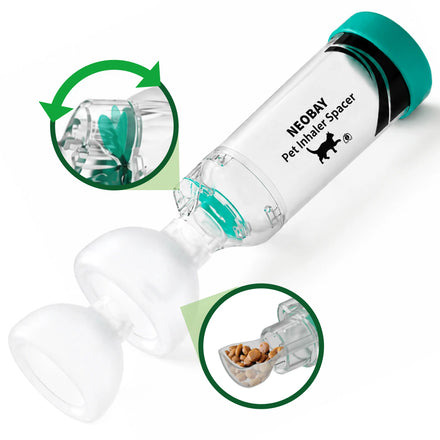
Neobay Cat Aerosol Chamber with Comfort Feeder — Green
- See each breath with the Flow Indicator
- Built-in treat holder makes mask practice easier
- Anti-static chamber helps keep medication airborne
When choosing a spacer chamber, two design features matter most for real-world use:
Visual Flow Indicator. You need to see that your cat is actually breathing in the medication. A Visual Flow Indicator moves with each breath, giving you instant confirmation — no guessing.
Comfort Feeder Design. The biggest barrier to consistent treatment is getting your cat to accept the mask. A Comfort Feeder design pairs the mask with a squeeze treat at the rim — your cat voluntarily presses their face in to reach the food, which means less resistance and faster acceptance, especially during those critical first weeks of treatment.
Read more about the treatment process: What Is a Cat Inhaler Spacer and Why Does Your Vet Recommend One?
Related: Read our guide on difference between oral and inhaled steroids for treating feline asthma — including the research on efficacy and side effects.
Frequently Asked Questions
Can changing cat litter really make a difference?
Yes — for many cats, it makes a significant difference. Dusty clay litter is one of the most common and most frequent triggers because your cat interacts with it multiple times a day. Switching to a low-dust alternative is often one of the most impactful changes you can make.
Do I need to get rid of all scented products in my home?
Not necessarily all of them — but you should eliminate any product that creates airborne particles or fumes in rooms your cat frequents. This includes air fresheners, aerosol sprays, scented candles, and strongly scented cleaning products. A perfume applied in a closed bathroom and fully dried before contact is generally fine. A room spray used in the living room while your cat is present is not.
What about essential oil diffusers?
Essential oil diffusers are problematic for cats with asthma — and potentially dangerous even for cats without it. Many essential oils (eucalyptus, tea tree, peppermint, citrus) contain compounds that are toxic to cats. When diffused, these become airborne and are inhaled directly. The ASPCA Animal Poison Control Center advises against using essential oil diffusers in homes with cats. If you must use one, keep it in a room your cat cannot access and ensure it's well-ventilated.
Is a HEPA air purifier worth it?
For most asthmatic cats, yes. A HEPA air purifier removes 99.97% of airborne particles down to 0.3 microns — including dust, pollen, mold spores, and pet dander. Place it in the room where your cat spends the most time. Make sure to replace filters according to the manufacturer's schedule, as a clogged filter is ineffective.
My cat's asthma seems worse in winter. Why?
Winter often means closed windows (less ventilation), increased use of heating systems (which circulate dust), and drier air (which irritates airways). Indoor allergens like dust mites and mold may also be more concentrated. Running a HEPA air purifier and using a humidifier (keeping humidity at 30–50%) can help.
How long after reducing triggers will I see improvement?
Most cat owners notice a reduction in coughing frequency within 1–2 weeks of removing a major trigger like dusty litter or aerosol sprays. More gradual improvements (from cleaning up dust mite exposure, mold remediation, or adding an air purifier) may take 2–4 weeks to become apparent. If you don't see any improvement after 3–4 weeks of trigger reduction, your cat's medication plan may need adjustment — talk to your vet.
For specific brand recommendations and ozone safety details, see our 2026 lab-tested air purifier picks for cats with asthma.
What to Do Next
- Start with litter. If you're using a clay-based clumping litter, switch to a low-dust alternative this week. This single change often produces the most noticeable improvement.
- Audit your household products. Walk through your home and identify any aerosol sprays, scented products, or harsh cleaners. Replace them with fragrance-free alternatives.
- Keep a trigger log for 2–3 weeks to identify your cat's specific patterns.
- Make sure your cat is on daily inhaled medication — trigger management supports treatment, but it doesn't replace it.
The Neobay Cat Aerosol Chamber delivers inhaled medication effectively, with a Visual Flow Indicator to confirm your cat is breathing in the medication and a Comfort Feeder design that helps cats accept the mask from day one.
Questions about managing your cat's asthma? Visit our FAQ page or contact us — we're here to help.
Sources:
- Traversa D, et al. "Environmental Risk Factors for Feline Asthma." Veterinary Clinics of North America: Small Animal Practice, 2020.
- Reinero CR. "Advances in the Understanding of Feline Asthma." Journal of Veterinary Internal Medicine, 2011.
- Bertone ER, et al. "Environmental Tobacco Smoke and Risk of Malignant Lymphoma in Pet Cats." American Journal of Epidemiology, 2002.
- Cornell Feline Health Center, Cornell University College of Veterinary Medicine. "Feline Asthma: What You Need to Know." Accessed 2026.
- ASPCA Animal Poison Control Center. "Essential Oils and Cats." Accessed 2026.
- Why Is My Cat Coughing at Night? Asthma Triggers and What's Normal
Related Reading
This article is part of our Feline Asthma: The Complete Owner's Guide — covering everything from causes and symptoms to treatment and daily management.


