

Key Takeaways
- Oral steroids like prednisolone work fast and effectively for feline asthma — but long-term use carries significant risks including diabetes, Cushing's syndrome, and increased infections. The research is clear: they control symptoms, but at a cost that compounds over time.
- Inhaled steroids (fluticasone/Flovent) deliver medication directly to the lungs — providing the same anti-inflammatory benefit with minimal systemic absorption. Three clinical studies have directly compared the two, and inhaled therapy consistently shows equal efficacy with dramatically fewer side effects.
- The most serious long-term risk is steroid-induced diabetes — cats on chronic oral or injectable steroids can develop insulin resistance that may become permanent. Overweight, older, and male cats are at highest risk.
- You cannot stop oral steroids abruptly — the adrenal glands shut down their own cortisol production during long-term steroid treatment. Stopping cold turkey can trigger a life-threatening adrenal crisis. Tapering must be done gradually, under veterinary supervision.
- The transition from oral to inhaled steroids follows a proven protocol — start the inhaler while still on pills, wait 2-4 weeks for the inhaled medication to reach full effect, then taper the oral dose slowly. Most cats can eventually be maintained on inhaled therapy alone.
Your vet prescribed prednisolone for your cat's asthma. The coughing stopped within days. Your cat is breathing easier, eating well, acting like herself again.
Then you search "cat steroids long term side effects" at 2am, and what comes back scares you. Diabetes. Cushing's disease. Immune system shutdown. These are real risks. They're not rare. And cat owners in forums talk about them constantly — the cat who gained three pounds in a month, the cat who suddenly couldn't control his blood sugar, the cat who got a UTI that turned septic because the steroids masked the fever.
But here's what those scary search results often miss: there is an alternative that's been studied in clinical trials, used in veterinary medicine for decades, and recommended by every feline respiratory specialist. It delivers the same medication class — corticosteroids — directly to the lungs where the inflammation actually is, instead of flooding the entire body.
This article covers exactly what oral steroids do to a cat's body over time, what the research says about how inhaled steroids compare, and how to make the transition safely if it's right for your cat.
What Are Corticosteroids and Why Are They Prescribed?
Corticosteroids are not the same thing as anabolic steroids. This is the first thing to clear up, because the word "steroid" carries a lot of baggage.
Corticosteroids are synthetic versions of cortisol — the hormone your cat's adrenal glands produce naturally. Cortisol is the body's master anti-inflammatory. When the immune system overreacts to an allergen or irritant, cortisol tells it to calm down.
In feline asthma, the immune system is overreacting to inhaled irritants — dust, pollen, litter dust, smoke. This overreaction causes the bronchial walls to swell, thicken, and constrict. The cat coughs. In severe cases, the airways close enough to cause a life-threatening attack.
Corticosteroids shut down that inflammatory response. They don't cure the asthma — nothing cures it — but they suppress the inflammation that drives the symptoms. For many cats, this is the difference between constant coughing and a normal life.
The Three Forms of Steroids Used in Cats
Oral prednisolone. The most commonly prescribed. Cats convert prednisone (the inactive form) to prednisolone poorly, so veterinarians prescribe prednisolone directly. It comes in tablets, a liquid suspension, or compounded flavored chews. Typically started at 1-2 mg/kg daily during an acute flare, then tapered to the lowest effective dose — often every other day.
Injectable steroids. Long-acting injections like methylprednisolone acetate (Depo-Medrol) release steroids slowly over weeks. They're convenient — one shot and the owner doesn't need to pill a cat. But they're also the riskiest form, because once injected, the dose can't be adjusted or removed if problems develop. The association with diabetes and congestive heart failure is strongest with injectable steroids. Most feline specialists strongly prefer oral over injectable for chronic management.
Inhaled steroids. Fluticasone propionate (Flovent) delivered through an aerosol chamber and mask. The medication goes directly to the bronchial surfaces — exactly where the inflammation is — rather than circulating through the entire bloodstream. This changes the risk profile dramatically. More on this below.

What the Research Actually Says: Oral vs. Inhaled Steroids
Three clinical studies have directly compared oral and inhaled corticosteroids for feline asthma. Here's what they found.
Study 1: Verschoor-Kirss et al. (2021) — Naturally Asthmatic Cats
This is the only study that used cats with naturally occurring asthma rather than laboratory-induced disease. Nine cats were randomized to either oral prednisolone (5 mg twice daily, then tapered) or inhaled fluticasone (110 µg twice daily via AeroKat).
Results at 8 weeks: - Clinical signs resolved in both groups - Airway eosinophils (the inflammatory cells driving asthma) decreased significantly in all cats - 75% of oral-therapy cats reached the therapeutic target for eosinophil reduction vs. 40% of inhaled-therapy cats - Oral prednisolone improved airway resistance more than inhaled fluticasone - Fructosamine levels (a marker for diabetic risk) did not change in the inhaled group
The inhaled therapy was slightly less potent at reducing inflammation, but it avoided the metabolic side effects entirely. The researchers noted that the inhaled dose used (110 µg BID) was potentially suboptimal — higher doses may close the efficacy gap.
Study 2: Leemans et al. (2012) — Experimentally Induced Asthma
Six cats with induced asthma received four different 4-day treatments in a crossover design: oral prednisolone, inhaled fluticasone alone, inhaled fluticasone combined with salmeterol (a bronchodilator), and no treatment.
Results: - All three steroid treatments reduced airway hyperresponsiveness - Oral prednisolone produced a statistically significant reduction in airway eosinophils - Inhaled fluticasone alone reduced eosinophils, but the reduction was not statistically significant - The combination inhaler (fluticasone + salmeterol) was as effective as oral prednisolone
This study suggests that adding a bronchodilator to inhaled steroids bridges the efficacy gap. In clinical practice, this translates to using Flovent (fluticasone) as the daily controller and Albuterol as a rescue inhaler for breakthrough symptoms.
Study 3: Reinero et al. (2005) — Bermuda Grass Allergen Model
Six cats sensitized to Bermuda grass allergen received oral prednisone, inhaled flunisolide, or placebo in a crossover design.
Results: - Both oral and inhaled steroids significantly reduced airway eosinophils compared to placebo - Neither treatment consistently normalized airway resistance in all cats - No significant difference between oral and inhaled for airway hyperresponsiveness
What the Evidence Tells Us (and What It Doesn't)
A 2022 systematic review in Veterinary Evidence rated the overall strength of evidence as "weak" — the studies were small (6-9 cats each), short (4 days to 8 weeks), and only one used naturally asthmatic cats. A definitive head-to-head trial with adequate statistical power does not exist.
But the pattern across all three studies is consistent: inhaled steroids work. They reduce airway inflammation. They resolve clinical signs. They may be slightly less potent than oral prednisolone at equivalent doses, but this can be compensated for with higher inhaled doses or the addition of a bronchodilator. And they do all of this without the systemic side effect burden that makes long-term oral steroids so concerning.
For veterinarians and owners weighing the tradeoffs, the clinical consensus is clear: inhaled steroids are the preferred long-term maintenance therapy for feline asthma, with oral steroids reserved for acute flares, severe cases that don't respond adequately to inhalers alone, or cats who cannot tolerate the mask and spacer.
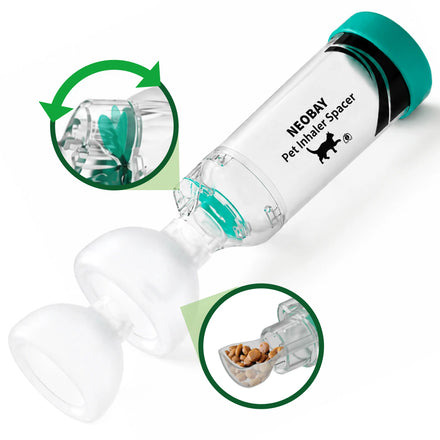
Neobay Cat Aerosol Chamber with Comfort Feeder — Green
- See each breath with the Flow Indicator
- Built-in treat holder makes mask practice easier
- Anti-static chamber helps keep medication airborne
The Real Risk: Long-Term Side Effects of Oral and Injectable Steroids
This is what keeps cat owners up at night. The side effect list for chronic corticosteroids is long, and the risks are not theoretical.
Steroid-Induced Diabetes Mellitus
The number one concern. Corticosteroids cause insulin resistance — the body's cells stop responding to insulin properly, and blood sugar rises. Cats are particularly susceptible because their glucose metabolism is already similar to a pre-diabetic state compared to other species.
Risk factors: obesity, older age, male sex, high doses, long-acting injectable formulations. Some cats develop transient diabetes that reverses when steroids are tapered off. Others develop permanent diabetes requiring lifelong insulin therapy. There is no way to predict which cat will fall into which category.
What owners report: increased thirst, increased urination, ravenous appetite combined with weight loss. These are the classic diabetes signs and they warrant immediate blood work.
Iatrogenic Cushing's Syndrome
Chronic high-dose steroids mimic Cushing's disease — a condition of cortisol excess. The signs develop gradually:
- Pot-bellied appearance despite muscle wasting elsewhere
- Thin, fragile skin that tears easily — even a routine blood draw can cause a skin tear
- Hair loss, poor coat quality, slow hair regrowth after shaving
- Enlarged liver (hepatomegaly)
- Increased susceptibility to skin infections
Cushing's changes are partially reversible if steroids are reduced, but severe skin thinning can be permanent.
Immunosuppression and Hidden Infections
Steroids suppress the immune response. This is actually part of how they work for asthma — the immune system is overreacting, and steroids dial it down. But the suppression isn't targeted. It's systemic.
One study found that up to 68% of animals on long-term steroids had urinary tract infections — with no visible symptoms. The steroids masked the fever and inflammation that would normally signal an infection. These silent UTIs can ascend to the kidneys and cause permanent damage.
Cats on long-term steroids are also at higher risk for: - Upper respiratory infections and herpesvirus reactivation - Delayed wound healing after even minor injuries - Fungal infections that a healthy immune system would clear easily
Congestive Heart Failure
This risk is specifically associated with long-acting injectable steroids like Depo-Medrol. The mechanism involves sodium and fluid retention, which can push a cat with borderline heart function into overt failure. Respiratory distress from heart failure looks similar to an asthma attack, which creates a dangerous diagnostic trap — owners and vets may assume "asthma flare" and give more steroids, when the real problem is a failing heart.
Adrenal Suppression and Withdrawal Crisis
This is non-negotiable: never stop oral steroids abruptly.
When a cat takes corticosteroids for more than a few weeks, the adrenal glands stop producing their own cortisol. The glands actually atrophy. If you stop the medication suddenly, the cat has zero cortisol — and cortisol is essential for basic physiological functions including blood pressure regulation and glucose metabolism.
An adrenal crisis looks like: sudden collapse, vomiting, weakness, low body temperature, and potentially death. It requires emergency hospitalization with IV fluids and injectable steroids.
The only safe way off long-term steroids is a gradual taper — reducing the dose by small increments over weeks to months, giving the adrenal glands time to wake up and resume cortisol production. Your vet should give you an exact tapering schedule. Do not deviate from it.

Transitioning from Oral to Inhaled Steroids: The Safe Protocol
This is the path most asthmatic cats eventually follow, and there's a standardized way to do it.
Phase 1: Start the Inhaler While Staying on Pills (Weeks 1-4)
Your cat needs to learn to accept the mask and spacer, and the inhaled medication needs time to build up therapeutic levels in the airway tissues. During this period, you continue the oral prednisolone at the current dose and add the inhaled fluticasone — typically 110-220 µg twice daily depending on severity.
This is also the training phase. If your cat isn't accustomed to the mask and spacer, start with short sessions: mask on face for 3-5 seconds, treat, release. Build up gradually to the full 7-10 breaths needed for a complete dose. Read our step-by-step inhaler training guide for the full protocol.
Phase 2: First Dose Reduction (Weeks 4-6)
If the cat is clinically stable — no coughing, normal breathing, normal activity — your vet will reduce the oral prednisolone dose. A typical taper might cut the daily dose by 25-50%.
Monitor closely during this phase. Any return of coughing, wheezing, or increased respiratory rate means the taper was too fast. Go back to the previous dose and wait another 2 weeks before trying again.
Phase 3: Continue Tapering (Weeks 6-12)
Continue reducing the oral dose in small increments, usually every 2-4 weeks, as long as the cat remains stable. The goal is to reach the lowest possible oral dose — ideally zero — while maintaining asthma control with the inhaled medication alone.
Some cats will always need a small maintenance dose of oral prednisolone, especially during allergy season or stressful periods. This is not a failure. A cat on 1 mg of prednisolone every other day plus inhaled steroids is still far better off than a cat on 5 mg daily with no inhaler.
Phase 4: Maintenance (Ongoing)
Once the cat is stable on the minimum effective dose, the maintenance phase is about consistency. Give the inhaled medication at the same time every day. Keep a rescue inhaler (Albuterol) on hand for breakthrough attacks. See your vet every 6-12 months for monitoring, including blood work to check organ function and glucose levels.
What If the Transition Doesn't Work?
About 10-20% of asthmatic cats cannot be fully transitioned off oral steroids. Reasons include: - Severe disease that inhaled medication alone can't control - Inability to tolerate the mask and spacer despite training - Owner schedule that can't accommodate twice-daily inhaler sessions
These cats can still benefit from a reduced oral dose combined with inhaled therapy. Even cutting the oral dose in half significantly reduces long-term risks.

Frequently Asked Questions
What are the side effects of prednisolone in cats?
Short-term: increased thirst and urination, increased appetite, possible GI upset or behavior changes. Long-term (months to years): diabetes mellitus, Cushing's syndrome (pot belly, thin skin, hair loss), immunosuppression with hidden infections, weight gain, and risk of adrenal crisis if stopped abruptly. The risks are dose-dependent and cumulative — higher doses and longer duration both increase risk.
Can cats be on steroids long term?
Yes, but with significant monitoring requirements and an understanding of the cumulative risks. Long-term oral steroid use requires blood work every 6-12 months, including a chemistry panel and urinalysis with culture. If a cat must be on long-term steroids, the goal should be the lowest effective dose, ideally every-other-day dosing to allow adrenal recovery between doses.
What is the alternative to steroids for cats with asthma?
Inhaled corticosteroids (fluticasone/Flovent) delivered through an aerosol chamber like the Neobay Cat Aerosol Chamber. The medication goes directly to the lungs with minimal systemic absorption. Three clinical studies confirm it's effective at controlling airway inflammation. Cost is higher than generic oral prednisolone but lower than the cost of treating steroid-induced diabetes.
How do inhaled steroids work for cats?
Fluticasone propionate is aerosolized by an inhaler canister, sprayed into a spacer chamber, then inhaled by the cat through a face mask. The spacer holds the medication in suspension so the cat can breathe it in over 7-10 normal breaths. The drug deposits on the bronchial surfaces and suppresses local inflammation. Very little reaches the bloodstream — this is why inhaled steroids avoid the systemic side effects of oral prednisolone.
How long does it take to transition a cat from oral to inhaled steroids?
Most cats transition over 6-12 weeks. The process involves starting the inhaler while on pills, waiting for the inhaled medication to build up (2-4 weeks), then gradually tapering the oral dose. Some cats may need a small maintenance dose of oral prednisolone long-term, especially during allergy season.
What's wrong with steroid injections for cat asthma?
Long-acting injectable steroids (Depo-Medrol) are convenient but carry the highest risk profile. Once injected, the dose cannot be removed or adjusted if problems develop. They are more strongly associated with diabetes and congestive heart failure than oral or inhaled steroids. Most feline respiratory specialists recommend avoiding them for chronic management and reserving them for emergencies where oral medication isn't possible.
How much does inhaled asthma treatment cost for cats?
Generic fluticasone (Flovent equivalent) costs approximately $50-80 per month for the most common dose (110 µg twice daily). A cat aerosol chamber is a one-time purchase of $40-60. International pharmacies may offer lower prices. While this is more expensive than generic prednisolone tablets ($10-20/month), it avoids the downstream costs of treating steroid-induced complications — diabetes management alone can cost $100-200/month for insulin, syringes, and monitoring.
Does my cat really need steroids or is there a natural alternative?
For moderate to severe feline asthma, there is no natural alternative that has been shown in clinical research to control airway inflammation. Some supplements (omega-3 fatty acids, L-lysine for herpesvirus-related inflammation) may provide supportive benefit, but they do not replace corticosteroids. Untreated asthma causes progressive airway remodeling — permanent damage that makes future attacks more severe. Read our article on natural remedies for cat asthma for a detailed evidence review.
What to Do Next
-
If your cat is on long-term oral or injectable steroids, ask your vet about inhaled alternatives at the next visit. Bring this article. The research is there — inhaled therapy is the standard of care for chronic feline asthma management.
-
If you're considering transitioning, schedule a vet appointment specifically to discuss a tapering protocol. Don't attempt to reduce or stop steroids on your own — the adrenal crisis risk is real and potentially fatal.
-
Monitor your cat on steroids for warning signs: increased thirst and urination (diabetes), a pot-bellied appearance with thinning skin (Cushing's), recurring infections, or wounds that won't heal. Catch these early and you may be able to reverse them by adjusting the steroid dose.
-
Count the real cost. Oral prednisolone is $10-20 a month. Inhaled fluticasone is $50-80 a month. Treating steroid-induced diabetes costs $100-200 a month — plus the daily insulin injections, the vet visits, and the reduced life expectancy. The math isn't complicated.
-
If your cat has never been diagnosed but is coughing regularly, don't self-diagnose. Read our guide on how vets diagnose feline asthma and schedule an appointment. Asthma caught early responds better to treatment than asthma that's been silently progressing for years.
Steroids save lives. They also demand respect. Use them when you need them, but don't let "temporary" become "permanent" without understanding what you're signing up for. For most cats with asthma, there's a better way.
Sources: - Verschoor-Kirss M, Rozanski EA, Sharp CR, et al. "Treatment of naturally occurring asthma with inhaled fluticasone or oral prednisolone: A randomized pilot trial." Canadian Journal of Veterinary Research, 2021; 85(1): 61-67. - Leemans J, Kirschvink N, Clercx C, et al. "Effect of short-term oral and inhaled corticosteroids on airway inflammation and responsiveness in a feline acute asthma model." The Veterinary Journal, 2012; 192(1): 41-48. - Reinero CR, Decile KC, Byerly JR, et al. "Effects of drug treatment on inflammation and hyperreactivity of airways and on immune variables in cats with experimentally induced asthma." American Journal of Veterinary Research, 2005; 66(7): 1121-1127. - Williams SC. "Do inhaled or oral glucocorticoids more effectively control feline asthma?" Veterinary Evidence, 2022; 7(4). - Trzil JE. "Feline Asthma: Diagnostic and Treatment Update." Veterinary Clinics of North America: Small Animal Practice, 2020; 50(2): 375-391. - Cornell Feline Health Center, Cornell University College of Veterinary Medicine. "Feline Asthma and Other Respiratory Conditions." Accessed 2026. - Plumb DC. Plumb's Veterinary Drug Handbook, 10th ed. Wiley-Blackwell, 2023.
Related Reading
This article is part of our Feline Asthma: The Complete Owner's Guide — covering everything from causes and symptoms to treatment and daily management.


