

Key Takeaways
- Most "natural remedies" for cat asthma have zero evidence — and some, like essential oils, are actively toxic to cats. Tea tree, eucalyptus, peppermint, and lavender can cause liver failure or trigger asthma attacks.
- Omega-3 fatty acids from fish oil have the strongest evidence as a natural anti-inflammatory for feline asthma. Pet-specific formulations, vet-dosed.
- A 2026 gut-lung axis study of 117 cats found a 76.47% treatment success rate in the obstructive (asthma-pattern) group on tailored probiotic and nutraceutical protocols — the most exciting development in natural feline asthma care that almost nobody is talking about.
- Environmental changes are not "alternative medicine." HEPA filtration, dust-free litter, and eliminating scented products are the highest-impact, lowest-risk interventions you can make — and they cost nothing compared to an ER visit.
- No natural remedy replaces inhaled medication during an asthma attack. The goal is to reduce daily steroid dependence, not eliminate the rescue inhaler.
You're Googling "natural remedies for cat asthma" because your cat just got diagnosed and the vet handed you a prescription for steroids — maybe prednisolone pills, maybe an inhaler — and something in you pushed back.
You're not anti-medicine. You just want to know: Is there a way to manage this without pumping my cat full of drugs for the next 10 years?
Here's the honest answer. Not the "big pharma bad, nature good" version. Not the "supplements are useless, just take the pills" version. What the actual evidence says as of 2026 — broken down by what has real data behind it, what's plausible but untested, and what will land your cat in the emergency room.
What "Natural" Even Means (Let's Define Terms)
Before we go further: "natural" is a meaningless word in medicine. Arsenic is natural. So is cyanide. The question is not whether something is natural — it's whether it works, whether it's safe for cats specifically, and what the evidence is.
This article sorts every commonly recommended natural approach into four buckets:
| Tier | Definition |
|---|---|
| 🟢 Evidence-Backed | Published veterinary research supports its use for feline respiratory disease |
| 🟡 Plausible, Limited Data | Mechanistically makes sense, anecdotal reports, but no robust feline studies |
| 🔴 Dangerous — Do Not Use | Toxic to cats or proven to worsen asthma |
Every recommendation below is filtered through one lens: Would a veterinary researcher at Cornell or UC Davis sign off on this?
🟢 Evidence-Backed: What the Data Actually Supports
Omega-3 Fatty Acids (Fish Oil)
This is the strongest natural intervention for feline asthma, and it's not particularly close.
Omega-3s (EPA and DHA) work by shifting the body's inflammatory pathway away from pro-inflammatory molecules (leukotrienes, prostaglandins) toward less inflammatory ones. In plain English: they turn down the volume on the immune overreaction that causes asthmatic airways to swell shut.
The evidence in cats specifically is moderate — most omega-3 research is in dogs and humans — but the mechanism is well-established across species. A 2020 review in the Journal of Feline Medicine and Surgery listed omega-3 supplementation as a reasonable adjunctive therapy for feline asthma, citing the anti-inflammatory mechanism.
What to use: A high-quality pet-formulated fish oil (salmon, sardine, or anchovy base). Do not use human fish oil capsules — the dosing is wrong and some contain additives unsafe for cats.
How much: This is vet-territory. Typical starting doses range from 250-500 mg combined EPA/DHA per day for an average cat, but your vet should calculate this based on your cat's weight and the specific product's concentration.
What to expect: Not a dramatic overnight change. Think of it as turning down a dial, not flipping a switch. Over 4-8 weeks, some cats show reduced coughing frequency and less reliance on rescue inhalers. Others show no observable change. The benefit-to-risk ratio is favorable enough that most integrative vets recommend it regardless.
Gut-Lung Axis: Probiotics (2026 Evidence)
This is the one that surprised researchers.
A 2026 retrospective study out of Aydın Adnan Menderes University analyzed 117 cats with respiratory distress treated over five years (2020-2025). Cats received targeted probiotic and nutraceutical protocols tailored to their specific respiratory pattern — not a one-size-fits-all probiotic pill.
The results, published in the Croatian Veterinary Journal:
| Respiratory Pattern | Cats (n) | Treatment Success Rate |
|---|---|---|
| Paradoxical breathing | 5 | 80.0% |
| Obstructive (asthma) | 17 | 76.47% |
| Inspiratory | 28 | 76.0% |
| Panting | 24 | 75.0% |
| Restrictive | 43 | 62.79% |
The mechanism is the gut-lung axis — the bidirectional communication between intestinal bacteria and respiratory immune function. Specific probiotic strains (notably Bifidobacterium breve MRx0004 and Bifidobacterium longum subsp. infantis) have been shown in mouse models to suppress the kind of eosinophilic airway inflammation that drives feline asthma. The cat study itself used commercially available veterinary probiotics and nutraceuticals, with a different combination assigned to each respiratory pattern.
This is not "give your cat some yogurt." The study used pattern-specific veterinary products at therapeutic doses. Yogurt contains the wrong species, the wrong strains, and doses that are orders of magnitude too low.
What to use: A veterinary-formulated probiotic containing Bifidobacterium species at ≥ 1 billion CFU per dose. Brands like FortiFlora (widely available but lower potency) or Visbiome (higher potency, vet-dispensed) are common starting points.
What to expect: The 2026 study suggests meaningful improvement in roughly 3 out of 4 cats in the obstructive (asthma-pattern) group. But this is a long game — gut microbiota shifts take 6-12 weeks minimum. Early signs of response include reduced coughing frequency and less labored breathing between attacks.
Environmental Control (Free, Safe, High Impact)
This belongs in the "evidence-backed" tier not because there are double-blind RCTs for "using a HEPA filter" — nobody funds that study — but because the mechanism is airtight and the safety profile is zero.
Feline asthma is an allergic airway disease. Every asthma attack starts with an inhaled trigger. Remove the triggers, reduce the attacks. Here's what moves the needle:
| Intervention | Why It Matters |
|---|---|
| HEPA air purifier in the cat's primary room | Removes airborne dust, pollen, dander, and mold spores — the most common asthma triggers |
| Dust-free litter (paper pellets, tofu, corn) | Clay litter dust is a direct airway irritant. Switching takes one day and costs about the same |
| No scented anything — candles, plugins, diffusers, sprays, scented litter | Fragrance compounds are volatile organic compounds that trigger airway constriction |
| No smoking or vaping indoors, ever | Tobacco smoke and vape aerosol are among the most potent feline asthma triggers known |
| HEPA vacuum 2x/week | Carpets and upholstery trap allergens. Standard vacuums blow fine particles back into the air |
| Wash bedding weekly in hot water | Dust mites colonize cat beds fast |
None of this replaces medication. But every trigger you eliminate is an asthma attack that doesn't happen — which means less rescue inhaler use, fewer ER visits, and a cat that breathes easier day to day.
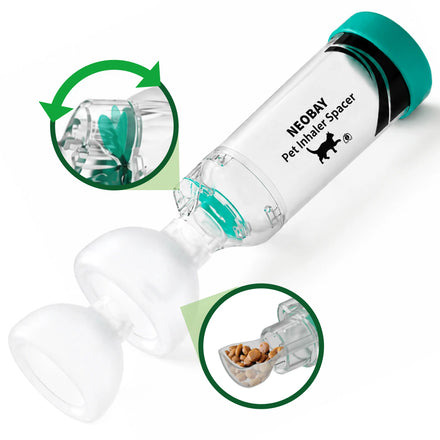
Neobay Cat Aerosol Chamber with Comfort Feeder — Green
- See each breath with the Breath Indicator
- Built-in treat holder makes mask practice easier
- Anti-static chamber helps keep medication airborne

🟡 Plausible, Limited Data: Maybe Worth Trying (With Vet Supervision)
Quercetin
Quercetin is a plant flavonoid — found in apples, onions, berries, and tea — that acts as a natural mast cell stabilizer. Mast cells are the immune cells that release histamine during allergic reactions. Stabilize them, and you blunt the allergic response.
In human medicine, quercetin is widely used for seasonal allergies and mild asthma. The challenge for cats: almost zero species-specific research. We're extrapolating from human data and mechanistic reasoning.
The case for: Quercetin's mechanism (mast cell stabilization) directly addresses the pathophysiology of feline asthma — IgE-mediated mast cell degranulation in the airways. This is a much stronger mechanistic argument than most supplements can claim.
The case against: Feline bioavailability is unknown. The effective dose is unknown. And some quercetin supplements contain bromelain (a pineapple enzyme) as a bioavailability enhancer — bromelain can cause GI upset in cats.
If you try it: Only use a veterinary-prescribed formulation. Do not dose based on human supplement labels. Expect to pay $30-60/month for a quality product.
Acupuncture
Acupuncture for feline asthma sits in a weird evidence space. A 2022 systematic review of veterinary acupuncture across all conditions found the evidence "neither compelling enough to recommend nor weak enough to reject." Catster's veterinary contributor rates it as a reasonable adjunct for cats who tolerate handling.
The mechanism proposed is neuromodulation — stimulating specific points (GV14, BL13, LU1, Ding Chuan) alters the autonomic nervous system's input to the airways, reducing bronchoconstriction. Is this proven? No. Is it plausible? Yes.
Practical considerations: - Requires a certified veterinary acupuncturist — your regular vet probably doesn't do this - Sessions run $50-150 each, typically weekly at first, then monthly - Some cats sit calmly for needles. Some absolutely do not. A stressed cat having an acupuncture session is worse than no acupuncture at all - The real-world benefit most owners report: over 3-6 months, the cat's daily steroid dose can sometimes be reduced
The risk of a properly performed acupuncture session is low (pneumothorax from a misplaced needle is possible but rare with a skilled practitioner). The cost and stress of transport are the bigger barriers.
CBD (Cannabidiol)
CBD is the most requested "natural" remedy across all pet conditions right now. For feline asthma specifically, the logic is CBD's anti-inflammatory effect via CB2 receptor activation.
Reality check: There are zero published studies on CBD for feline asthma. All recommendations are extrapolations from CBD's general anti-inflammatory properties in rodent models and human anecdotal reports.
If you try it: - Use a pet-specific product with third-party lab testing — contaminants and inaccurate labeling are rampant in the CBD industry - Ensure it contains <0.3% THC. THC is toxic to cats - Typical starting doses: 1-2 mg/kg twice daily - Watch for sedation, GI upset, or elevated liver enzymes on blood work
CBD is not a first-line supplement. If omega-3s, probiotics, and environmental control aren't enough, it's a conversation to have with your vet — but go in knowing the evidence is thin.
Salt Therapy (Halotherapy)
Dry salt inhalation therapy involves sitting in a room with aerosolized pharmaceutical-grade salt particles. The claim: salt's hygroscopic properties thin mucus, while its anti-microbial effects reduce airway pathogens.
Evidence: Case reports only. No controlled trials in cats. Zero.
At $30-60 per session, with the stress of transporting an asthmatic cat to a salt therapy facility, the risk/reward math is not favorable. If you're curious, some companies sell salt therapy devices for home use — but the quality of aerosolized salt at home is unregulated and the devices are expensive ($200-500).
🔴 Dangerous: "Natural" Things That Can Kill Your Cat
This is the section I wish nobody needed. But here we are.
Essential Oils — All of Them
Cats lack the liver enzyme glucuronyl transferase, which means they cannot metabolize the phenolic compounds in essential oils. What your body processes and excretes in hours accumulates in a cat's system and can cause:
- Liver failure
- Kidney damage
- Central nervous system depression (seizures, coma)
- Death
And for cats with asthma specifically, any aerosolized oil — even from a passive reed diffuser in the corner of a room — can trigger airway constriction and a full-blown asthma attack.
The specific oils most dangerous to cats: tea tree, eucalyptus, peppermint, wintergreen, citrus (all types), lavender, clove, cinnamon, pine, ylang ylang, pennyroyal.
"Pet-safe" essential oil blends are an unregulated marketing claim. There is no FDA or veterinary body certifying any essential oil as safe for cats. If you have a cat with asthma, get every essential oil product out of your house. This includes diffusers, roll-ons, cleaning products, and "natural" flea treatments.
Tea Tree Oil — The Most Common Feline Toxicity
The MSD Veterinary Manual identifies tea tree oil as the single most commonly reported essential oil intoxicant in pets. It takes only 7-8 drops of 100% tea tree oil on a cat's skin to cause severe poisoning. Products marketed as "natural flea control" containing tea tree oil have killed cats.
Homeopathic "Asthma Remedies"
Classical homeopathy uses substances diluted to the point where no molecule of the original substance remains. The claim is that water retains a "memory" of the substance that triggers healing.
There is no plausible mechanism by which water memory treats airway inflammation. Feline asthma is a real, physical condition involving eosinophils infiltrating the bronchial walls and smooth muscle constriction. Water memory does not interact with eosinophils or smooth muscle.
The danger is not the homeopathic remedy itself — at extreme dilutions, it's literally water. The danger is substitution: an owner uses homeopathic pellets instead of inhaled steroids during an asthma attack, or delays veterinary care because they're "trying the natural approach first." A cat in status asthmaticus can die within hours without bronchodilators and oxygen.
Unsupervised Herbal Formulas
Some Chinese herbal formulas (like Su Zi Jiang Qi) have a theoretical basis in TCVM for treating feline respiratory patterns. But the difference between a TCVM veterinarian prescribing a formula based on a specific cat's pattern diagnosis — and you buying an "asthma herbal blend" on Amazon — is the difference between medicine and Russian roulette.
Herbs are drugs. They contain pharmacologically active compounds. They interact with other medications. Their potency varies by batch, manufacturer, and growing conditions. Some herbs are directly toxic to cats (lilies, garlic, onion) and have no business being anywhere near a cat regardless of what the Amazon listing says.
Rule: If a TCVM veterinarian prescribes a specific formula for your specific cat, after an in-person pattern diagnosis — that's a conversation. If you found it on a blog or Amazon — no.
The One Natural Intervention That Costs Nothing
Here's the thing about feline asthma that gets buried under supplement recommendations and therapy modalities:
Every asthma attack you prevent is better than any treatment after the attack starts.
The most effective "natural" approach is trigger elimination — and most of it costs nothing:
- Throw out every scented candle, plugin, and air freshener in your home. Today.
- Switch to dust-free litter. Paper pellets cost the same as premium clay.
- No smoking or vaping indoors. Not "by the window." Not "in the other room." Outdoors only.
- Run a HEPA filter in the room your cat sleeps in. A decent one costs $80-150 and the filter replacements are $30-40 every 6 months — less than one month of brand-name Flovent.
- Vacuum with a HEPA-filter vacuum twice a week.
These five changes, done consistently, reduce asthma triggers by an estimated 60-80% in most homes. That's fewer attacks, less medication, fewer ER visits. No supplement comes close to that impact.

Frequently Asked Questions
What is the best natural remedy for cat asthma?
Omega-3 fatty acids from fish oil have the strongest evidence. They work by reducing systemic inflammation through EPA/DHA modulation of inflammatory pathways. Second is environmental control — HEPA filtration, dust-free litter, and eliminating scented products — which costs little and prevents attacks before they start. Third, a 2026 study on the gut-lung axis reported a 76.47% treatment success rate in cats with obstructive (asthma-pattern) breathing given tailored probiotic and nutraceutical protocols.
Can I treat my cat's asthma without steroids?
You can sometimes reduce steroid dependence, but you cannot eliminate the need for rescue medication. The goal of natural approaches is to bring baseline inflammation down enough that your cat needs less daily medication — not zero medication. Inhaled fluticasone (a corticosteroid that acts only in the lungs) is far safer than oral prednisolone for long-term use because it avoids systemic side effects like diabetes and kidney damage. If your concern is about steroids specifically, ask your vet about switching from oral to inhaled — this is a bigger safety improvement than any supplement.
Are essential oils safe for cats with asthma?
No. Essential oils are toxic to cats regardless of whether the cat has asthma. Cats lack the liver enzyme needed to metabolize the phenolic compounds in essential oils. Diffusing oils aerosolizes them into microdroplets that cats inhale — and for a cat with asthma, this can directly trigger airway constriction and an asthma attack. Tea tree, eucalyptus, peppermint, lavender, citrus, and dozens of other oils are dangerous. "Pet-safe" labeling on essential oil products is unregulated marketing, not a safety certification.
Does CBD help cats with asthma?
There are no published studies on CBD for feline asthma specifically. The theoretical benefit is anti-inflammatory action via CB2 receptors. If you try it, use a pet-specific product with third-party lab testing, ensure it contains less than 0.3% THC (which is toxic to cats), and start at 1-2 mg/kg twice daily under veterinary supervision. CBD is not a replacement for inhaled medication or environmental control — it's a fourth or fifth-line adjunct at best, and many cats show no observable response.
What supplements are proven to help feline asthma?
Only omega-3 fatty acids (fish oil) and specific probiotic strains have published evidence for feline respiratory disease. Omega-3s have the longest track record and strongest mechanistic support. Probiotics — delivered as part of tailored probiotic-and-neutraceutical protocols — were associated with a 76.47% treatment success rate in the obstructive (asthma-pattern) subgroup of a 2026 study of 117 cats. Quercetin has a plausible mechanism (mast cell stabilization) but no feline-specific studies. Everything else — CBD, salt therapy, herbal formulas, homeopathy — has either no evidence, negative evidence, or active safety concerns.
Can changing my cat's diet cure asthma?
No diet cures feline asthma. But a high-moisture, high-protein, low-carbohydrate diet can reduce systemic inflammation — which may translate to fewer or less severe asthma episodes. Dry kibble is the worst option: it's dehydrating, typically high in carbohydrates that promote inflammation, and the dust from dry food can directly irritate the airways during eating. Switching to high-quality canned or commercially prepared raw food (HPP-treated) is a reasonable dietary change that costs little and has zero downside risk.
How do I know if a natural remedy is making my cat worse?
Track your cat's resting respiratory rate. Count breaths per minute while your cat is sleeping (chest rises = one breath). Normal is under 30 breaths per minute at rest. If you start a new supplement and within days the resting rate goes up, coughing increases, or you see any open-mouth breathing — stop the supplement and call your vet. Open-mouth breathing in a cat is never normal and is a medical emergency.
What to Do Next
- Audit your home environment today. Walk through every room. Remove scented candles, plugins, diffusers, aerosol sprays, and scented cleaning products. This costs nothing and takes 30 minutes.
- Switch to dust-free litter. Paper pellets, tofu-based, or corn-based. Do it on your next litter purchase — no extra cost, immediate impact.
- Start omega-3 supplementation. Ask your vet for a pet-formulated fish oil recommendation and the right dose for your cat's weight. Budget ~$15-30/month.
- If you're using oral prednisolone long-term, ask your vet about transitioning to inhaled fluticasone with a spacer chamber. The medication goes only to the lungs, avoiding the systemic side effects that make steroids scary. This is the single biggest safety upgrade available in feline asthma management.
- Consider a veterinary probiotic with Bifidobacterium species at therapeutic doses. The 2026 gut-lung axis evidence is new but compelling. Budget ~$20-40/month.
Natural doesn't mean safe. And "natural" doesn't mean effective. The interventions that actually work — omega-3s, probiotics, environmental control — aren't flashy. They don't have dramatic before/after photos. What they have is data, mechanism, and a safety profile that makes them worth trying alongside conventional medication — not instead of it.
Your cat's lungs don't care whether a molecule is synthetic or natural. They care whether the airways are open.
Learn more about how a spacer chamber makes inhaled medication safer and more effective →
Have questions? Visit our FAQ page or contact us directly.
Sources: -Ural K, Erdoğan H, Erdoğan S, Paşa S, Gültekin M. "Gut-Lung Axis in Cats: Case Archives (2020-2025) for Further Evidence of Proof in Cats with Several Different Respiratory Patterns Treated with Natural Remedies." Croatian Veterinary Journal, 2026; 57(2): 170-179. https://doi.org/10.46419/cvj.57.2.8 - Trzil JE, Reinero CR. "Update on feline asthma." Veterinary Clinics of North America: Small Animal Practice, 2014; 44(1): 91-105. - Trzil JE. "Feline asthma: diagnostic and treatment update." Veterinary Clinics of North America: Small Animal Practice, 2020; 50(2): 375-391. - Cornell Feline Health Center. "Feline Asthma: What You Need to Know." Cornell University College of Veterinary Medicine. https://www.vet.cornell.edu/departments-centers-and-institutes/cornell-feline-health-center/health-information/feline-health-topics/feline-asthma-what-you-need-know - MSD Veterinary Manual. "Toxicoses from Essential Oils in Animals." Accessed 2026. - International Cat Care. Asthma and Chronic Bronchitis in Cats. - BC SPCA. "Safety Alert: The Dangers of Essential Oils and Pets." Accessed 2026. - Cats Protection (cats.org.uk). "Are Essential Oils Dangerous to Cats?" Accessed 2026.
Related Reading
This article is part of our Feline Asthma: The Complete Owner's Guide — covering everything from causes and symptoms to treatment and daily management.


