

Key Takeaways
- Both prednisolone and inhaled steroids effectively control feline asthma — the evidence shows no clear winner on efficacy alone. The real difference is in side effects, cost, and what your cat will tolerate.
- Oral prednisolone works faster (hours) but carries higher long-term risks: diabetes, weight gain, and adrenal suppression with extended use. Inhaled fluticasone targets the lungs directly and largely avoids these systemic effects.
- The strongest study comparing both treatments had only 9 cats. The evidence base is thin — most treatment decisions rely on clinical experience, not large-scale trials.
- 70-80% of cats can successfully transition from pills to an inhaler with a proper 10-14 day overlap period and slow prednisolone taper.
- Cost varies dramatically: generic oral prednisolone costs ~$10-20/month. Inhaled fluticasone runs $50-300/month depending on where you buy it — but the long-term health savings from fewer side effects often offset the difference.
Your vet just diagnosed your cat with asthma. They hand you two options: daily pills or an inhaler. Both work — but the right choice depends on your cat's health, your budget, and how much risk you're willing to accept from side effects.
How Each Treatment Actually Works
Prednisolone is a systemic corticosteroid. You give it as a pill or liquid, it enters the bloodstream, and it suppresses inflammation throughout the entire body — including the lungs. It kicks in within hours.
Inhaled fluticasone (Flovent, Flixotide) works differently. Using a spacer device, the medication goes directly into the lungs as a fine mist. Very little enters the bloodstream — which is why inhaled steroids have fewer systemic side effects.
The key difference: prednisolone is a whole-body approach. Fluticasone is a targeted one. This distinction drives everything else — side effects, safety, and which cats are better candidates for each.
Efficacy: What the Research Actually Shows
Three studies have directly or indirectly compared oral and inhaled steroids for feline asthma. Here's what they found — and what they didn't.
Verschoor-Kirss et al. (2021) conducted the most relevant trial: 9 cats with naturally occurring asthma, randomized to either oral prednisolone or inhaled fluticasone for 8 weeks. Both groups improved. Clinical signs resolved in both. Airway inflammation dropped in both. One finding worth noting: 75% of cats on oral prednisolone reached the target reduction in airway eosinophils, compared to 40% on inhaled fluticasone. But with only 9 cats total, that difference could be noise.
Leemans et al. (2012) and Reinero et al. (2005) were smaller crossover trials (6 cats each) using experimentally induced asthma. Both found comparable efficacy between oral and inhaled routes.
The bottom line: all three studies are small, short-term, and two used lab-induced asthma rather than real-world disease. As one veterinary evidence review put it, there is "weak evidence to suggest equal treatment efficacy." From a pure efficacy standpoint, neither is clearly superior. The decision should hinge on other factors.

Side Effects: The Real Trade-off
This is where the two treatments diverge sharply.
Oral prednisolone side effects are well-documented and become more likely with longer use:
- Increased thirst and urination — nearly universal.
- Increased appetite and weight gain — very common. Cats on pred can become food-obsessed.
- Diabetes mellitus — the most serious risk. Long-term oral steroid use can trigger insulin resistance, especially in overweight cats.
- Adrenal suppression — prednisolone suppresses natural cortisol production. After months of use, you can't stop abruptly; the adrenal glands need time to recover.
- Increased infection risk — systemic immunosuppression makes cats more vulnerable to UTIs and respiratory infections.
Inhaled fluticasone side effects are minimal by comparison. The most common issues are local: mild throat irritation or, rarely, a hoarse meow. Some cats develop a mild oral yeast infection if the face isn't wiped after each use — easily prevented with a damp cloth. At very high doses (2 puffs of 250mcg twice daily) some adrenal suppression can occur, but this is the exception, not the norm.
Cost Comparison: What You'll Actually Pay
| Treatment | Monthly Cost (US Pharmacy) | Monthly Cost (Canadian/International Pharmacy) | Device Cost |
|---|---|---|---|
| Generic prednisolone (5mg/day) | $10-20 | N/A (domestic only) | None |
| Fluticasone 110mcg (generic) | $50-120 | $25-50 | Spacer: $33-62 (one-time) |
| Fluticasone 220mcg (generic) | $80-180 | $40-80 | Same as above |
| Brand Flovent 110mcg | $200-350 | $60-120 | Same as above |
The spacer device (AeroKat or Neobay) is a one-time purchase. Replace it every 12-18 months if used daily.
Cost isn't just the medication price. If your cat develops diabetes from long-term prednisolone, you're looking at insulin, glucose monitoring, prescription food, and more vet visits — easily $500-1,000+ per year. From a total cost of care perspective, the inhaler often comes out ahead for cats needing lifelong treatment.
The Transition: How to Switch from Pills to an Inhaler
Many vets start cats on prednisolone for quick symptom control, then transition to inhaled fluticasone for long-term management. This is the standard protocol, refined by the feline asthma community over years of collective experience:
Step 1: Overlap (days 1-14). Start the inhaler at the prescribed dose. Continue the full dose of prednisolone. Do not reduce it yet. Fluticasone takes 7-10 days to build up to therapeutic levels in the lungs.
Step 2: First taper (days 15-21). If no coughing or wheezing, cut the prednisolone dose in half. Continue the inhaler twice daily.
Step 3: Alternate days (days 22-28). Give the reduced prednisolone dose every other day. Keep the inhaler going.
Step 4: Stop prednisolone (day 29+). Discontinue prednisolone entirely. Monitor for any return of symptoms. Have albuterol (rescue inhaler) on hand just in case.
If symptoms return during the taper: the fluticasone dose is likely too low. Many vets start conservatively at 110mcg twice daily. The feline asthma community consensus is that most cats need 220mcg (250mcg) twice daily for adequate control. Talk to your vet about adjusting up before going back to prednisolone.
Which Treatment Is Right for Your Cat?
Use this decision framework based on your cat's specific situation:
Consider oral prednisolone if:
- Your cat has mild, intermittent symptoms (occasional coughing only)
- You need fast symptom relief while waiting for an inhaler to arrive
- Your cat absolutely refuses the mask despite training (rare — most cats adapt)
- Short-term use only (under 3 months)
- Budget is the primary constraint and your cat has no other health issues
Consider inhaled fluticasone if:
- Your cat needs lifelong daily treatment
- Your cat is overweight, senior, or has any pre-existing metabolic condition
- You want to minimize long-term health risks
- Your cat also has CKD, heart disease, or other conditions that systemic steroids could worsen
- You're combining treatment with allergen-specific immunotherapy (oral steroids may reduce its effectiveness)
Consider combination therapy (inhaled + low-dose oral) if:
- Your cat has severe asthma that doesn't fully respond to max-dose fluticasone alone
- Seasonal flares require temporary add-on prednisolone
- Your vet has identified a specific reason combination is necessary
There's no shame in any of these paths. What matters is finding the lowest effective dose that keeps symptoms controlled.
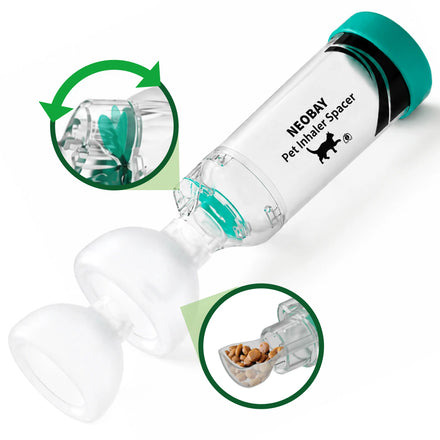
Neobay Cat Aerosol Chamber with Comfort Feeder — Green
- See each breath with the Breath Indicator
- Built-in treat holder makes mask practice easier
- Anti-static chamber helps keep medication airborne

Frequently Asked Questions
Can I just give my cat prednisolone when they cough, instead of every day?
No. Asthma is a chronic inflammatory condition — by the time your cat is coughing, airway inflammation has been building for days. Intermittent dosing lets inflammation smolder between doses, which can lead to airway remodeling (permanent scarring). Daily treatment is the standard of care.
How long does it take for inhaled fluticasone to start working?
About 7-10 days to reach full effect. This is why the transition protocol includes a 10-14 day overlap with oral prednisolone — the inhaler needs time to build up while the pills maintain control.
Is prednisolone the same as prednisone?
Almost. Prednisone is converted to prednisolone in the liver. Cats are less efficient at this conversion than dogs or humans, so vets generally prescribe prednisolone directly for cats. If your vet prescribed prednisone, ask if prednisolone would be more appropriate.
Can inhaled steroids cause the same side effects as oral ones?
At standard doses, no. Because fluticasone stays in the lungs with minimal systemic absorption, it doesn't trigger the metabolic side effects associated with oral prednisolone. At very high doses (maximum label dose or above) some systemic absorption does occur, but even then it's far less than oral steroids.
What if my cat won't accept the inhaler mask?
Most cats adapt with patience and food rewards. Start by letting your cat investigate the mask without the chamber attached. Gradually work up to holding it on their face for 1-2 seconds, then 5-7 seconds. The vast majority accept the device within 1-2 weeks of daily training. Neobay's Comfort Feeder attachment — which holds a small amount of wet food or paste treat in front of the mask — can help food-motivated cats warm up to the process faster.
What to Do Next
- If your cat was just diagnosed: ask your vet about starting prednisolone for immediate relief while you order an inhaler and spacer. This dual-start approach is the most common path.
- If your cat is already on prednisolone: ask whether a transition to inhaled medication makes sense for long-term management. Bring this article's transition protocol to the conversation.
- If your cat needs an inhaler setup: you'll need a spacer device and a prescription for fluticasone. Neobay's aerosol chamber ($39.99) includes a visual flow indicator so you can see each breath your cat takes — useful when you're learning together.
The right treatment is the one your cat will actually receive consistently. Whether that's a pill, a puff, or both — controlling inflammation is what prevents lung damage over time.
Have questions about your cat's specific situation? Visit our FAQ page or contact us.
Related Reading
This article is part of our Feline Asthma: The Complete Owner's Guide — everything you need to understand your cat's condition, from symptoms to treatment options.
Sources:
- Verschoor-Kirss M, Rozanski EA, Sharp CR. "Treatment of naturally occurring asthma with inhaled fluticasone or oral prednisolone: A randomized pilot trial." *Canadian Journal of Veterinary Research*, 2021.
- Leemans J, et al. "Effect of short-term oral and inhaled corticosteroids on airway inflammation and responsiveness in a feline acute asthma model." *The Veterinary Journal*, 2012.
- Reinero CR, Decile KC, Byerly JR, et al. "Effects of drug treatment on inflammation and hyperreactivity of airways and on immune variables in cats with experimentally induced asthma." *American Journal of Veterinary Research*, 2005; 66(7): 1121-1127.
- VCA Animal Hospitals. "Treatment Instructions for Asthma and Bronchitis in Cats."
- Trudell Animal Health. "Steroid Medications for Cats with Respiratory Conditions."
Related: Once you've chosen between oral and inhaled steroids, learn how to safely taper your cat off prednisolone when making the transition to Flovent.


