

Key Takeaways
- Open-mouth breathing in cats is always a red flag — unlike dogs, cats rarely pant with their mouth open, and it often signals serious respiratory distress.
- The position your cat takes matters: crouching with elbows out, neck extended, and head low (orthopneic posture) signals the cat is struggling to get air — this is an emergency.
- Gum color is the fastest triage tool: pink = oxygen is circulating; pale/blue/gray gums = get to an emergency vet immediately.
- Not all heavy breathing is an emergency: fast breathing after play, during purring, or in hot weather can be normal — but knowing the 3 critical warning signs separates panic from appropriate action.
- If your cat has feline asthma, having a spacer chamber and knowing your cat's normal resting breathing rate can help you distinguish an asthma flare-up from a true emergency.

You're sitting on the couch and glance over at your cat. Her mouth is slightly open. Her sides are moving faster than usual. She looks… wrong.
Your heart starts racing. Is this an emergency? Should you rush to the vet at 11pm? Or is she just hot, stressed, or recovering from a zoomie session?
Every cat owner who's been through this moment knows the gut-wrenching uncertainty. You don't want to overreact and spend $500 at the emergency vet for nothing. But you also can't shake the image of your cat struggling to breathe while you did nothing.
This guide gives you a clear, actionable framework to tell the difference — no veterinary degree required.
Why Cat Breathing Problems Are Different From Dogs
Here's something most new cat owners don't realize: cats and dogs breathe completely differently when something is wrong.
Dogs pant. It's what they do. After a walk, when excited, when hot — mouth open, tongue out, breathing fast. It's normal canine physiology.
Cats? A cat breathing with its mouth open is almost never normal.
Feline respiratory systems are designed for silent, efficient nasal breathing. When a cat resorts to open-mouth breathing, it's often because nasal breathing alone isn't delivering enough oxygen. This is what veterinarians call respiratory distress, and it means the cat's oxygen levels may already be compromised.
That said, there are a few situations where heavy or unusual breathing can be benign. The key is knowing which is which.
The 3 Critical Warning Signs: When to Go to the ER Now
If your cat shows any one of these three signs, do not wait until morning. Go to an emergency veterinarian.
1. Open-Mouth Breathing at Rest
A cat sitting still, not having exercised, with its mouth open and breathing through it — this is a medical emergency. The cat is working too hard to pull in oxygen through its nose and has switched to mouth breathing as a last resort.
What it looks like: Mouth held slightly or fully open, often with the tongue visible. Breathing may look shallow or exaggerated. The cat may seem dazed or unresponsive.
Common causes: Severe asthma attack, heart failure with fluid in the lungs (pulmonary edema), pleural effusion (fluid around the lungs), or a foreign object blocking the airway.
What to do: Get to the nearest emergency vet. Keep your cat as calm as possible during transport — stress makes breathing worse. Do not stick your fingers in your cat's mouth to check for obstructions unless you can clearly see a visible object; a struggling cat may bite reflexively.
2. Orthopneic Posture (The "Tripod" Position)
This is the body position a cat takes when breathing has become extremely difficult. It's instinctive and unmistakable once you know what to look for.
What it looks like: The cat is sitting or crouching with its elbows rotated outward, chest low to the ground, neck extended forward and slightly upward. It looks like the cat is trying to create as much space as possible for air to move. The cat will resist lying down — lying flat makes breathing harder.
This posture is the feline equivalent of a human leaning forward with hands on knees during a severe asthma attack. The cat is using every accessory muscle it has to pull in air.
What to do: This posture means the cat is in severe respiratory distress. Transport to an emergency vet immediately. Do not force the cat to lie down in the carrier — let it assume whatever position it needs.
3. Blue, Pale, or Gray Gums
Gum color is the single most reliable indicator of whether oxygen is reaching your cat's tissues.
How to check: Gently lift your cat's upper lip and look at the gums. Normal gums should be a healthy bubble-gum pink. If they appear pale (like raw chicken), grayish, or bluish-purple (cyanotic), your cat is not getting enough oxygen.
What to do: Cyanosis (blue/purple gums) means oxygen levels are critically low. This is a life-threatening emergency — go to the vet immediately, no exceptions.
Note: Some cats have naturally dark-pigmented gums. If your cat has black or spotted gums, check an area with less pigment, or check the color of the tongue instead.
Breathing Patterns That May or May Not Be Emergencies
Not every abnormal breathing pattern requires a middle-of-the-night ER visit. Here's how to evaluate the gray-area situations that cat owners most commonly face.
Fast Breathing After Playing
Scenario: Your cat just did five minutes of intense chasing-the-feather-toy, and now she's breathing fast with her mouth closed.
Is it an emergency? Usually not — if it resolves within 2-3 minutes.
Cats, especially kittens and young adults, can breathe rapidly after exertion. The key differentiator: how quickly does breathing return to normal? Count your cat's resting breaths per minute (one breath = chest rises and falls once). A normal resting rate is 20-30 breaths per minute. After play, it may spike to 60-100 but should return to normal within a few minutes.
If fast breathing persists more than 5 minutes after activity stops, or if the cat is open-mouth breathing after play, call your vet.
Heavy Breathing While Sleeping or Resting
Scenario: You notice your cat's sides moving faster than usual while she's asleep on the couch. She's not open-mouth breathing, but the rate seems high.
Is it an emergency? It depends on the rate and what's "normal" for your cat.
A cat's sleeping respiratory rate should be under 30 breaths per minute. To check: wait until your cat is truly asleep (not just resting with eyes closed), then count breaths for 15 seconds and multiply by 4.
Consistently elevated sleeping respiratory rates (above 30-35) can be an early sign of heart disease or worsening asthma. It warrants a non-emergency vet visit soon — but if it's above 40-50 or accompanied by any of the 3 critical warning signs, go to the ER.
Gasping During Purring
Scenario: Your cat is purring contentedly in your lap, but her breathing sounds raspy, punctuated, or she seems to pause and gulp between purrs.
Is it an emergency? Sometimes. Purring is a vibration of the larynx and diaphragm, and it can mask or distort breathing sounds. Some cats naturally breathe a bit oddly while purring, especially brachycephalic breeds (Persians, Himalayans).
But if the gasping or gulping is new for your cat, or if the cat is open-mouth breathing while purring, have your vet evaluate for laryngeal disease, nasal obstruction, or asthma-related airway narrowing. Purring increases respiratory effort, so it can unmask breathing problems that aren't visible at rest.
Breathing Fast in Hot Weather
Scenario: It's a hot summer day, and your cat is breathing faster than usual — maybe even panting slightly with her mouth open.
Is it an emergency? Possibly. Unlike dogs, cats do not pant efficiently to cool down. If a cat is panting from heat, it may already be approaching heat stress.
Move your cat to a cool area, offer water, and place a damp cloth on her paw pads. If panting doesn't stop within 5 minutes of cooling measures, or if the cat seems lethargic or disoriented, go to the vet. Heat stroke in cats progresses rapidly and can be fatal.
Gasping or Coughing With Tongue Out
Scenario: Your cat crouches low, extends her neck, and makes a hacking or wheezing sound with her tongue slightly out — almost like she's trying to cough up a hairball but nothing comes out.
Is it an emergency? This is the classic feline asthma attack posture, and it's a sign that the cat is struggling to exhale against constricted airways.
If the episode lasts less than 30 seconds and the cat returns to normal, it's a sign that asthma needs better management — not necessarily an ER trip tonight, but a vet visit soon to adjust the treatment plan.
If the episode lasts more than a minute, repeats multiple times in an hour, or the cat shows open-mouth breathing between episodes, go to the emergency vet.
When It's a Feline Asthma Attack vs. Something Else
For cats with diagnosed asthma, owners face an additional layer of uncertainty: is this an asthma flare-up I can manage at home, or is this something more dangerous?
| Sign | Likely Asthma Flare-Up | Possible Heart Disease or Other Emergency |
|---|---|---|
| Breathing pattern | Wheezing, coughing, extended neck, tongue slightly out | Open-mouth breathing, rapid shallow breaths, orthopneic posture |
| Gum color | Pink (unless severe) | Pale, blue, or gray |
| Response to albuterol | Improves within 5-10 minutes of rescue inhaler | No improvement — or worsens |
| Onset | Often triggered (dust, smoke, allergen) | May have no obvious trigger |
| Cat's behavior | May hide but still responsive | Lethargic, unresponsive, or collapsed |
| Leg involvement | No leg symptoms | Hind leg weakness or paralysis (saddle thrombus — an immediate emergency) |
The albuterol test: If your cat has a prescribed rescue inhaler and a spacer chamber, you can administer one puff of albuterol during a breathing episode. If breathing improves noticeably within 5-10 minutes, it's likely an asthma flare-up. If there's no improvement — or the cat gets worse — this is a red flag for heart disease, pleural effusion, or another non-asthma emergency.
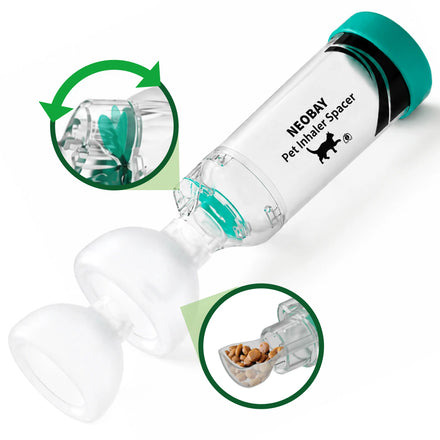
Neobay Cat Aerosol Chamber with Comfort Feeder — Green
- See each breath with the Flow Indicator
- Built-in treat holder makes mask practice easier
- Anti-static chamber helps keep medication airborne
What to Do While Transporting a Cat in Respiratory Distress
If you've determined your cat needs emergency care, how you transport them can make a difference in their outcome.
-
Minimize stress above all else. A stressed cat breathes faster, consumes more oxygen, and can decompensate rapidly. Move slowly. Speak quietly. Avoid loud noises or sudden movements.
-
Use a carrier with good ventilation. If you don't have one, a well-ventilated cardboard box works in a true emergency. Do not wrap a struggling cat tightly in a towel — this restricts chest movement and makes breathing harder.
-
Let the cat choose its position. Do not force a cat in respiratory distress to lie down. Many cats instinctively assume the orthopneic posture (elbows out, neck extended) because it helps them breathe. Restraining them in a different position can worsen their condition.
-
Keep the car cool and quiet. Crack a window for fresh air. Turn off the radio. Drive smoothly — sudden braking or sharp turns stress the cat further.
-
Call ahead if possible. Let the emergency clinic know you're coming with a cat in respiratory distress. They can prepare oxygen support and triage equipment before you arrive.
How to Monitor Your Cat's Breathing at Home (Before an Emergency Happens)
The best way to know when something is wrong is to know what's right. Establish your cat's baseline when they're healthy.
How to measure resting respiratory rate: - Wait until your cat is truly asleep (not dozing) - Watch the chest rise and fall — one rise + fall = one breath - Count for 15 seconds and multiply by 4 - Do this 2-3 times and average the results
A healthy cat's sleeping respiratory rate is under 30 breaths per minute. Write this number down. If you notice it trending up over weeks or months, mention it to your vet — it can be an early-warning signal for heart or lung disease.
For cats with asthma, track their resting breathing rate weekly. A consistently rising rate while on the same medication dose may mean the asthma is becoming less well-controlled.
Frequently Asked Questions
Is cat open mouth breathing always an emergency?
Yes, in most cases. Unlike dogs, cats do not normally breathe through their mouths. Open-mouth breathing at rest indicates the cat is working hard to get enough oxygen and should be evaluated by a veterinarian as soon as possible. The only potential exception is brief open-mouth panting immediately after intense play in a young, healthy cat — but even this should resolve within 2-3 minutes. If it doesn't, it's an emergency.
What does a cat asthma attack look like?
A feline asthma attack typically involves the cat crouching low with its neck extended forward, making wheezing or hacking sounds, often with the tongue slightly protruding. It may look like the cat is trying to cough up a hairball but nothing comes out. The cat's sides move visibly with each breath, and you may hear a whistling or rasping sound. Episodes usually last 10-30 seconds. If longer than a minute, it's an emergency.
Why is my cat gasping for air while resting?
Gasping at rest can have multiple causes: an asthma attack, heart failure with fluid accumulation in the lungs, pleural effusion (fluid around the lungs), a respiratory infection, or a foreign object in the airway. Any cat gasping for air at rest needs immediate veterinary evaluation. Check gum color — if pale, gray, or blue, go to the emergency vet immediately.
Can a cat gasp for air from stress or anxiety?
Stress alone rarely causes true gasping or open-mouth breathing in cats. While stress can cause rapid, shallow breathing (tachypnea), true respiratory distress with open-mouth breathing or orthopneic posture is a medical problem, not a behavioral one. If your cat appears to be gasping during a stressful event like a car ride, it's still worth having your vet rule out underlying heart or lung disease — stress can unmask a condition that was previously compensated.
How do I know if it's feline asthma or heart disease?
The two conditions can look similar, but there are key differences. Asthma attacks typically involve wheezing, coughing, and an extended-neck posture — the cat works to exhale. Heart-related breathing problems often look more like rapid, shallow breathing with less noise — the cat struggles to inhale. Asthma usually responds to a bronchodilator (albuterol) within minutes; heart-related breathing difficulty does not. If your cat has hind-leg weakness or paralysis along with breathing difficulty, this is a classic sign of aortic thromboembolism (saddle thrombus) — an immediate emergency.
Should I give my cat water if they're breathing heavily?
No. Do not put anything in your cat's mouth — including water, food, or medication — if they are in respiratory distress. A cat struggling to breathe may aspirate (inhale liquid into the lungs), which can make the situation catastrophic. Focus on getting the cat to a veterinarian. The only exception is administering a prescribed rescue inhaler through a spacer chamber, which delivers medication without forcing anything into the mouth.
What to Do Next
- Bookmark the 3 critical warning signs: open-mouth breathing at rest, orthopneic (tripod) posture, and pale/blue gums. These are your go/no-go rules for the emergency vet.
- Measure your cat's sleeping respiratory rate tonight while they're healthy. Write it down. Knowing "normal" is the only way to recognize "abnormal."
- If your cat has feline asthma, make sure your rescue inhaler is not expired and that you have a functioning spacer chamber. Know your cat's albuterol dose and practice the administration technique so you're not fumbling during an actual attack.
- Save your nearest emergency vet's phone number and address in your phone. In a crisis, you won't want to Google it.
Recognizing the difference between a true emergency and a manageable breathing episode can save your cat's life — or save you an unnecessary panic at 2am. When in doubt, err on the side of the vet. But with the right home monitoring habits and a clear understanding of the warning signs, you'll be equipped to make the right call.
Sources: - Rozanski, E.A. et al. "Evaluation of Respiratory Rate and Effort in Cats Presenting to the Emergency Room." Journal of Veterinary Emergency and Critical Care, 2019. - Trzil, J.E. "Feline Asthma: Diagnostic and Treatment Update." Veterinary Clinics of North America: Small Animal Practice, 2020. - Cornell Feline Health Center. "Feline Asthma: Diagnosis and Management." Cornell University College of Veterinary Medicine. - Cohn, L.A. "Feline Respiratory Disease: Differentiating Asthma from Other Causes." Journal of Feline Medicine and Surgery, 2011. - American College of Veterinary Emergency and Critical Care (ACVECC). "Recognition of Respiratory Distress in Cats." 2022.

Related Reading
This article is part of our How Vets Diagnose Feline Asthma — covering tests, X-rays, at-home monitoring, and what to expect at every step of the diagnostic process.
Gasping can also signal fluid around the lungs (pleural effusion) or pneumonia. See our pneumonia recovery guide for what to expect after diagnosis and treatment.


