

Key Takeaways
- Most cat colds are viral upper respiratory infections (URIs) — they usually clear up in 7-10 days with at-home supportive care, no antibiotics needed.
- The single most important thing to watch is eating — a cat that stops eating for 24+ hours needs a vet immediately, full stop. Cats can develop hepatic lipidosis (fatty liver) shockingly fast.
- Steam therapy actually works — 10-15 minutes in a steamy bathroom 2-3 times a day loosens mucus and helps your congested cat breathe easier. It's free, it's safe, and vets recommend it.
- Never give a cat human cold medicine — decongestants, acetaminophen, ibuprofen, and Vicks VapoRub are all toxic to cats. One tablet of acetaminophen can kill a cat.
- Green or yellow discharge means bacterial infection — clear snot and watery eyes are usually just the virus. When the discharge thickens and changes color, your cat likely needs antibiotics from the vet.
Your cat's been sneezing non-stop for two days. The nose is running. The purr sounds more like a wheeze. And she barely touched breakfast this morning.
You're worried. And you're googling "cat cold when to worry" at 11pm — which is exactly how half the readers find this article.
Here's the good news: most cat colds are like our colds. Annoying, but not dangerous. They run their course in a week or so with some basic TLC at home.
Here's the part people don't tell you: a "cat cold" isn't really a cold. It's a feline upper respiratory infection — a URI — and the same viruses that cause it can stick around in your cat's system for life, flaring up whenever stress hits.
This guide covers everything you need to know to get your cat through a URI at home, recognize when it's time for the vet, and understand what's actually happening inside your cat's respiratory system.

What Is a Cat Cold? (It's Not What You Think)
When people say "cat cold," they're talking about a feline upper respiratory infection — a URI. The infection affects your cat's nose, throat, and sinuses. Same general area as our colds, same miserable feeling.
But here's the difference: the viruses behind cat URIs don't just go away. They set up permanent residency.
Roughly 80-90% of cat URIs are caused by two viruses:
Feline herpesvirus type 1 (FHV-1). This is the big one. It infects the nasal passages, the eyes, and the throat. Once a cat catches it, the virus hides out in the nerve cells forever. During periods of stress — a new pet in the house, a move, boarding, even a change in routine — the virus reactivates. Your cat gets "sick" again years after the initial infection, same virus.
Feline calicivirus (FCV). Similar respiratory symptoms, but calicivirus also causes painful mouth ulcers. Some strains produce a limp — "limping kitten syndrome" — that resolves on its own. Calicivirus mutates constantly, which is why even vaccinated cats can sometimes get infected with a new strain.
A few URIs are bacterial — Chlamydia felis, Mycoplasma felis, Bordetella bronchiseptica — but these are far less common, and they usually show up as secondary infections on top of a viral URI, not on their own.
Neither FHV-1 nor FCV can infect humans. You can't catch your cat's cold. Your cat can't catch yours either.
How Cats Catch URIs
Direct contact — nose-to-nose greeting, grooming each other, sharing food bowls. But also indirect: the virus survives on surfaces for surprising lengths of time. FCV can live on a dry surface for up to a month. That blanket your neighbor's cat slept on three weeks ago? Still infectious.
This is why shelters, catteries, and multi-cat households are URI hot zones. And why newly adopted cats often come home sniffling — the stress of the shelter suppressed their immune system just enough for a latent virus to wake up.
Cat Cold Symptoms: What's Normal vs. What's Not
URI symptoms look different depending on the virus, the cat's age, their immune status, and whether it's a first infection or a flare-up of an old one.
Common mild symptoms — manageable at home:
- Sneezing (especially in bouts, especially in the morning)
- Clear, watery nasal discharge
- Watery eyes, mild squinting
- Mild congestion — you can hear it when they breathe, but they're not struggling
- Slightly reduced appetite (still eating, just less enthusiastically)
- Sleeping more than usual
- Quiet meow or hoarse voice
These symptoms in an otherwise healthy adult cat with normal energy and appetite? You can handle this at home with the care steps below. Most cases resolve in 7-10 days.
Symptoms that need a vet visit (non-emergency, but don't wait a week):
- Thick, green or yellow nasal discharge
- Green or yellow eye discharge, swollen or sealed-shut eyes
- Coughing (not just sneezing — an actual cough)
- Not eating for more than 24 hours
- Fever (over 102.5°F)
- Oral ulcers or drooling
- Symptoms lasting more than 10 days without improvement
Call your vet and get an appointment within 24-48 hours. These signs suggest either a bacterial infection that needs antibiotics, or a more serious case that needs prescription medication.
Emergency signs — go to the vet immediately:
| Sign | What It Looks Like |
|---|---|
| Open-mouth breathing | Cat is panting or breathing through an open mouth at rest. Cats are obligate nose-breathers — if they're mouth-breathing, something is seriously wrong |
| Labored breathing | Exaggerated chest and belly movements with each breath. You can see ribs moving. Neck extended, elbows pointed outward |
| Pale, blue, or grey gums | Pull up the lip. Gums should be bubblegum pink. Blue/grey = oxygen deprivation |
| Extreme lethargy | Cat can't or won't stand up, doesn't respond to you, seems confused |
| No eating for 48+ hours | Beyond 24 hours is vet-visit territory; beyond 48 is emergency territory |
| Severe eye involvement | Ulcers visible on the cornea, eye looks cloudy, or the cat holds the eye completely shut in pain |
Kittens, senior cats, and cats with FIV or FeLV: any URI symptom at all warrants a faster vet visit. Their immune systems don't have the same margin for error.
Cat Cold Home Treatment: 7 Vet-Approved Care Steps
There's no cure for viral URIs in cats — just like there's no cure for the human common cold. Treatment is 100% supportive: help the cat feel better while their immune system fights off the active infection.
Here's what actually works, in order of importance.
1. Steam Therapy (Do This First)
Congestion is what makes a cat miserable. When the nose is blocked, they can't smell food. When they can't smell food, they stop eating. When they stop eating, things get dangerous fast.
Steam is the most effective home tool you have.
Run a hot shower with the bathroom door closed and the fan off. Once the room is steamy, bring your cat in and sit with them for 10-15 minutes. Do this 2-3 times a day. You don't need to hold them in the steam — just being in the room helps.
No time for the bathroom routine? A cool-mist humidifier next to your cat's favorite sleeping spot does the same thing continuously. Run it while they sleep.
Do not use a steam vaporizer with menthol or eucalyptus additives. Those are toxic to cats. Plain water steam only.
2. Keep Eyes and Nose Clean

URI discharge dries crusty, and cats hate it. Worse, accumulated gunk around the eyes creates a perfect environment for secondary bacterial infections.
Use a soft, warm, damp cloth or cotton ball. Gently wipe from the inner corner of the eye outward. One pass, then use a fresh part of the cloth. Same motion for nasal discharge — wipe away from the nose, don't rub upward into it.
Do this 2-3 times a day. It takes thirty seconds and makes a real difference in how your cat feels.
For sticky eye discharge, a plain sterile saline solution (the same kind used for contact lenses) can help loosen things up. Ask your vet before using any medicated eye drops — steroid drops can make herpesvirus eye ulcers dramatically worse.
3. Get Them Eating

A cat's appetite runs on smell. Congested cat = can't smell = won't eat.
Warm wet food slightly — 10-15 seconds in the microwave, then stir and test the temperature on your wrist. It should be barely warm, never hot. Warming releases aromatics that cut through the congestion.
If warming doesn't work, escalate: - Strong-smelling foods: tuna in water, sardines, warmed pate-style food - Meat-only baby food (check the label — absolutely no onion or garlic powder, both are toxic) - High-calorie nutritional gel (Nutri-Cal or similar — available at any pet store) - Hand-feeding small amounts directly
The 24-hour rule: if your cat hasn't eaten a meaningful amount in 24 hours, stop trying home care and go to the vet. Cats can develop hepatic lipidosis — fatty liver disease — after just 2-3 days of not eating. It's life-threatening and requires hospitalization.
4. Hydration Is Non-Negotiable
Congestion + fever = dehydration risk. Plus, cats already tend not to drink enough water.
- Offer fresh water in multiple bowls throughout the house
- A pet fountain often entices cats who ignore still water
- Add warm water to wet food to increase fluid intake
- Low-sodium chicken broth (no onion, no garlic) as a treat
Check for dehydration: gently pinch the skin between your cat's shoulder blades and release. It should snap back instantly. If it stays tented or returns slowly, your cat is dehydrated and needs veterinary fluids.
5. Create a Recovery Zone
Your cat needs rest, and rest means low stress. Stress releases cortisol, which suppresses the immune response — exactly the opposite of what you want right now.
Set up a quiet room with: - Soft bedding in a warm, draft-free spot - A litter box, water bowl, and food bowl all within easy reach - Reduced noise and traffic — no TV, no visitors, no other pets - A dark hiding spot (a cardboard box on its side with a blanket inside works perfectly)
If you have multiple cats, isolate the sick one. URI viruses spread fast in multi-cat households. Wash your hands after handling the sick cat, and consider changing clothes between interacting with sick and healthy cats.
6. Immune Support (Evidence Is Mixed, but Low Risk)
L-lysine is the most commonly recommended supplement for feline herpesvirus. The theory: lysine interferes with arginine, an amino acid the virus needs to replicate. The reality: clinical studies are conflicting — some show reduced shedding and milder symptoms, others show no effect. At standard doses (250-500mg twice daily for adult cats), side effects are rare. Ask your vet if it's worth trying.
Probiotics (cat-specific formulations like FortiFlora) support gut health during illness. If your vet prescribes antibiotics, probiotics become especially important — antibiotics wipe out gut flora along with the bad bacteria.
What not to give: No vitamin C, no zinc, no echinacea, no herbal remedies unless specifically prescribed by your vet. Cats metabolize substances differently than humans and many "immune boosters" are toxic at cat-relevant doses.
7. Disinfect Everything (The Virus Lingers)
FCV can survive on surfaces for 30 days. FHV-1 is killed faster (24-48 hours on dry surfaces) but survives in damp environments longer.
What to clean: - Food and water bowls — hot soapy water daily - Litter box — scoop twice daily, full clean with diluted bleach (1:32 ratio) weekly - Bedding — hot water wash every 2-3 days during active illness - Toys, scratching posts — wipe down or spray with pet-safe disinfectant
Bleach is the most effective disinfectant against FCV and FHV-1. Commercial pet-safe disinfectants labeled "virucidal" also work. Regular household cleaners may not kill these specific viruses — check the label.
Recovery Timeline: What to Expect Day by Day
Every cat is different, but here's the typical trajectory for an uncomplicated URI:
Days 1-3: Peak symptoms. The sneezing is worst here. Discharge is typically clear or slightly cloudy. Your cat is probably sleeping a lot and eating less. This is when you start steam therapy and keep a close eye on food intake.
Days 4-6: The turning point or the warning sign. In uncomplicated cases, symptoms start easing by day 4 — less sneezing, more interest in food, some energy returning. If instead symptoms are getting worse — thicker discharge, coughing starts, appetite drops to zero — this is the bacterial infection window. Secondary bacterial infections often set in 4-7 days after the viral URI starts. Time for the vet.
Days 7-10: Resolution. Most cats are back to normal by day 10. Sneezing may linger on and off for another week. That's normal. What you're watching for is: is the trend moving in the right direction? Eating more each day, more alert, less discharge.
Days 10-14+: If symptoms haven't resolved. A URI that drags on past two weeks warrants investigation. It could be: - A stubborn secondary bacterial infection that needs a different antibiotic - A nasal foreign body (grass blade, piece of food) causing ongoing irritation - A chronic condition like rhinitis or a nasal polyp - Something that isn't a URI at all — feline asthma, for example
If your cat has had multiple "colds" in the past year, or if respiratory symptoms come and go in cycles, don't assume it's a repeating URI. Get a proper diagnosis.
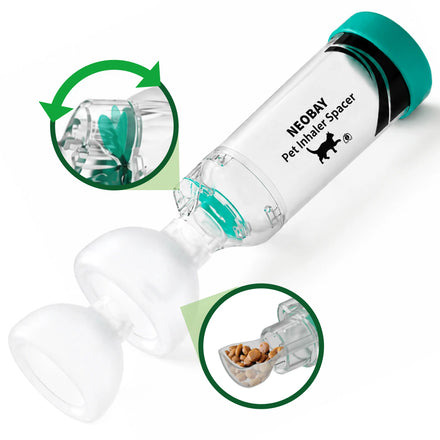
Neobay Cat Aerosol Chamber with Comfort Feeder — Green
- See each breath with the Flow Indicator
- Built-in treat holder makes mask practice easier
- Anti-static chamber helps keep medication airborne
When URI Symptoms Don't Go Away: Could It Be Something Else?
Here's a scenario we hear from cat owners constantly: their cat gets diagnosed with repeated "colds" or "URI flare-ups," but the real problem was feline asthma the entire time.
URI symptoms and mild feline asthma can look nearly identical in the early stages: - Sneezing? URI. But also — some asthmatic cats sneeze from airway irritation. - Coughing? Both. URI cough is from throat irritation. Asthma cough is from constricted airways. Telling them apart by ear is hard. - Lethargy? Both. Sick cats hide and sleep. Asthmatic cats reduce activity because exertion triggers breathing difficulty. - Reduced appetite? Both. Congestion makes eating hard. Respiratory distress makes everything hard.
The difference matters because the treatments are opposite. URI treatment is supportive + sometimes antibiotics or antivirals. Asthma treatment is inhaled corticosteroids — medication delivered directly to the lungs through a device called an inhaler spacer.
If your cat's "URI" lasts more than two weeks, or comes back repeatedly with no obvious exposure to other sick cats, ask your vet about feline asthma. A chest X-ray is usually the first step. Blood work can help rule out other conditions. In some cases, a bronchoalveolar lavage (BAL) — flushing the airways and analyzing the fluid — gives a definitive answer.
This is especially important for cats who do the classic "asthma crouch" — neck extended, body low to the ground, breathing with visible effort. If you've seen this posture and thought "my cat is trying to cough up a hairball," you might be looking at an asthma attack, not a cold.
Read our guide on how vets diagnose feline asthma for the full diagnostic process, and cat flu or feline asthma to understand the clinical differences.
Frequently Asked Questions
Can I catch my cat's cold?
No. Feline herpesvirus and calicivirus are species-specific. They infect cats, not humans. Your cat can't give you their URI, and you can't give your cat your cold. However, you can transmit the virus between cats on your hands or clothing — wash up between handling sick and healthy cats.
How long does a cat cold last?
Most uncomplicated URIs resolve in 7-10 days. Sneezing can linger for up to two weeks. If symptoms persist beyond 14 days, or worsen instead of improving after day 4, see a vet — it may be a secondary bacterial infection or a different condition.
What can I give my cat for a cold?
Steam therapy, warm food, clean nose and eyes, a comfortable resting space, and time. These are the evidence-backed home treatments. Do not give human cold medications, pain relievers, decongestants, or herbal remedies without veterinary approval. Most are toxic to cats.
When should I take my cat to the vet for a cold?
Go to the vet if: your cat stops eating for 24+ hours, nasal or eye discharge turns green or yellow, symptoms get worse after day 4, your cat develops a cough, or any fever above 102.5°F. Go to the emergency vet immediately for open-mouth breathing, blue or pale gums, or extreme lethargy.
Can a cat cold go away on its own?
Yes. The vast majority of viral URIs resolve without medication in 7-10 days. Your job is supportive care — keeping the cat comfortable, hydrated, and eating while the immune system clears the virus. Antibiotics don't treat viruses and aren't needed unless a secondary bacterial infection develops.
Why does my cat keep getting colds?
Repeated URI symptoms usually mean one of two things: either your cat is a chronic carrier of feline herpesvirus (the virus reactivates during stress), or the symptoms aren't actually from a URI. Feline asthma, chronic rhinitis, nasal polyps, and dental disease can all cause recurring respiratory symptoms. If your cat has had three or more "colds" in a year, ask your vet to investigate beyond the standard URI diagnosis.
Should I isolate my sick cat from other cats?
Yes. URI viruses spread through direct contact and shared surfaces. Keep the sick cat in a separate room with their own food, water, litter box, and bedding. Wash your hands between handling cats. The isolation should continue until the sick cat is symptom-free, which usually means 7-14 days.
What to Do Next
-
Assess your cat right now. Run through the symptom checklist in this guide. Is your cat eating? Are they breathing with their mouth closed? If both are true, you're in home-care territory.
-
Start steam therapy today. It's free, it takes 15 minutes, and it's the single most effective thing you can do for a congested cat at home.
-
Monitor food intake closely. This is your #1 indicator of whether things are getting better or worse. Write it down if you need to. If 24 hours pass with no meaningful eating, call the vet.
-
Set a 10-day check-in. If symptoms haven't noticeably improved by day 10, book a vet appointment. Something other than a simple viral URI might be going on.
-
If your cat has recurring respiratory symptoms, don't keep treating them as repeat URIs. Get a proper diagnosis. Feline asthma, chronic rhinitis, and other respiratory conditions require different treatment approaches — and the sooner you know what you're dealing with, the better the outcome for your cat.
A "cat cold" is usually nothing to panic about. But it's also not nothing. Pay attention, provide care, and know when to escalate. Your cat counts on you to tell the difference.
Have questions about your cat's respiratory health? Visit our FAQ page or browse our cat breathing resources for more in-depth guides.
Sources: - Maggs DJ, et al. "Feline Herpesvirus." In: Slatter's Fundamentals of Veterinary Ophthalmology, 6th ed. Elsevier, 2018. - Gaskell R, et al. "Feline Herpesvirus." Veterinary Research, 2007; 38(2): 337-354. - Radford AD, et al. "Feline Calicivirus." Veterinary Research, 2007; 38(2): 319-335. - Cornell Feline Health Center, Cornell University College of Veterinary Medicine. "Feline Upper Respiratory Infection." Accessed 2026. - Scherk MA, et al. "2013 AAFP Feline Vaccination Advisory Panel Report." Journal of Feline Medicine and Surgery, 2013; 15(9): 785-808. - Helps CR, et al. "Factors Associated with Upper Respiratory Tract Disease Caused by Feline Herpesvirus, Feline Calicivirus, Chlamydophila felis and Bordetella bronchiseptica in Cats." Veterinary Record, 2005; 156(21): 669-673.
Related Reading
This article is part of our How Vets Diagnose Feline Asthma — covering tests, X-rays, at-home monitoring, and what to expect at every step of the diagnostic process.


