

Key Takeaways
- Cats with well-managed asthma live normal, full lifespans. The 2019 veterinary consensus is clear: mortality is low, prognosis is good to excellent. Asthma is not a death sentence.
- Untreated asthma is dangerous — not because of sudden death, but because of silent, progressive lung damage. Chronic inflammation causes irreversible airway remodeling that permanently reduces lung function.
- What kills cats isn't the diagnosis. It's severe acute attacks (status asthmaticus) left untreated. Open-mouth breathing = emergency. Get to a vet immediately.
- The three things that determine lifespan: early diagnosis, consistent daily medication (inhaled corticosteroids, not just rescue inhalers), and environmental trigger control.
- Inhaled fluticasone via a spacer chamber is the single biggest longevity upgrade available. It stops inflammation at the source — the lungs — without the systemic side effects that make long-term oral steroids risky.
You just heard the word "asthma" come out of your vet's mouth, and your brain went straight to one question.
Is my cat going to die from this?
It's the question every cat owner asks and almost no one says out loud. You're standing in the exam room, nodding along while the vet explains inhalers and triggers and follow-up visits, and underneath all of it, you're doing the math: How much time do we have?
Here's the answer, directly, before anything else: Cats with properly managed asthma live normal lifespans. They don't live shorter lives. They don't die young. The 2019 veterinary research consensus — from the top feline respiratory researchers in the world — is that feline asthma carries "low mortality and a good to excellent prognosis."
Your cat is not going anywhere. But that outcome is not automatic. It depends on what you do next.
The Short Answer: Normal Lifespan Is the Norm
The most-cited paper on this topic comes from Garrity, Lee-Fowler, and Reinero, published in the Journal of Feline Medicine and Surgery in 2019. Their conclusion, drawn from reviewing the full body of clinical research on feline asthma:
"In asthma, morbidity is relatively high, but mortality is low, with an overall good to excellent prognosis."
Let's translate that from research-ese into plain English:
- Morbidity is high — This means asthmatic cats have symptoms. They cough. They wheeze. Some have scary episodes where they struggle to breathe. The disease announces itself.
- Mortality is low — This means they don't die from it. Not when it's treated. Not even close to the mortality rates of conditions that look similar, like heartworm-associated respiratory disease or congestive heart failure.
- Prognosis is good to excellent — This means the expected outcome, for the typical diagnosed cat receiving standard treatment, is a normal life.
The MSD Veterinary Manual confirms the same finding. So does every major veterinary teaching hospital that publishes on this topic.
The numbers behind this: feline asthma affects an estimated 1-5% of all pet cats. It typically first appears in young to middle-aged cats (median age 4-5 years). Siamese and Himalayan cats may be slightly predisposed. And the overwhelming majority of these cats — with treatment — live out their natural lives.
What the Research Says About Mortality
The question people actually mean when they ask about life expectancy is: Can my cat die from this?
The answer is yes, but with important context.
A severe, untreated asthma attack — what veterinarians call status asthmaticus — can be fatal. During these episodes, the airways constrict so severely that the cat cannot move enough oxygen. Cyanosis sets in (blue-tinged gums and tongue from oxygen deprivation). Without emergency intervention — oxygen therapy, injectable bronchodilators, systemic steroids — a cat in status asthmaticus can die within hours.
A dvm360 clinical proceedings review described feline asthma as causing "substantial morbidity and occasional mortality" — meaning the disease makes cats sick frequently, but death is the exception, not the rule.
The most common acute complication is secondary spontaneous pneumothorax — air leaking from damaged lungs into the chest cavity, causing lung collapse. A 2014 study in the Journal of Veterinary Emergency and Critical Care found that asthma was the single most common cause of spontaneous pneumothorax in cats, responsible for 25% of cases. But critically: all four asthmatic cats in that study survived to discharge with medical management.
The pattern is consistent across the literature: acute crises are terrifying and require immediate treatment, but they are survivable when treated promptly.
What the Numbers Mean for You
If your cat coughs occasionally and the cough responds to medication: normal lifespan.
If your cat has had one or two emergency episodes that were treated promptly: still normal lifespan, with a note that recurrent status asthmaticus warrants more aggressive daily management.
If your cat's asthma is untreated and progressive: this is where lifespan shortens. Not because asthma itself is fatal, but because chronic inflammation remodels the airways into permanently damaged, poorly functioning tissue.
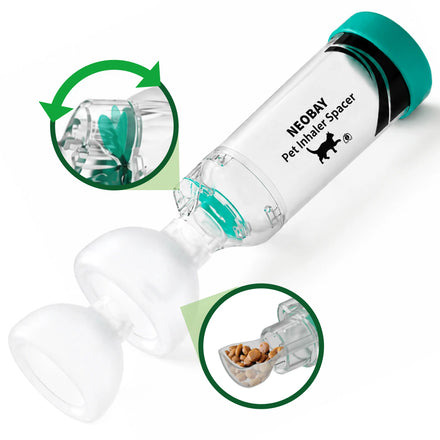
Neobay Cat Aerosol Chamber with Comfort Feeder — Green
- See each breath with the Breath Indicator
- Built-in treat holder makes mask practice easier
- Anti-static chamber helps keep medication airborne

The Real Threat: Airway Remodeling
This is the part most "cat asthma life expectancy" articles skip. But it's the mechanism that actually determines long-term outcomes.
Feline asthma starts as an allergic reaction. A sensitized cat inhales an allergen — dust mites, pollen, mold spores, cigarette smoke — and their immune system overreacts. Mast cells in the airway walls release histamine and other inflammatory mediators. The airways constrict. Mucus pours into the passages. The cat coughs and wheezes.
In a treated cat, medication suppresses this cycle. The inflammation quiets down. The airways relax. Lung function returns to near-normal.
In an untreated cat, the cycle continues — and the lungs change permanently.
Airway remodeling is the term for what happens when inflammation goes unchecked for months and years:
| Change | What Happens | Consequence |
|---|---|---|
| Bronchial wall thickening | Collagen deposits build up in airway walls | Airways become stiff, unable to dilate fully |
| Smooth muscle hypertrophy | The muscle layer wrapping airways grows thicker | More severe bronchoconstriction during attacks |
| Goblet cell hyperplasia | Mucus-producing cells multiply | Chronic mucus plugging, trapping air in lungs |
| Subepithelial fibrosis | Scar tissue forms beneath the airway lining | Permanent reduction in airflow |
Once these structural changes occur, they don't reverse. Bronchodilators can relax the muscle component, but they can't undo fibrosis or thin a thickened airway wall. This is the "fixed obstruction" component of asthma — like a pipe that's been narrowed by scale buildup rather than a temporary kink.
Mesenchymal stem cell therapy, still experimental, showed promise in a 2014 study for reducing CT-measured airway remodeling in cats — but the effects weren't permanent, and the therapy isn't clinically available. The only proven way to prevent remodeling is to suppress inflammation before it causes damage.
This is why "I'll treat it when he coughs" doesn't work. Subclinical inflammation — inflammation that's present but not causing visible symptoms — continues damaging airways between episodes. By the time you hear coughing, the inflammatory process has been active for days or weeks.
What Actually Determines How Long Your Cat Lives
Five factors, based on the veterinary literature:
1. How early treatment starts
Cats diagnosed and treated within months of symptom onset have far better long-term outcomes than cats who've been coughing for years before anyone realizes it's asthma. Early inhaled corticosteroids prevent the remodeling cascade from starting. Late treatment can only slow it down.
2. Consistency of daily medication
The cats who live longest are not the ones on the most expensive medication. They're the ones whose owners give medication every single day, not just when the cat coughs. Inhaled fluticasone takes 48-72 hours to reach full anti-inflammatory effect. It's a maintenance drug, not a rescue drug. Missing days means inflammation creeps back.
3. Whether the cat uses a spacer chamber
This is not a minor detail. An inhaler without a spacer delivers medication to the back of the throat, where it's swallowed — not to the lungs, where it's needed. Deposition without a spacer is under 5%. With a proper feline spacer chamber, it reaches 10-20%. That's a 2-4x difference in medication reaching the target.
Cats on inhaled medication without a spacer are effectively under-dosed. Over years, that under-dosing adds up to more inflammation, more remodeling, and a shorter functional lifespan.
4. Environmental trigger control
Every asthma attack starts with a trigger. A cat living in a home with scented candles, cigarette smoke, dusty clay litter, and aerosol cleaning products is inhaling inflammatory stimuli every day. A cat in a home with HEPA filtration, dust-free litter, and no scented products has a fundamentally lower inflammatory burden. Same disease, same medications — different trajectory.
5. Weight
Obesity directly compromises respiratory function. Excess body fat restricts diaphragm movement, reduces lung capacity, and increases the work of breathing. Obese cats with asthma have worse outcomes than lean cats with the same disease severity. Body condition score matters. Target: 4-5 out of 9.
Older cats face the same trade-offs. Our guide to feline asthma in senior cats covers how aging changes diagnosis, treatment, and daily management.

Quality of Life: What "Normal" Looks Like
Life expectancy numbers don't capture what owners actually want to know: Will my cat still be a cat?
The answer, across dozens of documented cases, is yes.
Zoe, diagnosed at 12 months with moderate asthma. Flovent 220 mcg twice daily via AeroKat. Cough-free within 3 months. A year later: "happy, loving, and extremely active." Normal cat life.
Leo, an 11-year-old rescue adopted by a veterinary professional. Inhaled medication plus a kidney-friendly diet. His owner describes him as "living his best life."
Big Guy, 7 years old at diagnosis. His owner Linda reports he "religiously comes to me in the evening before we go to bed for a puff." He associates the spacer with attention and treats. It's a routine, not a struggle.
The pattern: once the right medication and routine are established, cats return to their baseline. They chase toys, watch birds, nap in sunbeams, demand food at 5 am. The asthma becomes background noise — managed, not defining.
Isis, a Bengal cat whose owners pursued an integrative approach, lived to 18 — well past the average cat lifespan — with her asthma managed throughout.
How to Maximize Your Cat's Lifespan
New to a feline asthma diagnosis? Before worrying about the long term, get through the first day with confidence — our step-by-step checklist for your first 24 hours covers everything from medication setup to home changes.
Five evidence-based actions, in order of impact:
1. Start inhaled corticosteroids now, not later. Fluticasone delivered via a metered-dose inhaler with a feline spacer chamber. This is the single highest-impact decision. It controls inflammation at the source, prevents airway remodeling, and avoids the systemic side effects of oral prednisolone (diabetes risk, kidney strain, weight gain). Oral steroids work — they're better than nothing — but they bathe the entire body in corticosteroids, not just the lungs. Inhaled is targeted. For a cat you expect to live another 10-15 years, the cumulative difference in side-effect burden is enormous.
2. Use a rescue inhaler correctly. Albuterol opens airways during an attack. It does not treat inflammation. A cat who needs albuterol more than twice a week needs more anti-inflammatory medication, not more albuterol. Over-reliance on rescue inhalers without adequate steroid therapy is associated with increased mortality in human asthma — and the same concern applies to cats.
3. Eliminate triggers. Remove scented candles, plugins, diffusers, aerosol sprays, and all smoking/vaping from the home. Switch to dust-free litter (paper pellets, tofu, corn). Run a HEPA air purifier in the cat's primary room. Vacuum with a HEPA-filter vacuum twice a week. These changes cost little and prevent attacks before they start.
4. Monitor respiratory rate at home. Count your cat's breaths per minute while sleeping. Normal: under 30. Elevated resting respiratory rate is an early warning sign — often appearing days before visible symptoms. Catching an impending flare-up early lets you intervene (increase medication temporarily under vet guidance) before it becomes an emergency.
5. Keep your cat lean. Body condition score 4-5/9. Every extra pound compresses the lungs and increases systemic inflammation. Weight management is part of asthma management.
Frequently Asked Questions
Can cats die from asthma?
Yes, but it's uncommon with proper treatment. Death occurs during status asthmaticus — a severe, prolonged asthma attack where the airways constrict so tightly the cat cannot oxygenate. This is a medical emergency requiring immediate veterinary intervention (oxygen, injectable bronchodilators, systemic steroids). A cat showing open-mouth breathing, panting, or blue-tinged gums needs an emergency vet immediately. The 2019 veterinary research consensus is that feline asthma carries "low mortality" overall.
How long can a cat live with untreated asthma?
There is no single number. The danger of untreated asthma is not sudden death but progressive, irreversible lung damage (airway remodeling). Over months to years, chronic inflammation causes bronchial wall thickening, fibrosis, and permanent airflow obstruction. An untreated cat may live 5-8 years with progressively worsening symptoms, compared to a normal 15-18 year lifespan with treatment. The quality-of-life decline — increasing respiratory distress, reduced activity, frequent emergency visits — often precedes actual mortality by years.
Does feline asthma shorten a cat's life?
Not when it's properly managed. The current veterinary consensus is that cats on consistent anti-inflammatory therapy (inhaled corticosteroids ± bronchodilators) with environmental trigger control achieve normal lifespans. The factors that do shorten life are: delayed diagnosis, inconsistent medication use, failure to use a spacer chamber with inhaled medication, obesity, and repeated episodes of status asthmaticus.
What is the life expectancy of a cat with asthma?
Normal. The 2019 Garrity et al. review in the Journal of Feline Medicine and Surgery states the prognosis is "good to excellent." Cats diagnosed early and treated consistently live as long as cats without asthma. The condition is chronic and incurable, but highly manageable. The key variable is not the diagnosis — it's the quality of daily management.
How do I know if my cat's asthma is getting worse?
Track three metrics: (1) resting respiratory rate while sleeping — consistently above 30 breaths per minute is a red flag; (2) frequency of coughing episodes — increasing frequency means inflammation is not controlled; (3) albuterol rescue inhaler use — needing it more than twice a week signals inadequate baseline anti-inflammatory control. Any instance of open-mouth breathing or panting is an emergency, not just a data point.
Can cats with asthma still have a good quality of life?
Yes. Documented cases across veterinary literature and owner testimonials consistently describe cats returning to normal activity — playing, climbing, hunting, socializing — once the right medication protocol is established. Many cats learn to accept or even look forward to inhaler sessions when paired with treats. The adjustment period is typically 2-4 weeks. After that, asthma management becomes a 2-minute daily routine, not a lifestyle constraint.
Is inhaled medication really better than pills for life expectancy?
For long-term outcomes, yes. Inhaled fluticasone delivers corticosteroids directly to the lungs, where the inflammation is, with minimal systemic absorption. Oral prednisolone circulates through the entire body. Over 10-15 years, the cumulative risks of oral steroids — diabetes mellitus, iatrogenic Cushing's disease, kidney damage, weight gain — become statistically significant. Inhaled medication avoids these risks almost entirely. A spacer chamber is required for effective delivery; without one, the medication never reaches the lungs.
What to Do Next
- If your cat is newly diagnosed: Start inhaled fluticasone now. Not next month, not "let's see if diet helps first." Every week of uncontrolled inflammation contributes to airway remodeling. The sooner you start, the more lung function your cat preserves for life.
- If your cat is on oral prednisolone long-term: Ask your vet about transitioning to inhaled fluticasone with a spacer chamber. Same anti-inflammatory mechanism, fraction of the systemic risk. Most vets support this transition — they'd rather your cat be on lung-targeted medication than whole-body steroids for a decade.
- If your cat's asthma seems well-controlled: Count resting respiratory rate once a week. It takes 60 seconds. Write it down. An upward trend over 2-3 weeks is your earliest warning that inflammation is building. Adjust treatment before symptoms appear.
- Audit your home for triggers. Scents, smoke, dust, aerosol sprays. Removing triggers is free and prevents attacks before they happen.
The research is clear and it's been consistent for years: feline asthma is not a death sentence. It's a chronic condition that requires daily management, like diabetes in humans or hypothyroidism in cats. The cats who live longest aren't the ones with the mildest disease. They're the ones whose owners treat it seriously, consistently, and early.
Your cat is not going anywhere. But they need you to do the work.
Learn more about how a spacer chamber ensures inhaled medication actually reaches the lungs →
Have questions? Visit our FAQ page or contact us directly.
Sources: - Garrity S, Lee-Fowler T, Reinero C. "Feline asthma and heartworm disease: Clinical features, diagnostics and therapeutics." Journal of Feline Medicine and Surgery, 2019; 21: 825-834. - Trzil JE. "Feline asthma: diagnostic and treatment update." Veterinary Clinics of North America: Small Animal Practice, 2020; 50(2): 375-391. - MSD Veterinary Manual. "Feline Bronchial Asthma." Accessed 2026. - Liu DT, Silverstein DC. "Feline secondary spontaneous pneumothorax: a retrospective study of 16 cases (2000-2012)." Journal of Veterinary Emergency and Critical Care, 2014. - Trzil JE, Reinero CR. "Update on feline asthma." Veterinary Clinics of North America: Small Animal Practice, 2014; 44(1): 91-105. - Trzil JE, et al. "Long term evaluation of mesenchymal stem cell therapy in a feline model of chronic allergic asthma." Clinical & Experimental Allergy, 2014; 44(12): 1546-1557. - Cornell Feline Health Center. "Feline Asthma: What You Need to Know." Cornell University College of Veterinary Medicine. https://www.vet.cornell.edu/departments-centers-and-institutes/cornell-feline-health-center/health-information/feline-health-topics/feline-asthma-what-you-need-know - dvm360. "Therapy for feline bronchopulmonary disease (asthma) (Proceedings)." Accessed 2026.
Related Reading
This article is part of our Feline Asthma: The Complete Owner's Guide — covering everything from causes and symptoms to treatment and daily management.


