

Key Takeaways
- A HEPA air purifier can reduce airborne asthma triggers in your home, but it cannot replace medication — it removes particles from the air, not inflammation from your cat’s lungs.
- HEPA filters capture 99.97% of particles at 0.3 microns, which covers the size range of most feline asthma triggers including cat dander (1–10 μm), dust mite debris (10–40 μm), and pollen (10–100 μm).
- Ozone-generating air purifiers are dangerous for cats with asthma — ozone itself is a respiratory irritant and can trigger the very attacks you’re trying to prevent.
- One air purifier is rarely enough for a multi-room home — air does not circulate freely between rooms, so you need coverage where your cat actually spends time.
- The most effective strategy combines air purification with medication and environmental management — a purifier alone is one piece, not the solution.
You bought the $200 air purifier. You switched to unscented cleaning products. You give your cat the inhaler every day, wrapping her in a towel like a burrito just to get the mask on her face for ten seconds. And still — the coughing fits come.
If this sounds familiar, you’re not alone. A post on Reddit from a cat owner who had “done everything” and was still watching their cat have multiple asthma attacks a day drew hundreds of replies from people in the exact same situation. The air purifier is supposed to help. Your vet said it would help. So why is your cat still coughing?
This article looks at what the research actually says about air purifiers and feline asthma, how HEPA filtration works (and where it falls short), and how to build a complete environmental management plan instead of betting everything on a single machine.
How Airborne Triggers Cause Asthma Attacks in Cats
Feline asthma is a chronic inflammatory disease of the lower airways that causes recurring episodes of coughing, wheezing, and labored breathing. When a cat with asthma inhales an irritant, the immune system overreacts — the airways constrict, mucus production increases, and breathing becomes difficult.
Airborne triggers are central to this process. Not every asthma attack is triggered by something in the air, but many are — and reducing those triggers is one of the few things you can control directly. The common triggers that make your cat’s asthma worse include household dust, cat litter particles, perfume, smoke, pollen, and mold spores. All of these are particles suspended in the air that your cat breathes in.
Here’s why airborne triggers hit cats harder than humans:
- Airway size. A cat’s bronchioles are roughly 1 to 2 millimeters in diameter. A particle that barely irritates a human airway can partially block a cat’s.
- Proximity to dust sources. Your cat’s nose is inches from the litter box while digging, and close to the floor where dust settles.
- Grooming behavior. Particles that land on your cat’s fur get ingested or pushed deeper into the nasal passages during grooming.
- Confined indoor environment. Most indoor cats spend their entire lives in the same airspace, with no escape from whatever is floating around.
The size of the particle matters because it determines where it lands in the respiratory tract:
| Trigger | Particle Size | Reaches Lower Airways? | HEPA Captures? |
|---|---|---|---|
| Cat dander | 1–10 μm | Yes | Yes |
| Dust mite debris | 10–40 μm | Some | Yes |
| Pollen | 10–100 μm | Rarely | Yes |
| Mold spores | 2–20 μm | Yes | Yes |
| Cat litter dust (PM2.5) | <2.5 μm | Yes | Yes |
| Cigarette smoke (particulate) | 0.01–1 μm | Yes | Most |
| VOCs (perfume, cleaners) | Gas molecules | Yes | No |
This table tells you two things: HEPA filters can capture most of the solid particles that trigger feline asthma, and they cannot capture gaseous irritants like perfume fumes or volatile organic compounds (VOCs). We’ll come back to that limitation.

What HEPA Filters Actually Do (And Why That Matters for Cats)
HEPA stands for High-Efficiency Particulate Air. A true HEPA filter must capture at least 99.97% of particles that are 0.3 microns in diameter, as defined by the U.S. Department of Energy standard.
The 0.3-micron specification is not arbitrary — it represents the Most Penetrating Particle Size (MPPS). Particles smaller than 0.3 microns move in random Brownian motion and are more likely to collide with and stick to filter fibers. Particles larger than 0.3 microns are more likely to be caught directly by interception or impaction. So 0.3 microns is the hardest size to capture — and HEPA filters still catch 99.97% of them.
For cats with asthma, this means:
- Cat dander (1–10 μm): Larger than MPPS → captured at rates above 99.97%
- Dust mite debris (10–40 μm): Much larger → effectively 100% capture
- Pollen (10–100 μm): Much larger → effectively 100% capture
- Mold spores (2–20 μm): Above MPPS → captured above 99.97%
- Cat litter dust (<2.5 μm): At or above MPPS → captured at 99.97% or higher
This is why veterinarians who specialize in feline respiratory disease often recommend HEPA air purifiers as part of an environmental management plan. The mechanism is sound — if you remove the particles from the air, your cat inhales fewer triggers, and the frequency and severity of asthma attacks should decrease.
But there are two important gaps:
1. HEPA does not capture gases. Volatile organic compounds from cleaning products, perfumes, essential oils, and cigarette smoke exist as gas molecules, not particles. HEPA filters pass these right through. An activated carbon pre-filter can adsorb some gaseous pollutants, but carbon filters saturate quickly and need frequent replacement. If your cat’s primary trigger is a scented product or smoke, a HEPA purifier alone will not solve the problem.
2. HEPA does not eliminate the source. An air purifier removes particles that are already airborne. It does not stop your cat from kicking up dust in the litter box, and it does not prevent mold from growing in your HVAC ducts. If you’re dealing with cat litter dust triggering your cat’s asthma, switching to a low-dust litter is at least as important as running a purifier.
What the Research Says About Air Purifiers and Feline Asthma
Here is where we need to be honest: there are no randomized controlled trials testing air purifiers specifically for cats with asthma. The veterinary literature does not include a study that takes 50 asthmatic cats, gives half of them HEPA purifiers and half a placebo, and measures the difference in coughing frequency. That study does not exist.
What does exist is indirect evidence from several directions:
Environmental trigger management is a recognized part of feline asthma treatment. A review by Reinero and colleagues published in the Journal of Feline Medicine and Surgery identified environmental dust and aerosolized irritants as significant contributors to airway inflammation in cats with lower respiratory disease, and recommended environmental modification as part of a comprehensive treatment plan (Reinero et al., 2019). Air purifiers are one method of environmental modification.
HEPA filtration demonstrably reduces indoor particulate matter. The U.S. Environmental Protection Agency reports that portable HEPA air cleaners can reduce indoor PM2.5 concentrations by 40 to 80 percent, depending on room size, airflow, and outdoor pollution levels (EPA, 2024). This is not specific to cats — it’s about the particles — but since those same particles are feline asthma triggers, the reduction applies.
Human studies on air purifiers and asthma show modest benefit. A meta-analysis in the Annals of Allergy, Asthma & Immunology found that HEPA air cleaners reduced asthma symptoms and medication use in human patients, particularly when combined with other environmental controls (Sublett, 2011). Cats are not humans, but the underlying mechanism — removing airborne triggers from the breathing zone — is the same.
The bottom line: The evidence supports HEPA air purifiers as a reasonable, likely helpful addition to feline asthma management. But “reasonable and likely helpful” is not the same as “proven and sufficient.” An air purifier is one tool in a toolkit that must also include medication and other environmental changes.
Ozone Generators: The Air Purifier Type That Can Harm Your Cat
Not all air purifiers are created equal. Some devices marketed as “air purifiers” produce ozone — and ozone is a direct respiratory irritant that can make your cat’s asthma worse, not better.
Ozone generators work by producing ozone (O₃), a highly reactive gas that oxidizes odors, mold, and bacteria. They’re sometimes marketed for “shock treatment” of heavily contaminated spaces. The problem: ozone damages the mucous membranes of the respiratory tract at concentrations as low as 0.05 parts per million, which is below the level some ozone generators produce.
The U.S. EPA has issued explicit warnings that ozone generators should not be used in occupied spaces. The California Air Resources Board (CARB) has gone further, banning the sale of ozone generators for air cleaning purposes in California.
Ionizing air purifiers are a more subtle concern. Some electrostatic precipitators and “negative ion” purifiers produce trace amounts of ozone as a byproduct. The amount is usually small — well below the EPA limit — but for a cat with severe asthma, even trace ozone in a small, poorly ventilated room could be a trigger.
How to make sure your air purifier is safe:
- Look for CARB certification — all air cleaners sold in California must be certified ozone-free
- Check if the device is listed with the Association of Home Appliance Manufacturers (AHAM) — AHAM-certified models meet ozone safety standards
- Avoid any product that says “ozone generator,” “activated oxygen,” or “super-oxygenated air”
- If your purifier has an “ionizer” feature, check whether it can be turned off independently — many can
- If you smell a sharp, chlorine-like odor near your purifier, it may be producing ozone — unplug it
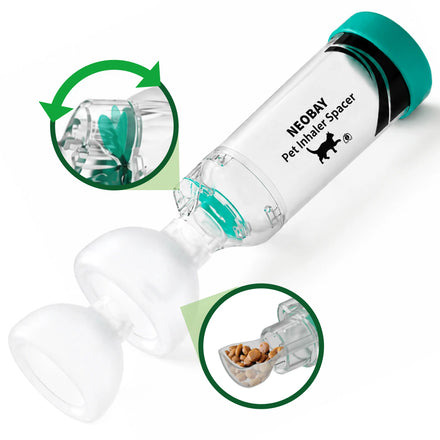
Neobay Cat Aerosol Chamber with Comfort Feeder — Green
- See each breath with the Flow Indicator
- Built-in treat holder makes mask practice easier
- Anti-static chamber helps keep medication airborne
If your cat has been diagnosed with asthma, you already know that inhaled medication is the foundation of treatment. A spacer chamber holds the medication from the metered-dose inhaler so your cat can breathe it in at their own pace — no coordination required. A flow indicator on the chamber gives you visual confirmation that your cat is actually inhaling the medication, which removes the guesswork from every session.
But here’s the connection that many cat owners miss: even with perfect medication compliance, if your cat is still breathing in dust, dander, and mold spores every day, the underlying inflammation never fully calms down. The medication controls the fire. The air purifier removes the kindling. You need both.

How to Choose an Air Purifier for a Cat with Asthma
If you’re going to invest in an air purifier, make sure you’re getting one that actually helps. Here’s what matters:
1. True HEPA, Not “HEPA-Type”
“True HEPA” means the filter meets the DOE standard of 99.97% capture at 0.3 μm. “HEPA-type” or “HEPA-style” means nothing — these filters have no defined performance standard and may capture significantly less. Always look for “True HEPA” on the label.
2. Match CADR to Room Size
CADR (Clean Air Delivery Rate) measures how quickly the purifier cleans the air, expressed in cubic feet per minute (CFM). The higher the CADR, the faster the air in the room is cleaned.
A rough rule: choose a purifier with a smoke CADR that is at least two-thirds of the room’s square footage. For a 150-square-foot bedroom, you want a smoke CADR of at least 100. For a 300-square-foot living room, at least 200.
AHAM recommends that the purifier’s CADR allow for 5 air changes per hour (ACH) in the target room. You can calculate this:
Required CADR = (Room volume in cubic feet × 5 ACH) ÷ 60 minutes
For a 12 ft × 12 ft × 8 ft room: (1,152 × 5) ÷ 60 = 96 CFM minimum.
3. One Purifier Per Room Where Your Cat Spends Time
This is the single most common mistake. Air does not circulate freely between rooms in a typical home — walls, doors, and furniture create barriers. A purifier running in the living room does nothing for the bedroom where your cat sleeps.
For most cat owners, this means at least two purifiers: one for the main living area and one for the room where your cat sleeps. If your cat’s litter box is in a separate room, that room needs coverage too.
If budget is a concern, prioritize the room where your cat spends the most time and add coverage as you can.
4. Consider Noise Level
Cats have far more sensitive hearing than humans. A purifier that sounds like a quiet hum to you may sound like a jet engine to your cat. If the purifier is loud enough to make your cat avoid the room, it defeats its own purpose.
Look for purifiers rated at 40 decibels or below on their lowest setting. Many quality HEPA purifiers have a “sleep mode” that runs at near-silent levels. This is usually sufficient for overnight use and is the setting your cat is most likely to tolerate.
5. Replace Filters on Schedule
A HEPA filter that is clogged with captured particles is less effective at cleaning the air and, in some designs, can begin to release trapped particles back into the air. This was a problem reported by multiple cat owners on Reddit — their cat’s asthma seemed to get worse, and the culprit turned out to be a filter that hadn’t been changed in over a year.
Most manufacturers recommend replacing the HEPA filter every 6 to 12 months and the carbon pre-filter every 3 months. Set a calendar reminder. Your cat can’t tell you when the air is getting worse.

Beyond the Purifier: A Complete Environmental Management Plan
An air purifier is one component of environmental management, not the whole strategy. If you’re relying on the purifier alone, you’re leaving the most effective interventions on the table.
Switch to low-dust cat litter. If you haven’t already, this is probably the single highest-impact change you can make. Clumping clay litter produces fine dust that HEPA filters can capture — but only after it’s already airborne and your cat has already inhaled some of it. Switching to paper-based or walnut shell litter prevents the dust from entering the air in the first place. Our article on cat litter and feline asthma covers this in detail.
Clean your HVAC ducts. If your cat’s asthma gets worse when the heat or air conditioning turns on, the problem may not be the temperature — it may be what’s inside the ductwork. Dust, mold, and pet dander accumulate in HVAC ducts over time and get blown into every room when the system runs. Professional duct cleaning costs $300 to $500 but can make a measurable difference in indoor air quality.
Remove the source, don’t just filter the air. Stop using scented candles, essential oil diffusers, perfume, and aerosol sprays in your home. HEPA filters cannot remove VOCs from the air — the only solution is not to introduce them in the first place. This is a change an air purifier cannot make for you.
Vacuum with a HEPA-filter vacuum. Standard vacuums pick up large debris but exhaust fine particles back into the air. A vacuum with a sealed HEPA filtration system captures those particles instead of redistributing them. Vacuum at least twice a week in areas where your cat spends time, and more often during high-pollen seasons.
Combine air purification with inhaled medication. This is the point most resources miss. Environmental management reduces the frequency and severity of asthma attacks, but it does not eliminate the underlying airway inflammation. That requires inhaled corticosteroids delivered through a spacer chamber — the gold-standard treatment for feline asthma. The medication and the purifier serve different purposes. One reduces triggers. The other treats the disease. You need both.
Frequently Asked Questions
Can an air purifier stop my cat’s asthma attacks?
An air purifier can reduce the frequency and severity of asthma attacks by removing airborne triggers from your cat’s environment, but it cannot stop attacks entirely. Feline asthma is a chronic inflammatory disease that requires medication (typically inhaled corticosteroids via a spacer chamber) in addition to environmental management. Think of the air purifier as removing matches from a room — it helps, but the fire is still there.
Are air purifiers safe for cats?
Yes — as long as you choose the right type. True HEPA air purifiers are safe for cats and produce no harmful byproducts. However, ozone-generating air purifiers and some ionizing models produce ozone, which is a respiratory irritant and can trigger asthma attacks. Look for CARB-certified models that are verified ozone-free. If your purifier has a separate ionizer switch, turn it off.
Do I need more than one air purifier for my asthmatic cat?
In most homes, yes. Air does not circulate freely between rooms, so a single purifier only cleans the air in the room where it’s placed. If your cat moves between the living room, bedroom, and the room with the litter box, you need coverage in each of those spaces. At minimum, place a purifier in the room where your cat sleeps and the room where your cat spends the most awake time.
Can a used air purifier make my cat’s asthma worse?
Yes, it can. A used air purifier may harbor allergens, mold, and contaminants from its previous environment that get released back into the air when the device is turned on. If you acquire a used purifier, replace all filters before using it in your home. A clogged or contaminated filter can release trapped particles and actually worsen air quality. One cat owner on Reddit reported that a secondhand purifier from a smoking household made their cat’s symptoms significantly worse until the filters were replaced.
Should I run the air purifier all the time?
For a cat with asthma, yes — run your air purifier continuously on a low or medium setting. Airborne particles are constantly being generated by daily activities (cooking, cleaning, your cat using the litter box, dust being disturbed by movement). Running the purifier only at night or only part-time means your cat is breathing unfiltered air for a significant portion of the day. Most quality HEPA purifiers are designed for continuous operation and consume relatively little electricity (comparable to a light bulb).
What is the difference between HEPA and ozone generators?
HEPA air purifiers use a dense physical filter to capture particles from the air — they trap dust, dander, pollen, and other solids as air passes through. They produce no chemical byproducts and are safe for continuous use around pets. Ozone generators produce ozone gas (O₃) to chemically oxidize odors and contaminants. Ozone is a lung irritant that can trigger asthma attacks in cats and humans. The EPA and the California Air Resources Board warn against using ozone generators in occupied spaces. If you have a cat with asthma, choose a HEPA purifier — never an ozone generator.
For specific brand recommendations and ozone safety details, see our 2026 lab-tested air purifier picks for cats with asthma.
What to Do Next
- Check your current air purifier. Is it True HEPA? Does it have a CARB certification? If it’s an ozone generator or an unbranded “HEPA-type” unit, replace it.
- Place purifiers where your cat actually spends time. One in the bedroom, one in the main living area. If budget allows, add one near the litter box.
- Talk to your vet about the full picture. If your cat is still having regular asthma attacks despite an air purifier, the treatment plan likely needs adjustment. Inhaled corticosteroids delivered through a spacer chamber are the foundation of feline asthma treatment — a purifier supports the medication, but it doesn’t replace it. And if your cat resists the mask, a soft, contoured mask design can make daily treatment sessions far less stressful for both of you.
An air purifier is a good investment for a cat with asthma. Just don’t expect it to do the job alone.
Have questions? Visit our FAQ page or contact us directly.
Sources: - Reinero CR, et al. “Feline asthma: diagnosis and treatment.” Journal of Feline Medicine and Surgery, 2019. - Trzil JE, Reinero CR. “Update on feline asthma.” Veterinary Clinics of North America: Small Animal Practice, 2020. - U.S. Environmental Protection Agency. “Residential Air Cleaners: A Technical Summary.” 3rd ed., 2024. - Sublett JL. “Effectiveness of air filters and air cleaners in allergic respiratory diseases.” Annals of Allergy, Asthma & Immunology, 2011. - California Air Resources Board. “Hazardous Ozone-Generating Air Purifiers.” Accessed 2026.
Related Reading
This article is part of our Feline Asthma: The Complete Owner's Guide — covering everything from causes and symptoms to treatment and daily management.


