

Key Takeaways
- An asthma attack with open-mouth breathing, blue gums, or collapse is a life-threatening emergency — get to the vet immediately. Do not "wait and see."
- Mild attacks (coughing, wheezing, normal gum color) can often be managed at home if you have a rescue inhaler and know the steps.
- If you don't have a rescue inhaler yet, you can still help — reduce triggers, keep your cat calm, and call the vet for guidance.
- A cat-specific spacer chamber is non-negotiable for rescue medication — without it, the medicine never reaches the lungs.
- After any attack, log it. Date, time, severity, what happened before. Your vet needs this data to adjust treatment.
Your cat is crouched low to the ground, neck stretched forward, making a sound you've never heard before. Maybe it's a wheeze. Maybe it's a hacking cough that produces nothing. Maybe her sides are moving in and out way too fast.
And you're standing there, heart racing, thinking: Is this an emergency? What do I do? Do I grab the carrier or wait it out?
Here's the thing — most cat asthma guides tell you what asthma is. They don't tell you what to do at 11pm on a Tuesday when your cat can't breathe and the vet is closed.
This one does.
What a Cat Asthma Attack Actually Looks Like
Before you can act, you need to know what you're looking at. Asthma attacks don't always look like you'd expect.

The Classic Attack Posture
A cat in an asthma attack typically crouches low with her neck extended forward and downward — almost like she's trying to cough up a hairball. Her shoulders may hunch. Her mouth may be slightly open. Her sides might pump in and out visibly.
This posture is called orthopnea — the body's way of trying to open the airways by positioning the head and neck in a straight line.
The sound? It varies. Some cats wheeze — a high-pitched whistling noise, especially on the exhale. Others make a dry, hacking cough that sounds exactly like the pre-hairball gag. That's why so many owners mistake early asthma attacks for hairballs: the posture and sound are nearly identical.
The difference: a hairball eventually produces something. An asthma attack doesn't.
Mild vs. Emergency: The Decision That Matters
This is the part no other guide gives you. When your cat is struggling, you need to know whether you're grabbing keys or waiting and watching.
| Symptom | Mild Attack (Monitor at Home) | Emergency (Go to Vet NOW) |
|---|---|---|
| Breathing | Coughing, wheezing, slightly faster than normal | Open-mouth breathing, gasping, sides heaving |
| Gum color | Pink (normal) | Blue, purple, grey, or pale |
| Posture | Crouched but alert, responsive | Collapsed, unresponsive, or extreme distress |
| Breathing rate | Under 40 breaths/min at rest | Over 40 breaths/min at rest and not slowing down |
| Duration | Resolves within a few minutes | Lasts more than 5 minutes or keeps getting worse |
| Sound | Dry cough, wheeze, gurgling | Frothy mucus, choking sounds, silent struggle |
The one rule that overrides everything else: blue gums = emergency. Period. That means your cat isn't getting enough oxygen. Nothing you do at home will fix it. Go.
If you've never seen your cat have an asthma attack before and you're not sure what's happening — treat it as an emergency. The first attack is always the most dangerous because you don't yet know how severe your cat's asthma is.
Step-by-Step: What to Do During an Attack
Step 1: Stay Calm (Yes, Really)
Your cat is already struggling to breathe. If you panic, she panics more — and stress tightens airways, making the attack worse.
Take a breath. Your cat needs you clear-headed. Everything else on this list depends on you staying calm enough to do it.
Step 2: Check Gum Color
Lift your cat's lip and look at her gums. Pink is okay. Anything blue, grey, purple, or pale — stop reading and go to the emergency vet. Right now.
This takes 5 seconds. It tells you everything you need to know about whether this is a home-management situation or a life-threatening emergency.
Step 3: Reduce Triggers Immediately
Move your cat to a cool, quiet, well-ventilated space. If you know what triggered the attack — smoke, scented candles, a dusty room, a new cleaning product — get away from it.
Turn off anything that puts particles in the air: air fresheners, diffusers, candles, fans blowing dust around. If you were cooking and there's smoke or steam, move to a different room.
If you have a HEPA air purifier, turn it on max. If you don't, opening a window (screened, so she can't escape) helps — as long as it's not a high-pollen day.
Do not run a hot shower for steam. This advice shows up online and it's wrong for asthma attacks. Steam can help with upper respiratory congestion but it does nothing for constricted lower airways — and the heat and humidity can stress a panicking cat further.
Step 4: Use the Rescue Inhaler (If You Have One)
If your vet has prescribed a rescue inhaler (usually albuterol/salbutamol), now is when you use it.
The process:
- Shake the inhaler canister for 5 seconds.
- Attach it to the spacer chamber — the mask-and-tube device your vet prescribed.
- Press the inhaler once to release the medication into the spacer.
- Gently place the mask over your cat's nose and mouth.
- Let her breathe through the spacer for 7-10 seconds — you'll see the flow indicator valve moving with each breath.
- If your vet prescribed 2 puffs, wait 30 seconds between them.
The whole thing takes under a minute. Most cats tolerate it better during an actual attack because they're focused on breathing, not on the mask. (If your cat fights the mask, don't wait until an emergency to practice — here's our step-by-step guide to training your cat to accept an inhaler mask.)
If you don't have a rescue inhaler, skip to Step 5. Do not use a human inhaler without a spacer. Without a spacer chamber, the medication hits the back of the throat and never reaches the lungs. It's useless at best, dangerous at worst.
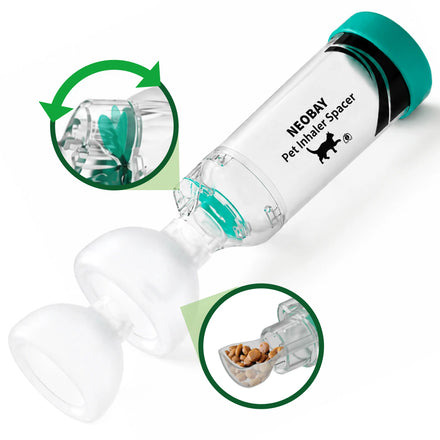
Neobay Cat Aerosol Chamber with Comfort Feeder — Green
- See each breath with the Flow Indicator
- Built-in treat holder makes mask practice easier
- Anti-static chamber helps keep medication airborne
Step 5: Keep Monitoring and Call the Vet
If the attack doesn't improve within 5-10 minutes of using the rescue inhaler — or if it worsens at any point — call your vet or the nearest emergency animal hospital. Tell them you're on the way so they can prepare oxygen and medication.
If the attack subsides: call your vet anyway. Let them know it happened. They may want to adjust your cat's daily medication or see her for a follow-up.
What If You Don't Have Any Medication Yet?
This is more common than veterinary guides admit. Maybe your cat was just diagnosed and the inhaler hasn't arrived. Maybe you've been managing without one and this is the first attack that's scared you.
If you have zero medication and your cat is having a mild attack (pink gums, no open-mouth breathing):
- Reduce triggers — move to clean air immediately.
- Keep your cat calm — quiet room, dim lights, no other pets.
- Do not try to force anything into her mouth or throat. No oils, no herbs, no home remedies. You'll make it worse.
- Call your vet or a 24-hour animal hospital and describe what's happening. They'll tell you whether to come in.
If the attack is anything more than mild — if gums look blue-ish, if she's open-mouth breathing, if she collapses — none of the above matters. Go to the ER.
The Night & Weekend Problem
Asthma attacks have terrible timing. They love 2am. They love Sunday afternoons when your regular vet is closed.
If your regular vet is unavailable: - Google "24 hour emergency vet near me" — have this saved in your phone before you need it. Do it today. - Call ahead — tell them you're coming with a cat in respiratory distress. This lets them prepare oxygen and medication before you arrive. - If you're not sure whether to go: call and describe the symptoms. A vet tech will tell you whether it's a "come in now" or "monitor and call us in the morning" situation.
After the Attack: The Next 24 Hours
The attack is over. Your cat is breathing normally. Now what?
Rest and Recovery
An asthma attack is physically exhausting. Your cat just spent several minutes fighting to breathe. She needs:
- Quiet. No visitors, no vacuuming, no loud TV. Let her sleep.
- A cool room. Heat makes breathing harder. Keep the room 68-72°F if you can.
- Easy access to water. Hydration helps thin mucus. Make sure fresh water is nearby.
- No triggers for at least 24 hours. No candles, no cooking smoke, no dusty litter scooping.
Document the Attack
Before you forget the details, write down:
- Date and time
- How long it lasted
- What happened right before (playing? sleeping? something in the air?)
- What symptoms you saw
- What you did (rescue inhaler? how many puffs?)
- Whether it resolved or required a vet visit
Do this every time. Bring the log to your next vet appointment. The pattern — time of day, triggers, frequency — tells your vet way more than a verbal description can.
Call Your Vet
Even if the attack was mild and resolved quickly, your vet needs to know. Frequent mild attacks mean the daily management plan isn't working. Your cat may need a higher dose of inhaled steroid, a different medication, or trigger identification work. (If your cat hasn't been formally diagnosed yet, here's how vets diagnose feline asthma — tests, X-rays, and what to expect.)
A single mild attack every few months? Probably fine with current management. Multiple attacks per week? Something needs to change.
How to Be Prepared for the Next One
You can't prevent every asthma attack. But you can make the next one less terrifying — for both of you.
Build a Cat Asthma Emergency Kit
Keep these in one place, accessible, where you can grab them in 30 seconds:
- Rescue inhaler (albuterol/salbutamol) — check expiration date every 3 months
- Spacer chamber — cleaned and assembled, ready to use
- Your vet's phone number + nearest 24-hour ER number — saved in your phone AND written down
- A carrier — not buried in a closet. Leave it out with the door open so your cat doesn't associate it only with panic trips
Learn Your Cat's Baseline
When your cat is relaxed and healthy, count her breathing rate. Watch her sides rise and fall for 15 seconds, multiply by 4. A normal resting rate for cats is 20-30 breaths per minute. Anything over 40 at rest is a concern.
Knowing her baseline means you can spot a change immediately — sometimes before the coughing starts.
Take the Triggers Seriously
The most common asthma triggers in cats:
- Cigarette smoke and vaping aerosol
- Scented candles, air fresheners, and essential oil diffusers
- Dusty cat litter (especially clay-based)
- Household cleaners with strong fumes
- Pollen from open windows during allergy season
- Mold and mildew
- Fireplace smoke
You don't need to live in a bubble. But if your cat has asthma, some things have to go. Candles and diffusers are the easiest — just stop using them. For litter, switch to a low-dust option (paper or tofu-based). For cleaning products, choose unscented and keep your cat in another room until surfaces are dry.
For the full list of triggers and how to eliminate them, read our guide to common triggers that make your cat's asthma worse.
Get a Spacer Chamber (If You Haven't Already)
Here's the blunt truth: a rescue inhaler without a spacer chamber is almost useless. The medication needs to be suspended in the chamber's tube for the cat to inhale it into the lungs. Without the spacer, it hits the back of the throat — zero therapeutic effect.
A cat-specific spacer with a visual flow indicator lets you see each breath moving through the device, so you know the medication is actually being inhaled. When you're in the middle of an emergency, that visual feedback matters — it tells you the dose went in.
Learn more about what a cat inhaler spacer is and how it works.
Frequently Asked Questions
What does a cat asthma attack look like?
A cat in an asthma attack typically crouches low with her neck extended forward, coughing or wheezing. Her sides may pump in and out visibly with each breath. In severe attacks, she may open-mouth breathe, drool frothy mucus, or have blue-tinged gums. The posture is often confused with trying to cough up a hairball — the key difference is that nothing comes out.
How do I know if it's an asthma attack or a hairball?
A hairball eventually produces something — even if it takes several tries. An asthma attack produces nothing. Asthma attacks also tend to involve wheezing, visible chest movement, and a longer duration than hairball gagging. If your cat is crouched low, neck extended, making a dry hacking sound with no result after 30 seconds, it's more likely an asthma attack or respiratory issue.
Can a cat die from an asthma attack?
Yes. A severe, untreated asthma attack can be fatal. When airways constrict and oxygen levels drop far enough, respiratory failure occurs. This is why blue gums, open-mouth breathing, and collapse are non-negotiable emergency signs — they mean the cat is running out of oxygen and needs immediate veterinary intervention.
What should I do if my cat has an asthma attack and I don't have an inhaler?
First, check gum color. If gums are pink and the attack appears mild, move your cat to a cool, quiet, well-ventilated space away from any possible triggers. Keep her calm. Call your vet or the nearest emergency animal hospital and describe the symptoms — they'll tell you whether to come in. If gums are blue, purple, or grey, or if she's open-mouth breathing, go to the ER immediately. Do not attempt home remedies or force anything into her mouth.
How often do cats have asthma attacks?
It varies widely. With proper daily medication and trigger management, some cats go months between attacks. Others have weekly episodes, especially if triggers aren't identified or medication isn't optimized. If your cat is having more than one attack per month, talk to your vet about adjusting the treatment plan — the current approach isn't working.
Can cat asthma attacks happen at night?
Yes, and they commonly do. Cats are often resting or sleeping when asthma symptoms appear, and many owners report attacks occurring overnight or in the early morning. This is one reason having an emergency plan matters — midnight is the worst time to be Googling "24 hour emergency vet near me" for the first time. Save those numbers now.

- Save your vet's number and the nearest 24-hour ER in your phone. Do it right now. If you don't know where the closest emergency animal hospital is, Google it and save the address.
- Count your cat's resting breathing rate tonight. 15 seconds of watching her sides rise and fall, multiply by 4. Write that number down. That's your baseline.
- Check your rescue inhaler's expiration date. If it's expired or you don't have one, schedule a vet visit to get a current prescription. Make sure you have a cat-specific spacer chamber to go with it.
- Remove one trigger today. The scented candle on the coffee table. The plug-in air freshener. The dusty clay litter. Pick one and eliminate it.
If your cat has been diagnosed with asthma and you don't yet have a spacer chamber for medication delivery, the Neobay Cat Aerosol Chamber is designed specifically for cats — with a visual flow indicator that lets you see each breath, so you know the medication is getting where it needs to go.
Have questions? Visit our FAQ page or contact us directly.
Sources: - Cornell Feline Health Center, Cornell University College of Veterinary Medicine. "Feline Asthma." Accessed 2026. - Reinero CR, et al. "Feline asthma: Diagnosis and management." Journal of Feline Medicine and Surgery, 2023. - Trzil JE, Reinero CR. "Update on feline asthma." Veterinary Clinics of North America: Small Animal Practice, 2020. - American College of Veterinary Emergency and Critical Care (ACVECC). "Respiratory Emergencies in Small Animals." 2024. - International Society of Feline Medicine (ISFM). "Feline Respiratory Disease Guidelines." 2022.
Related Reading
This article is part of our Feline Asthma: The Complete Owner's Guide — covering everything from causes and symptoms to treatment and daily management.


