

Key Takeaways
- Cat asthma coughing and hairball gagging look similar but are completely different problems requiring different responses.
- The key differences are in sound, posture, timing, and outcome — asthma produces a dry, repetitive cough; a hairball produces gagging that ends with a hairball.
- If your cat goes through the hacking motion repeatedly without producing anything, it's likely asthma — and you should schedule a vet visit.
- Feline asthma is progressive: each untreated episode causes more airway damage, making future episodes worse.
- Inhaled medication delivered through a spacer chamber is the gold standard treatment — a Visual Flow Indicator confirms delivery, and a Comfort Feeder design helps cats accept the mask.

The key difference: a hairball ends with a hairball on the floor; an asthma cough ends with nothing but a tired, distressed cat — and hacking repeatedly without producing anything is the pattern most commonly missed as feline asthma. Asthma is progressive, but daily inhaled corticosteroids through a Neobay spacer chamber with Visual Flow Indicator and Comfort Feeder control it long-term, with most cats accepting the mask after 1–2 weeks of training (7–10 breaths per session). Below: how to read posture, sound, and timing to tell the two apart — and when to call your vet.
What a Hairball Actually Looks Like
Hairballs are a normal part of cat life. Cats groom themselves by licking, and their rough tongues pull loose hair from their coat. Most of that hair passes through the digestive tract and ends up in the litter box. But some hair accumulates in the stomach and forms a wad — a trichobezoar, to use the medical term.
When a cat needs to expel a hairball, the process is usually straightforward:
- Posture: The cat hunches slightly, extends their neck downward, and may retch or gag.
- Sound: A wet, gagging or retching noise — you can hear that something is being moved up from the stomach.
- Duration: Typically brief — a few seconds to a couple of minutes.
- Outcome: A hairball (a tubular, damp mass of hair) is produced on the floor. After that, the cat is fine and goes back to normal immediately.
Most cats produce a hairball every few weeks, though long-haired breeds like Persians and Maine Coons may have them more often. If your cat produces a hairball and then acts completely normal, there's usually no cause for concern.
What Feline Asthma Coughing Looks Like
Feline asthma coughing can look deceptively similar to a hairball episode at first glance — which is exactly why it gets missed. But the details are different:
- Posture: The cat crouches low to the ground, extends their neck forward (not down), and keeps their elbows out to the side. It looks like they're trying to clear their throat, not their stomach.
- Sound: A dry, hacking cough — more like a cough than a gag. There's no wet, retching quality. Some cat owners describe it as sounding like a "goose honk."
- Duration: Episodes can last from a few seconds to several minutes, and they tend to recur — often triggered by exercise, excitement, dust, or other irritants.
- Outcome: Nothing is produced. The cough is dry. After the episode, the cat may seem tired or reluctant to move around — unlike after a hairball, where they bounce right back.
The most important distinction: a hairball episode ends with a hairball. An asthma episode ends with nothing but a tired, possibly distressed cat.
Read more about the mechanics: Why Is My Cat Wheezing? A Comprehensive Guide to Feline Asthma and Respiratory Health
Side-by-Side Comparison
| Feature | Hairball | Feline Asthma Cough |
|---|---|---|
| Posture | Hunched, neck extended downward | Crouched low, neck extended forward, elbows out |
| Sound | Wet gagging, retching | Dry, hacking cough (sometimes "honking") |
| Neck direction | Downward | Forward and slightly up |
| Triggers | Random, often after eating or grooming | Exercise, excitement, dust, smoke, strong scents |
| What's produced | A wet, tubular mass of hair | Nothing — dry cough |
| After the episode | Cat returns to normal immediately | Cat may seem tired, withdrawn, or less active |
| Frequency | Occasional (every few weeks) | Recurring, often multiple times per week or per day |
| Pattern | One-off events | Consistent pattern tied to specific triggers |
Why This Misdiagnosis Is Dangerous
Here's what makes the asthma-or-hairball confusion so costly: feline asthma is progressive.
Each time a cat has an asthma attack — even a mild one — inflammation builds in their airways. Over time, the airway walls thicken, mucus production increases, and the airways become permanently narrower. This is called airway remodeling, and it makes future attacks more frequent and more severe.
A cat who might have been managed with occasional medication early on can progress to needing daily steroids — or experience life-threatening attacks — simply because the condition wasn't caught in time.
Delayed diagnosis is one of the biggest factors in poor asthma outcomes in cats. The earlier treatment starts, the better the long-term prognosis.
So every time you assume "it's just a hairball" and it's actually asthma, the condition is getting worse.
The "No Hairball Produced" Rule
If there's one takeaway that should change your behavior, it's this:
If your cat goes through the hacking/coughing motion three or more times and nothing is produced, it's likely not a hairball. Schedule a vet visit.
A cat who produces a hairball once and is fine — that's normal. A cat who repeatedly hacks and gags but never produces anything, or who has these episodes weekly or more often, needs to be evaluated for feline asthma.
Other red flags that point toward asthma rather than hairballs:
- Coughing that happens during or right after exercise (running, playing, zooming)
- Coughing triggered by dusty litter, smoke, perfume, or cleaning products
- Wheezing or noisy breathing between episodes
- Open-mouth breathing or increased respiratory rate at rest
- A dry cough — no gagging, no retching, just hacking
If you notice any of these, record a video of the episode and show it to your vet. Video is far more useful than a verbal description because the posture and sound tell your vet a lot.
Learn more about the warning signs: our complete guide to feline asthma
Can a Cat Have Both Hairballs and Asthma?
Yes — and this is where it gets tricky. Having hairballs doesn't rule out asthma, and vice versa. Many cats produce hairballs occasionally and also have asthma.
The key is to look at the pattern:
- If your cat produces a hairball once every few weeks and acts fine afterward — that's probably just a hairball.
- If your cat has frequent hacking episodes, some of which produce hairballs and some of which don't — the dry episodes may be asthma.
- If your cat seems to be coughing more often over time, regardless of whether a hairball comes up — the frequency increase itself is a warning sign.
Don't let the occasional real hairball lull you into dismissing a growing pattern of coughing. If you're not sure, a vet visit is always the safe call.
Read more about other respiratory conditions: Is Your Cat Sneezing? The Ultimate Guide to Feline Rhinitis
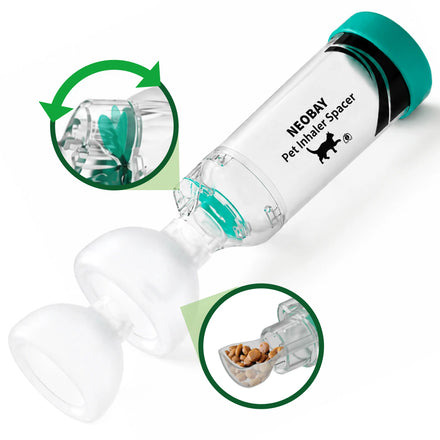
Neobay Cat Aerosol Chamber with Comfort Feeder — Green
- See each breath with the Breath Indicator
- Built-in treat holder makes mask practice easier
- Anti-static chamber helps keep medication airborne
What to Do If You Suspect Feline Asthma
Step 1: Record the Episode
Grab your phone and take a video the next time your cat coughs. Show it to your vet. The posture, sound, and breathing pattern in the video will help your vet distinguish between a hairball and asthma more than any description can.
Step 2: Schedule a Vet Visit
Your vet will likely perform:
- Chest X-rays to look for characteristic signs of asthma (inflated lungs, thickened airway walls, "donut-shaped" bronchial patterns)
- Blood work to rule out infections
- Possibly a bronchoalveolar lavage to examine cells from the lungs
Step 3: Start Treatment
If feline asthma is diagnosed, your vet will likely prescribe inhaled medication — the same approach used in human asthma, adapted for cats.
Rescue inhalers (albuterol) open the airways during an active attack.
Controller inhalers (fluticasone) reduce daily inflammation and prevent attacks from occurring.
Both are delivered through a spacer chamber — a device that holds the medication so your cat can breathe it in through a mask, rather than trying to coordinate a quick puff from an inhaler.
Step 4: Choose the Right Spacer
Not all cat spacer chambers are the same. Two features matter more than anything else:
Visual Flow Indicator. When you're giving your cat medication, you need to know they're actually inhaling it. A Visual Flow Indicator — a small mechanism that moves with each breath — shows you in real time that your cat is breathing in the medication. Without it, you're just guessing.
Comfort Feeder Design. The single biggest barrier to inhaled treatment isn't the medication itself — it's getting your cat to accept the mask. A spacer with a Comfort Feeder design holds a squeeze treat at the mask rim — your cat voluntarily presses their face in to reach the food, bypassing the initial panic response. This is especially important in the first 1–2 weeks of treatment when your cat is still getting used to the routine. Once they accept the mask, the whole process becomes quick and stress-free for both of you.

For a step-by-step guide to the treatment process: How to Administer Inhaled Medication Stress-Free
Helping Your Cat Adjust to a Spacer
The transition from "cat who's never seen a spacer" to "cat who calmly takes their medication" usually takes 1–2 weeks. Here's what works:
- Familiarize first. Leave the mask near your cat's food or resting area for a few days. No pressure.
- Pair with treats. Place treats near and on the mask. Let your cat associate it with good things.
- Gradual contact. Hold the mask near your cat's face for a few seconds, then reward. Build up to brief contact.
- Add the spacer. Attach the chamber, hold the unit near your cat, reward calm behavior.
- First treatment. Actuate the inhaler into the chamber, place the mask gently, and let your cat take 7–10 breaths. Watch the Visual Flow Indicator to confirm delivery.
Keep each session under 30 seconds. Consistency beats duration.
Frequently Asked Questions
Can a hairball cause coughing?
Yes — the act of expelling a hairball involves gagging and coughing. But the coughing is brief, produces a hairball, and then stops. If your cat coughs repeatedly without producing anything, the coughing is likely not caused by a hairball.
How often should a cat cough?
A healthy cat should not cough at all. Occasional hairball-related gagging is normal, but true coughing — dry, hacking, repetitive — is not. Any cat who coughs more than once every few weeks should be evaluated by a veterinarian.
What does a cat asthma cough sound like?
A feline asthma cough is typically dry and hacking, often described as a "goose honk." It sounds distinctly different from the wet gagging of a hairball. Recording a video of the episode is the best way to show your vet exactly what you're hearing.
Can I use my own inhaler on my cat?
No. Never use a human inhaler directly on a cat. The medication dosage, the delivery method, and the mask size are all wrong. Cats need their medication delivered through a spacer chamber designed specifically for feline use, with a mask that fits their face properly.
Is feline asthma fatal?
Feline asthma can be life-threatening if left untreated — severe attacks can be fatal. But with proper management, most asthmatic cats live normal, full lives. The key is early diagnosis and consistent treatment with inhaled medication delivered through a proper spacer.
Related: Can Cats Outgrow Asthma? — the long-term outlook for feline asthma, why remission isn't cure, and how consistent treatment protects your cat's lungs.
Sometimes what looks like asthma isn't — learn which conditions mimic feline asthma.
What to Do NextIf your cat has been "coughing up hairballs" that never seem to produce a hairball, it's time to take a closer look.
- Record the next episode on your phone — posture, sound, and what comes up (or doesn't).
- Schedule a vet visit and show them the video. Mention the pattern specifically.
- If asthma is diagnosed, ask about inhaled medication with a spacer chamber. It's the safest, most effective long-term approach — and with a Visual Flow Indicator and Comfort Feeder design, it's easier than you might think.
The Neobay Cat Aerosol Chamber is built specifically for cats, with both a Visual Flow Indicator and a Comfort Feeder design to make treatment simpler and more effective from day one.
Not sure if what you're seeing is early asthma? Read our guide on the early signs of feline asthma most owners dismiss as something else.
Have questions? Visit our FAQ page or reach out to us — we're here to help.
Sources:
- Reinero CR. "Advances in the understanding of pathogenesis, and diagnostics and therapeutics for feline allergic asthma." The Veterinary Journal, 2011; 190(1): 28-33.
- Padrid P. "Feline asthma. Diagnosis and treatment." Veterinary Clinics of North America: Small Animal Practice, 2000; 30(6): 1279-1293.
- Cornell Feline Health Center. "Feline Asthma: What You Need to Know." Cornell University College of Veterinary Medicine. https://www.vet.cornell.edu/departments-centers-and-institutes/cornell-feline-health-center/health-information/feline-health-topics/feline-asthma-what-you-need-know
- Cannon M. "Hair balls in cats: a normal nuisance or a sign that something is wrong?" Journal of Feline Medicine and Surgery, 2013; 15(1): 21-29.
Related Reading
This article is part of our Feline Asthma: The Complete Owner's Guide — covering everything from causes and symptoms to treatment and daily management.


