

Key Takeaways
- First-year costs for a newly diagnosed cat typically run $500-$2,500, including diagnostics, equipment, and medication setup.
- Ongoing monthly costs range from $10 (oral steroids) to $150+ (brand-name inhalers), depending on treatment type and where you buy.
- Generic fluticasone + GoodRx coupon can cut inhaler costs by 60-70% — from $200-300 down to $45-65 per inhaler.
- A spacer chamber is a one-time purchase that lasts years — skip it and you're wasting every puff of medication.
- Preventing emergencies is the single biggest money saver. One ER visit costs more than 2-3 years of consistent daily management.
You're standing at the vet counter, credit card in hand, staring at a number you didn't expect. The diagnosis is feline asthma. The treatment plan involves an inhaler, a spacer device, and twice-daily medication — for the rest of your cat's life.
And you're thinking: What is this actually going to cost me?
Here's the honest answer — broken down into real numbers, not ranges pulled from a vet brochure. Along with the money-saving strategies that cat owners (the ones in the Reddit threads and pharmacy lines) have already figured out.
The First-Year Cost: Diagnosis + Setup
The first year is the expensive one. You're paying for answers, not just treatment.

Getting Diagnosed
There's no single test for feline asthma. Vets diagnose by ruling everything else out — which means multiple tests.
| What You're Paying For | Cost Range | Why It's Needed |
|---|---|---|
| Initial exam + consultation | $80-$250 | Physical exam, listening to lungs, discussing symptoms |
| Chest X-rays (2-3 views) | $150-$400 | Rules out pneumonia, tumors, fluid, heart disease |
| Blood work (CBC + chemistry panel) | $80-$200 | Checks for infection, organ function, eosinophil count |
| Fecal exam | $20-$70 | Rules out lungworm and other parasites |
| Heartworm test | $30-$60 | Heartworm can mimic asthma symptoms |
| Typical total | $360-$980 | Most cats need exam + X-rays + blood work at minimum |
If your cat has a complicated case — the X-rays aren't conclusive, or symptoms overlap with heart disease — you might also need: - Bronchoscopy with airway washing: $500-$1,000 - Echocardiogram (heart ultrasound): $300-$600 - CT scan: $1,000-$2,500
These are edge cases. Most cats are diagnosed with exam + X-rays + blood work.
Equipment: The One-Time Purchase
| Item | Cost | Lifespan | Notes |
|---|---|---|---|
| Spacer chamber (AeroKat) | $55-$75 | 3-5 years | The standard. Mask + chamber + valve. |
| Spacer chamber (Neobay) | $39.99 (1-pack) / $59.99 (2-pack) | 3-5 years | Same function, visual flow indicator, comfort feeder design |
| Nebulizer (optional) | $30-$60 | 2-3 years | Alternative delivery method for cats who won't tolerate a mask |
This is not where you should cut costs. A spacer chamber is what makes inhaled medication actually reach the lungs. Without it, the medicine hits the back of the throat and does nothing. You'd be paying for inhalers and getting zero benefit.
First-Year Medication Setup
| Medication | Type | Monthly Cost | Notes |
|---|---|---|---|
| Prednisolone (oral) | Daily steroid pill | $10-$30 | Cheapest option. Long-term risks: diabetes, weight gain, kidney strain |
| Fluticasone generic (inhaled) | Daily maintenance inhaler | $45-$80 | Gold standard. Goes to lungs only, minimal body-wide effects. Requires spacer |
| Fluticasone brand (Flovent) | Daily maintenance inhaler | $200-$300 | Same drug. 3-5x the price for the label |
| Albuterol (inhaled) | Rescue inhaler, as-needed | $20-$60 per inhaler | For attacks only. One inhaler can last 6-12 months |
Typical first-year total (moderate case): $360-$980 (diagnosis) + $40-$75 (spacer) + $540-$960 (12 months generic fluticasone) + $20-$60 (rescue inhaler) = $960-$2,075
The Ongoing Monthly Cost: What to Actually Expect
Once you're past the first year, costs stabilize. Here's what three real scenarios look like:
Scenario A: Budget-Conscious ($15-$35/month)
- Oral prednisolone: $10-$30/month
- No inhaler, no spacer
- 1-2 vet checkups per year: $80-$200 each
Annual: $300-$820
The catch: prednisolone is a systemic steroid. It works. But over years, it increases the risk of diabetes, weight gain, UTIs, and weakened immune response. Some cats tolerate it fine. Some don't. This is a conversation with your vet, not a decision to make alone based on price.
Scenario B: Standard Inhaled Treatment ($50-$100/month)
- Generic fluticasone (110mcg, 2 puffs twice daily): $45-$65/month via GoodRx or Canadian pharmacy
- Albuterol rescue inhaler: ~$5/month amortized (one $30-$60 inhaler lasts 6-12 months)
- Spacer chamber: already purchased, $0/month
- 1-2 vet checkups: $80-$200 each
Annual: $760-$1,600
This is where most well-managed asthmatic cats land. Generic fluticasone, a spacer, and a rescue inhaler. The monthly cost is predictable. The cat gets gold-standard care without the brand-name markup.
Scenario C: Brand-Name + Maximum Coverage ($150-$250/month)
- Brand Fluticasone (Flovent): $200-$300/month
- Albuterol rescue inhaler: $5/month
- High-end HEPA air purifier filters: $10-$20/month
- Prescription hypoallergenic food: $30-$60/month
- Frequent vet monitoring: $200-$400/year
Annual: $2,400-$4,200
This is the "everything" scenario. Some cats need it. Most don't. The single biggest lever here is brand vs. generic — switching from Flovent to generic fluticasone alone drops the annual cost by $1,800-$2,700.
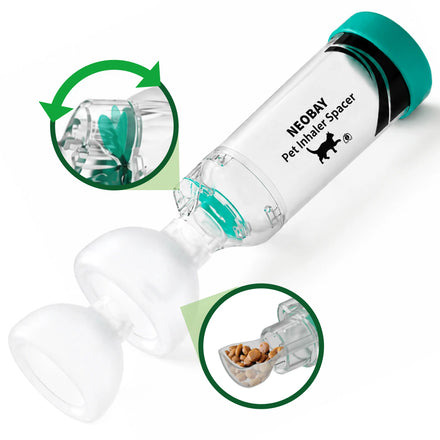
Neobay Cat Aerosol Chamber with Comfort Feeder — Green
- See each breath with the Breath Indicator
- Built-in treat holder makes mask practice easier
- Anti-static chamber helps keep medication airborne
6 Ways to Cut Costs Without Cutting Corners
1. Use GoodRx or SingleCare at a Human Pharmacy
Your vet writes a prescription. You take it to a pharmacy. The pharmacy charges wildly different prices depending on which one you walk into.
Generic fluticasone propionate (110mcg, 120 metered doses): - Walgreens cash price: $200-$280 - Costco with GoodRx coupon: $45-$65 - Walmart with SingleCare: $50-$70
Same drug. Same inhaler. Different counter. Always check GoodRx and SingleCare before filling. The 30 seconds it takes to compare can save you $150 per inhaler.
2. Order from Canadian or International Pharmacies
This is the move that Reddit cat owners swear by. Canadian pharmacies sell the same medications (same manufacturers, same packaging) at prices regulated by the Canadian government, not the US market.
- Canada Drugs Direct, Northwest Pharmacy, Canada Pharmacy: generic fluticasone ~$35-$55 per inhaler
- InhousePharmacy (Vanuatu): often cheapest option, but shipping takes 2-4 weeks
Your vet needs to write or fax the prescription to the international pharmacy. Most vets will do this if you explain it's a cost issue — they'd rather you use inhaled medication from Canada than skip treatment entirely.
Plan ahead. Order when you have 3-4 weeks of medication left. The shipping delay is the trade-off for the price.
3. Get Pet Insurance Before the Diagnosis
Pet insurance doesn't cover pre-existing conditions. Period. If your cat is already diagnosed, insurance won't pay for asthma treatment.
But if you're reading this and your cat hasn't been diagnosed yet — or you're getting a new cat — enroll now. Most plans cover asthma if diagnosed after the waiting period (typically 14-30 days). Given that first-year costs can hit $2,000, a $30-$50 monthly premium can pay for itself in one diagnosis.
4. Eliminate Triggers (Free)
Every asthma attack you prevent is money you don't spend on emergency vet visits. The most impactful free changes:
- Stop using scented candles, air fresheners, essential oil diffusers, and aerosol sprays
- Switch to dust-free litter (paper pellets or tofu-based — about the same price as premium clay)
- No smoking or vaping indoors. Ever.
- Vacuum with a HEPA-filter vacuum twice a week
- Keep windows closed on high-pollen days
These changes cost nothing or close to nothing. They reduce attack frequency, which reduces medication needs, which reduces costs. It's the closest thing to a free lunch in cat asthma management.
5. Ask About Compounded Medications
Compounding pharmacies can make custom formulations. For cats on unusual doses or those who can't tolerate certain ingredients, compounded fluticasone can sometimes be cheaper than commercial generics. Prices vary by pharmacy — call and ask.
6. Negotiate with Your Vet
Vets know the medications are expensive. They see owners struggle with this every day. Ask directly:
- "Is there a generic version of this?"
- "Can you write this prescription to a Canadian pharmacy?"
- "Is there a lower-cost alternative that still gives good results?"
- "Can we try every-other-day dosing to stretch the medication?"
Most vets would rather work with you on cost than watch a cat go untreated.
What About Emergency Costs?
An asthma attack that requires emergency care — oxygen therapy, injectable steroids, hospitalization — costs between $800 and $3,500 per visit. Sometimes more.
Here's the math that matters: spending $50-$100/month on consistent daily management prevents emergencies that cost $1,500+. The daily inhaler isn't the expensive option. The ER visit is.
One emergency visit = roughly 1.5-3 years of daily inhaled medication. Prevention isn't just better for your cat. It's cheaper.
The Spacer Chamber: Don't Skip It
Every puff of medication you give without a spacer is a puff that mostly doesn't reach the lungs. The medication hits the back of the throat, your cat swallows it, and you've paid for an inhaler that delivered maybe 1-5% of the dose.
A spacer chamber holds the medication in suspension so your cat can inhale it over several breaths. Deposition goes from <5% to 10-20%. That's a 2-4x improvement in medication delivery for a one-time $40-$75 purchase.
Look for a spacer with a visual flow indicator — a valve that moves with each breath so you can see that your cat is actually inhaling the medication. Without it, you're guessing whether the dose went in.
AeroKat vs Neobay comparison: which spacer is right for your cat?
Frequently Asked Questions
How much does cat asthma treatment cost per month?
For most cats on inhaled medication, expect $50-$100 per month. This covers generic fluticasone ($45-$65 via GoodRx or Canadian pharmacy), a rescue inhaler (~$5/month amortized), and periodic vet visits. Cats on oral prednisolone alone can cost as little as $10-$30 per month, but long-term steroid use carries higher health risks.
Is cat asthma expensive to treat?
The first year is the most expensive — $500-$2,500 including diagnosis and equipment. After that, ongoing costs are typically $500-$1,800 per year for a well-managed cat. The biggest cost driver is whether you use brand-name (Flovent, $200-300/month) or generic fluticasone ($45-$65/month). Switching to generic alone cuts annual costs by roughly $2,000.
Can I treat cat asthma without an inhaler?
Oral prednisolone is a valid, vet-supervised alternative that costs $10-$30 per month. It controls inflammation effectively for many cats. The trade-off is higher long-term risk of side effects (diabetes, weight gain, weakened immunity). Talk to your vet — for some cats, the risk/reward favors oral medication. For most, inhaled is preferred specifically because it avoids those systemic effects.
Why are cat asthma inhalers so expensive?
Most cat asthma medications are human drugs used off-label for cats. The US pharmaceutical market sets the prices. Generic fluticasone costs $45-$65 with a GoodRx coupon, but the same medication without a coupon can be $200-$280 at the same pharmacy. The price you pay depends far more on where and how you buy than on what you're buying.
Does pet insurance cover asthma treatment?
Yes — if the asthma was diagnosed after you enrolled and after the waiting period. Most pet insurance plans cover chronic conditions including asthma. If your cat is already diagnosed, insurance won't cover it (pre-existing condition exclusion). The time to enroll is before there's a problem.
Can I use my own inhaler for my cat?
No. Human inhalers are dosed for human lungs, which are roughly 100 times larger than cat lungs. And without a cat-specific spacer with a properly sized face mask, the medication won't reach your cat's lungs. Using human inhalers on cats without veterinary guidance is dangerous — wrong dose, wrong delivery, wrong outcome.

- Check your current costs. Are you paying brand-name prices for a medication that has a generic? Check GoodRx for your cat's specific prescription. It takes 30 seconds.
- If you don't have a spacer chamber yet, get one. It's the single most cost-effective purchase in cat asthma care — it makes every inhaler puff count.
- Ask your vet about generic fluticasone if you're currently on brand-name Flovent. Same drug, fraction of the price.
- Calculate your annual spend. Total up your last 12 months of vet visits, medications, and equipment. Compare it to the scenarios above. If you're spending more than $1,800/year on a moderate case, there's probably fat to trim.
Managing feline asthma doesn't have to break the bank. Generic medications, smart pharmacy shopping, trigger reduction, and a one-time investment in the right equipment bring the annual cost down to a predictable, manageable level — about the same as a streaming subscription and a couple of takeout meals per month.
And for that, your cat breathes easy. Literally.
Have questions? Visit our FAQ page or contact us directly.
Related reading: For our complete cat asthma inhaler cost guide — with coupons, Canadian pharmacy options, and 5-year cost projections.
Related reading: See our complete guide to affording cat asthma treatment — GoodRx coupons, Canadian pharmacies, manufacturer assistance programs, charity grants, and payment plans, with exact application steps.
Sources: - Cornell Feline Health Center. "Feline Asthma: What You Need to Know." Cornell University College of Veterinary Medicine. https://www.vet.cornell.edu/departments-centers-and-institutes/cornell-feline-health-center/health-information/feline-health-topics/feline-asthma-what-you-need-know - Trzil JE. "Feline asthma: diagnostic and treatment update." Veterinary Clinics of North America: Small Animal Practice, 2020; 50(2): 375-391. - Trzil JE, Reinero CR. "Update on feline asthma." Veterinary Clinics of North America: Small Animal Practice, 2014; 44(1): 91-105. - GoodRx. "Fluticasone Propionate HFA: Prices, Coupons, and Savings Tips." 2026. - American Animal Hospital Association (AAHA). "Chronic Disease Management in Companion Animals." 2023.
Related: Since Flovent was discontinued, is the generic version just as effective? Generic Fluticasone vs Flovent for Cats — full comparison of prices, efficacy, and where to buy.
Related Reading
This article is part of our Cat Asthma Treatment Cost: Real 2026 Numbers — covering medication prices, insurance options, and practical affordability strategies.


