

Key Takeaways
- Open-mouth breathing or blue gums = emergency vet immediately. Don't wait. Don't second-guess. These are signs your cat is running out of oxygen.
- If you have a prescribed bronchodilator (albuterol) + spacer, give it right away. One puff, let your cat take 8-10 breaths through the mask. This can save your cat's life while you get to the vet.
- No inhaler? Stay calm, move your cat to a cool ventilated space, keep them upright, and go to the ER. Even without medication, the right actions in the first 5 minutes make a difference.
- After any asthma attack, keep your cat calm and cool for 24 hours. Attacks stress the airways — a second attack within hours is common if triggers aren't removed.
- The best emergency response is being prepared before it happens. A rescue inhaler + spacer at home turns a panic situation into a manageable one.
It's 2 a.m. and your cat is crouched low on the floor, neck stretched forward, making a sound you've never heard before — somewhere between a wheeze and a hacking cough. She looks like she's struggling to breathe.
Your mind races: Is this an emergency? Should I go to the vet right now? What if I overreact and it's just a hairball? What if I wait and it gets worse?
Here's the truth: a cat asthma attack is a respiratory emergency. It can escalate from mild coughing to life-threatening oxygen deprivation in minutes. The decisions you make in the first five minutes directly affect the outcome.
This guide walks you through exactly what to do — step by step — whether your cat has already been diagnosed and you have medication on hand, or this is the first time you're seeing these symptoms and you have nothing prepared.

What Does a Cat Asthma Attack Look Like?
Before you can respond to an asthma attack, you need to recognize one. Cat asthma attacks don't look like human asthma attacks — and many owners mistake them for hairballs until a vet tells them otherwise.
The Classic Asthma Attack Posture
A cat in the middle of an asthma attack will typically:
- Crouch low to the ground with the body flattened and neck extended forward — almost like they're trying to push something out
- Cough or hack repeatedly, but nothing comes up (no hairball, no vomit)
- Breathe with visible effort — you'll see the abdomen working hard with each breath
- Make wheezing or whistling sounds, especially when exhaling
- Refuse to move or respond to your voice, focused entirely on breathing
Asthma Attack vs. Hairball: How to Tell the Difference Fast
This is the most common mistake cat owners make — and it can delay life-saving treatment.
| Sign | Asthma Attack | Hairball |
|---|---|---|
| End result | Nothing comes out | Produces a hairball or bile |
| Posture | Neck extended, body low, stays in position | Similar posture, but usually resolves quickly |
| Sound | Wheezing, whistling, dry hacking | Wet, gurgling, retching |
| Duration | 30 seconds to several minutes | Usually under 30 seconds |
| Aftermath | Cat seems tired, may have labored breathing | Cat walks away normally, no breathing issues |
| Frequency | Can happen multiple times per day or week | Typically occasional |
The simplest rule: if there's no hairball at the end, and the breathing doesn't return to normal within a minute, treat it as an asthma attack. You can clean up a hairball later. You can't undo lost minutes when your cat can't breathe.
What a Cat Asthma Attack Sounds Like
If you've never heard one before: an asthma attack typically produces a dry, raspy, hacking cough — many owners describe it as "goose honking" or "duck-like." It's distinctly different from the wet, productive sound of a hairball being brought up.
There will often be an audible wheeze at the end of each exhale — a high-pitched whistling or sighing sound. Some cats also produce a soft gurgling or crackling sound from mucus in the airways.
If you can safely do so, record a video of the episode. This is one of the most valuable diagnostic tools your vet will have — because cats rarely have attacks during clinic visits.
> Normal resting breathing rate for a cat is 15-30 breaths per minute. Count your cat's breaths when she's sleeping to learn her baseline. During an asthma attack, this can spike to 40-60+ breaths per minute.
Emergency Response: What to Do Right Now
If your cat is conscious and you've recognized the signs, follow these steps in order. The goal is to stabilize your cat and get them to professional care if needed.
Step 1: Stay Calm
This sounds obvious, but it's the hardest step — and the most important. Cats are acutely sensitive to human stress. If you panic, your cat's cortisol spikes, which constricts airways further and makes the attack worse.
Take a deep breath. Speak to your cat in a low, steady voice. Move slowly and deliberately. Your calm presence is literally medicine right now.
Step 2: Remove Your Cat from the Trigger
If you know what set off the attack — or even if you don't — move your cat to a cool, quiet, well-ventilated space away from:
- Cigarette smoke, vaping, or fireplace residue
- Scented candles, air fresheners, diffusers, or incense
- Cleaning products (especially bleach, ammonia, or aerosol sprays)
- Dusty areas, litter boxes with clay-based litter
- Other pets, children, or noise
Open a window for fresh air if the outdoor air quality is good. Turn on a fan or air conditioning — but don't blow air directly at the cat's face, which can startle them.
Step 3: Administer Rescue Medication (If You Have It)
If your cat has been diagnosed with feline asthma and your vet prescribed a bronchodilator (usually albuterol, brand name Ventolin or ProAir), give it immediately. This is exactly what a rescue inhaler is for.
How to administer albuterol with a spacer:
- Shake the inhaler well (5 seconds)
- Attach it to the spacer chamber
- Place the mask gently but firmly over your cat's nose and mouth
- Press the inhaler once to release the medication into the chamber
- Let your cat take 8-10 breaths through the mask — watch the valve indicator move with each breath
- Remove the mask and let your cat rest
Critical rules for rescue medication:
- Albuterol opens airways within 5-10 minutes. If there's no improvement after 10-15 minutes, you can give a second puff — but if symptoms are severe, don't wait for a second dose to work. Go to the vet.
- Never use human inhalers without a vet's prescription and dosage instructions. The canister itself may be the same, but the dosage, administration technique, and frequency are specific to your cat.
- Bronchodilators only treat the constriction — not the underlying inflammation. Your cat still needs to see a vet for a long-term plan.
Step 4: Position Your Cat for Easier Breathing
The right body position can make a measurable difference in how much air your cat can get:
- Keep your cat upright on their chest and stomach — not on their side, not on their back. An upright sternal position allows the lungs to expand fully.
- Let the neck stay naturally extended — don't tuck the chin or force the head up.
- Elevate the chest slightly by placing a folded towel under the upper body if your cat will tolerate it.
Never lay a cat having breathing difficulty on their side. This compresses one lung and reduces oxygen intake. Never try to give food, water, or oral medication during an attack — the risk of choking or aspiration is high.
Step 5: Use Steam (If Your Cat Tolerates It)
Moist air can help loosen mucus and soothe constricted airways. This is most useful when the attack involves audible congestion or gurgling sounds.
How to do it safely:
- Run a hot shower with the bathroom door closed
- Sit with your cat in the steamy room (NOT in the shower) for 5-10 minutes
- Keep your cat in a carrier or on your lap — don't force proximity to the steam
- Watch for signs of stress. If your cat is more stressed by being in the bathroom, skip this step
Do not use a nebulizer, essential oils, or vapor rubs. These can irritate feline airways further and make the attack worse.
Step 6: Monitor Breathing Rate and Gum Color
While you're helping your cat, track two things:
Breathing rate:
- Count breaths for 15 seconds, multiply by 4
- Normal: 15-30 breaths per minute at rest
- Concerning: 30-40 breaths per minute
- Emergency: 40+ breaths per minute
Gum color:
- Gently lift your cat's upper lip and look at the gums
- Pink = normal oxygenation
- Pale or white = poor circulation, possible shock
- Blue, purple, or grey = severe oxygen deprivation (cyanosis) — go to the ER NOW
When to Drop Everything and Go to the Emergency Vet
Some signs mean you should skip the home response entirely. If you see any of the following, put your cat in the carrier and go.
Red Flag #1: Open-Mouth Breathing or Panting
Cats are obligate nose-breathers. A cat breathing through their mouth — especially with the mouth open wide — is in severe respiratory distress. This is not a "watch and wait" situation. Go to the vet.
Red Flag #2: Blue, Purple, or Grey Gums
This is cyanosis — a direct indicator that your cat's blood oxygen level has dropped dangerously low. This is a life-threatening emergency. Do not spend time on home remedies or steam. Go to the nearest emergency vet immediately.
Red Flag #3: Collapse, Lethargy, or Unresponsiveness
If your cat has become weak, wobbly, or unresponsive, they are decompensating — meaning their body can no longer compensate for the lack of oxygen. This can progress to respiratory arrest within minutes.
How to Transport Your Cat Safely to the ER
While driving to the vet:
- Use a carrier if possible. If you don't have one, a cardboard box with air holes or a laundry basket with a towel draped over it will work in a pinch. The goal is to limit movement.
- Keep your cat upright. Place the carrier so your cat can stay in a sternal (chest-down) position. Don't tilt or tip the carrier.
- Keep the car cool. Turn the AC on. Heat makes respiratory distress worse.
- Minimize noise and stress. No music. No loud conversations. Just a calm, quiet drive.
- Call ahead. Tell the vet clinic you're coming with a cat in respiratory distress so they can prepare oxygen and have a team ready at the door.
What If You Don't Have an Inhaler?
This is the scariest scenario — and it's the one most cat owners face during their first asthma attack experience. Your cat hasn't been diagnosed yet. There's no rescue inhaler in the house. What do you do?
The protocol is the same — minus Step 3:
- Stay calm
- Move your cat to a cool, ventilated space away from triggers
- Keep your cat upright
- Steam if tolerated
- Go to the emergency vet
Without a bronchodilator, you cannot stop the attack at home. Your role is to keep your cat stable during transport and get to professional care as fast as possible.
Under no circumstances should you:
- Give your own asthma inhaler to your cat (human dosages are different, and human spacers don't fit a cat's face)
- Give any oral medication during an attack
- Wait to see if it gets better on its own
What to Expect at the Emergency Vet

Knowing what happens at the ER can ease some of the anxiety:
- Immediate assessment — The vet will check gum color, breathing rate, and oxygen saturation within seconds of arrival
- Oxygen therapy — Your cat will be placed in an oxygen cage or given oxygen via mask to stabilize blood oxygen levels
- Sedation if needed — A mild sedative may be given to reduce stress and the work of breathing
- Injectable bronchodilators and corticosteroids — Fast-acting medications to open airways and reduce inflammation
- Diagnostic chest X-rays — Once your cat is stable, the vet will image the lungs to confirm asthma and rule out other causes like heart failure, pneumonia, or a foreign body
The vet may keep your cat for several hours or overnight for observation, especially if oxygen therapy was needed.
Cat Asthma Attack at Night: Special Considerations
Late-night attacks are among the most common — and the most frightening — because your regular vet is closed and every decision feels heavier.
Why do asthma attacks often happen at night?
- The body's natural cortisol levels drop during sleep, reducing the body's natural anti-inflammatory response
- Cats are often in one position for longer, which can make breathing slightly more labored
- Nighttime air tends to be cooler and sometimes drier, which can irritate sensitive airways
- Many environmental triggers accumulate during the day (dust settling, allergens building up)
What to do differently at night:
- Know the nearest 24-hour emergency vet before you need it. Save the address and phone number in your phone right now. A 3 a.m. Google search while your cat can't breathe is not the time to figure out where to go.
- Err on the side of going in. At 2 a.m., you can't call your regular vet for guidance. If you're uncertain, go. The cost of an unnecessary ER visit is a bill. The cost of waiting too long is your cat.
- Keep a rescue inhaler accessible at all times. This is one of the strongest arguments for having a prescribed inhaler + spacer at home — it can turn a nighttime crisis into a manageable situation.
After the Attack: The First 24 Hours
The attack is over — but your job isn't. The 24 hours following an asthma attack are critical for preventing a second episode.
Immediately after the attack:
- Keep your cat in a cool, quiet room with minimal stimulation
- Remove any potential triggers (see the trigger checklist below)
- Monitor breathing rate every 1-2 hours while awake
- Do not allow vigorous play, running, or chasing — increased respiration can re-trigger bronchoconstriction
When to contact your vet (if you didn't go to the ER):
- Schedule a follow-up within 24-48 hours, even if the attack seemed mild
- Bring any videos you recorded of the episode
- Your vet will likely want to discuss long-term management: inhaled corticosteroids (fluticasone), bronchodilators for emergencies, and trigger identification
Signs your cat needs to go back to the vet:
- Breathing rate stays above 30 breaths per minute at rest
- A second attack occurs within 24 hours
- Your cat seems lethargic, has no appetite, or is hiding
- Coughing or wheezing continues intermittently

Preventing the Next Attack: A Preparedness Plan
You never want to feel that helpless again. Here's how to be ready.
Get a Rescue Inhaler + Spacer — Before the Next Attack
If your cat has been diagnosed with feline asthma, the single most important emergency preparedness step is having a prescribed bronchodilator (albuterol) and a cat-specific spacer chamber at home.
A spacer — also called an aerosol chamber — is the device that holds the medication after you press the inhaler, allowing your cat to breathe it in over multiple breaths. Without a spacer, the medication hits the back of your cat's throat and never reaches the lungs. The spacer is not optional — it's the difference between the medication working and being wasted.
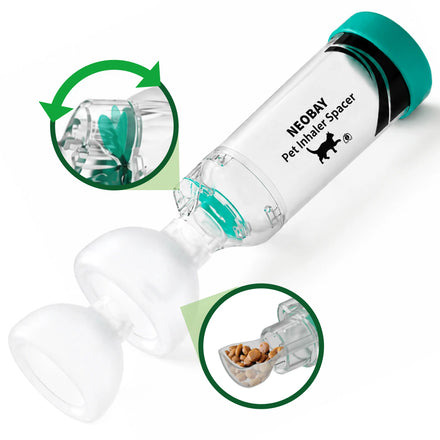
Neobay Cat Aerosol Chamber with Comfort Feeder — Green
- See each breath with the Flow Indicator
- Built-in treat holder makes mask practice easier
- Anti-static chamber helps keep medication airborne
Ask your vet to prescribe both:
- A rescue bronchodilator (albuterol) for attacks
- A daily inhaled corticosteroid (fluticasone) to reduce airway inflammation and prevent attacks from happening in the first place
Store your cat's rescue kit in an accessible, memorable location — not buried in a cabinet. Every adult in the household should know where it is and how to use it.
Identify and Remove Your Cat's Triggers
Most cat asthma attacks have an environmental trigger. Common culprits and actions:
| Trigger | What to Do |
|---|---|
| Clay or dusty cat litter | Switch to low-dust paper, wood pellet, or corn-based litter |
| Cigarette/vape smoke | No smoking indoors. Period. Smoke residue on clothing can also trigger attacks |
| Scented products | Remove air fresheners, plug-ins, scented candles, essential oil diffusers |
| Cleaning products | Switch to unscented, non-aerosol cleaners. Keep cats out of recently cleaned rooms |
| Dust mites | Wash bedding weekly in hot water. Vacuum with a HEPA-filter vacuum |
| Pollen | Close windows during high-pollen seasons. Use an air purifier with a HEPA filter |
| Fireplace/wood stove | Avoid use, or ensure the room is fully sealed off from cats |
| Mold | Check for and remediate any damp areas, especially in basements and bathrooms |
If you're not sure what your cat's triggers are, keep a log and look for patterns. Did the attack happen after you cleaned the bathroom? After you lit a candle? After your cat used the litter box?
Track and Record Every Attack
Start a simple log — a notes app on your phone works fine. Record:
- Date and time of the attack
- Duration (how long the coughing/wheezing lasted)
- Severity (mild cough / moderate wheezing / severe open-mouth breathing)
- What happened right before (using litter box, playing, sleeping, after you cleaned, etc.)
- What medication you gave and whether it helped
- Video (if you can record safely)
This log is invaluable for your vet — it turns "my cat coughs sometimes" into a data-driven picture of your cat's asthma that guides treatment decisions.
Frequently Asked Questions
How long does a cat asthma attack last?
A typical asthma attack lasts 30 seconds to 2 minutes, but severe attacks can persist for longer. If coughing or labored breathing continues for more than 5 minutes, or if your cat has back-to-back attacks within a short period, this is a medical emergency — go to the vet.
Can a cat die from an asthma attack?
Yes. While most individual asthma attacks are not fatal, a severe attack can cause respiratory failure — where the airways close so tightly that oxygen can't reach the bloodstream. This can happen in minutes. Cats with untreated or poorly managed asthma are at the highest risk. This is why having a rescue inhaler at home and knowing the emergency signs is so important.
What should I do if my cat has an asthma attack and I don't have an inhaler?
Stay calm. Move your cat to a cool, well-ventilated space away from any potential triggers (smoke, dust, scents). Keep your cat upright on their chest and stomach. Use steam from a hot shower if your cat tolerates it. Go to the nearest emergency vet — without a bronchodilator, you cannot stop the attack at home. Do not use your own inhaler on your cat.
Is my cat having an asthma attack or choking?
A choking cat will typically paw at their mouth, drool excessively, and appear panicked. The onset is usually sudden — during eating or playing with a small object. An asthma attack usually involves a hunched posture, extended neck, and a characteristic wheeze or hacking cough without anything in the mouth. If you suspect choking, check the mouth for a foreign object (if safe to do so) and go to the vet immediately in either case.
Why does my cat only have asthma attacks at night?
Nocturnal asthma attacks are common in both humans and cats. The body's natural cortisol levels drop during sleep, reducing the body's natural anti-inflammatory response. This allows airway inflammation — which had been suppressed during the day — to surface. Environmental factors like dust settling overnight or the cooler, drier air can also contribute. If attacks are happening predominantly at night, talk to your vet about adjusting medication timing.
How many asthma attacks are too many?
More than one attack per week is too many. It means your cat's underlying airway inflammation is not adequately controlled, and you need a stronger long-term management plan — likely daily inhaled corticosteroids. Also, if your cat's attacks are getting more severe or more frequent over time, this is a sign the current treatment isn't working and needs adjustment.
What to Do Next
- If your cat has been diagnosed with asthma and you don't have a rescue inhaler + spacer at home — contact your vet this week and get one prescribed. This is the single most important thing you can do for your cat's safety.
- Identify and remove at least three triggers from your home today — start with scented products (candles, plug-ins, sprays), then check your cat litter, then look at cleaning products.
- Save the nearest 24-hour emergency vet in your phone — including the address and phone number. If you're in the US, the ASPCA Animal Poison Control Center (888-426-4435) and Red Cross Pet First Aid app are both worth having.
- Learn your cat's normal resting breathing rate — count breaths during sleep tonight. If you know what "normal" looks like, you'll recognize "abnormal" immediately.
An asthma attack is terrifying. But being prepared — knowing the signs, having a plan, and keeping rescue medication accessible — turns a helpless panic into a situation you can handle.
For more on managing your cat's asthma long-term, see our guides on common asthma triggers, how to train your cat to accept an inhaler mask, and emergency signs vs. manageable symptoms.
Sources:
- Trzil, J.E. "Feline Asthma: Diagnostic and Treatment Update." Veterinary Clinics of North America: Small Animal Practice, 2020.
- Reinero, C.R. et al. "Perspectives in Feline Asthma: Pathophysiology, Diagnosis, and Management." Journal of Feline Medicine and Surgery, 2019.
- Cornell Feline Health Center. "Feline Asthma: What You Need to Know." Cornell University College of Veterinary Medicine.
- American College of Veterinary Emergency and Critical Care (ACVECC). "Respiratory Emergencies in Small Animals."
- Merck Veterinary Manual. "Asthma and Bronchitis in Cats."
Related Reading
This article is part of our Feline Asthma: The Complete Owner's Guide — covering everything from causes and symptoms to treatment and daily management.


