Key Takeaways
- A cat coughing after running or playing is not normal — it's often the first visible sign of an underlying respiratory condition like feline asthma.
- Exercise-induced coughing is one of the earliest and most overlooked signs of feline lower airway disease. Many owners mistake it for hairballs for months.
- Feline asthma is manageable with inhaled medication from a puffer, delivered through a spacer chamber — safer long-term than oral steroids.
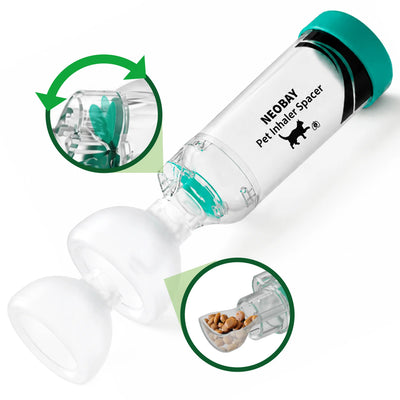
- The right spacer makes a real difference: a Visual Flow Indicator confirms your cat is actually inhaling the medication, and a Comfort Feeder design uses food-led encouragement so your cat accepts the mask willingly.
A cat coughing after running or playing is one of the earliest and most overlooked signs of feline asthma — a chronic airway condition affecting an estimated 1–5% of all cats (Padrid P. "Feline asthma. Diagnosis and treatment." Veterinary Clinics of North America: Small Animal Practice 2000;30(6):1279-1293). The condition is progressive if untreated, but manageable with daily inhaled corticosteroids delivered through a Neobay spacer chamber with a Visual Flow Indicator, which lets you confirm each breath your cat actually inhales. Below: how to tell exercise-induced coughing from a harmless hairball, when to call your vet, and what treatment looks like at home in Australia.

What Does It Mean When a Cat Coughs After Exercise?
When a cat coughs after running, chasing toys, or doing zoomies down the hallway, it usually means their airways are already inflamed or narrowed. The extra breathing effort during exercise pushes air through those tightened passages, triggering a cough reflex.
Feline asthma — also called feline allergic bronchitis or feline lower airway disease — is the most common cause. In asthmatic cats, the immune system overreacts to inhaled allergens, causing:
- Swelling of the airway lining
- Constriction of the smooth muscle around the airways
- Mucus buildup that further blocks airflow
At rest, a cat with mild asthma may breathe normally. But exercise increases oxygen demand and breathing rate, which forces air through already-narrowed airways — and that's when the coughing starts.
Key insight: Studies estimate that 1–5% of all cats develop feline asthma, with Siamese cats overrepresented (Padrid P. "Feline asthma. Diagnosis and treatment." Veterinary Clinics of North America: Small Animal Practice 2000;30(6):1279-1293). The condition is progressive if left untreated.

Cat Coughing vs. Hairball: How to Tell the Difference
This is one of the most common questions vets hear, and it matters because the right response is completely different for each.
| Sign | Hairball | Asthma-Related Cough |
|---|---|---|
| Body posture | Hunched, neck extended low | Crouched low, neck extended forward and low |
| Sound | Gagging, retching, hacking | Dry, hacking cough, sometimes wheezy |
| Timing | Random, often after eating | Triggered by exercise, excitement, or allergen exposure |
| Outcome | Usually produces a hairball | Dry cough, no material produced |
| Duration | Brief episode | Can last seconds to minutes, recurring |
A hairball cough is a one-off event — your cat gags, produces the hairball, and moves on. An asthma cough is repetitive, dry, and tends to happen in the same situations over and over, especially after physical activity.
If you're unsure, film the episode on your phone and show your vet. A video is far more useful than trying to describe the sound in words.
Common Causes of Exercise-Induced Coughing in Cats
Feline asthma is the leading cause, but it's not the only possibility. Here's what your vet will consider:
Feline Asthma
The most likely culprit. An allergic airway disease where the immune system reacts to inhaled triggers, causing airway inflammation and bronchoconstriction. Exercise worsens symptoms because faster breathing pulls more air — and more irritants — through already-sensitive airways. Our complete feline asthma owner's guide covers the full disease picture.
Rhinitis and Upper Respiratory Infections
Chronic nasal inflammation or lingering respiratory infections can cause post-nasal drip, which irritates the throat and triggers coughing during exertion. Frequent sneezing or nasal discharge alongside the cough points this way.
Heart Disease
Less common but more serious. Certain heart conditions (like hypertrophic cardiomyopathy) can cause fluid buildup in or around the lungs, leading to coughing during activity. It's more prevalent in older cats and breeds like Maine Coons and Ragdolls.
Parasitic Infections
Lungworm and certain migrating parasites can cause coughing, though this is relatively rare in indoor-only cats.
Foreign Body
A grass awn or seed lodged in the airway can cause persistent coughing — a classic summer hazard in Australian backyards. This typically comes on suddenly rather than being exercise-specific.
When Should You Take Your Cat to the Vet?
Any cat that coughs after exercise more than once or twice should see a vet. But some signs need urgent attention — most Australian capitals have 24-hour emergency hospitals, so after-hours help is available if you need it.
Schedule a same-day visit if your cat shows:
- Open-mouth breathing at rest
- Blue or pale gums
- Laboured breathing with visible abdominal effort
- Coughing that doesn't stop within a few minutes
- Lethargy or refusing food after a coughing episode
Schedule a routine visit within a week if:
- Your cat coughs after exercise repeatedly
- The episodes are getting more frequent or longer
- You notice wheezing or noisy breathing
- Your cat seems less active than usual
Your vet will likely recommend chest X-rays, and possibly a bronchoalveolar lavage or blood work to rule out other conditions. Our guide to how vets diagnose feline asthma — the tests, X-rays and what to expect walks through the whole process.
How Is Feline Asthma Treated?
If your vet diagnoses feline asthma, the treatment plan typically has two parts.
1. Reducing Exposure to Triggers
Common feline asthma triggers in Australian homes include:
- Dust and dust mites
- Scented cat litter (especially clay-based)
- Smoke — cigarettes, wood heaters, candles, and bushfire smoke haze during fire season
- Household cleaning products and aerosols
- Spring pollen (which peaks between September and November across much of southern and eastern Australia)
- Mould
Switching to unscented, low-dust litter and clearing smoke and aerosols out of the house can significantly reduce flare-ups. During bushfire smoke events, keeping your cat indoors with windows shut and running a HEPA air purifier helps protect irritated airways.
2. Medication
There are two main categories of medication for feline asthma, both delivered by metered-dose inhaler — what most Australians simply call a puffer:
Rescue medication (fast-acting bronchodilators like salbutamol, the active ingredient in the Ventolin puffer) — used during an active asthma attack to open the airways quickly.
Controller medication (inhaled corticosteroids like fluticasone, commonly dispensed in Australia under the Flixotide brand) — used daily to reduce airway inflammation and prevent attacks from happening.
Why Inhaled Medication Is Preferred Over Oral Steroids
Oral corticosteroids (like prednisolone) are still prescribed, but they come with significant long-term side effects: weight gain, diabetes, immune suppression, and liver strain. Inhaled corticosteroids deliver the medication straight to the lungs, where it's needed, with minimal absorption into the bloodstream. Same anti-inflammatory effect, far fewer systemic side effects.
That's why most veterinary specialists now recommend inhaled medication as the first-line long-term treatment for feline asthma.

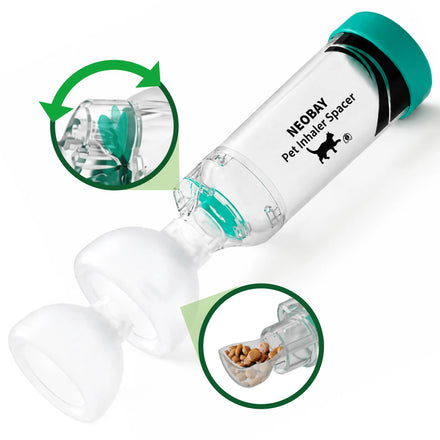
Neobay Cat Inhaler Spacer with Breath Indicator in Australia
- See each breath with the Breath Indicator
- Built-in treat holder makes mask practice easier
- Anti-static chamber helps keep medication airborne
The Problem: Cats Can't Use a Puffer on Their Own
Here's the catch. You can't hold a puffer up to a cat's face and expect them to inhale on command. Cats need a spacer chamber (also called an aerosol chamber) to receive inhaled medication. The puffer fires medication into the chamber, and the cat breathes it in through a mask attached to one end. If you're new to the concept, start with what a cat inhaler spacer actually is.
But not all spacers are the same, and the differences matter — especially for a cat who's never used one before.
Two Features That Make a Real Difference
Visual Flow Indicator. The biggest worry cat owners have is: is my cat actually breathing in the medication? With a standard spacer, you have no way to know. A visual flow indicator — a small valve that moves with each breath — shows you in real time that your cat is inhaling properly. This isn't a nice-to-have. It's the difference between hoping the medication is working and knowing it is.
Comfort Feeder design. The hardest part of inhaled therapy isn't the medication — it's getting your cat to accept the mask. Most cats are wary of having something pressed against their face, and early sessions often end with the cat bolting. The Comfort Feeder takes a different approach: the mask holds a squeeze treat, so your cat voluntarily presses their face in to reach the food — food-led encouragement that helps them accept the mask on their own terms. Once your cat accepts the routine, the whole treatment becomes dramatically easier.
How to Help Your Cat Accept a Spacer (Without the Battle)
Getting a cat comfortable with a spacer takes patience, but it's entirely doable:
- Leave the mask out. Put it near your cat's food bowl or favourite resting spot for a few days. Let them investigate on their own terms.
- Associate it with good things. Place treats on or near the mask. Let your cat eat beside it without any pressure.
- Brief, gentle contact. Hold the mask near (not on) your cat's face for a few seconds, then reward. Gradually work up to brief contact.
- Add the chamber. Once your cat tolerates the mask, attach the spacer chamber and hold the whole unit near them. Reward calm behaviour.
- First real treatment. Actuate the puffer into the chamber, place the mask over your cat's nose and mouth, and let them take 7–10 breaths. The Visual Flow Indicator tells you exactly when they've inhaled enough.
Most cats adjust within 1–2 weeks if you stay consistent and keep sessions short (under 30 seconds). For a day-by-day plan, follow our five-day cat inhaler training timeline — the Comfort Feeder design makes each step smoother because the mask is less intimidating from the start.
Frequently Asked Questions
Is it normal for cats to cough after exercise?
No. A healthy cat should not cough after running or playing. Occasional coughing can happen, but repeated exercise-induced coughing strongly suggests an underlying respiratory condition — most commonly feline asthma. Book a vet visit for a proper diagnosis.
Can feline asthma be cured?
Feline asthma can't be cured, but it can be managed effectively. Most asthmatic cats live normal, active lives on a consistent treatment plan — typically inhaled corticosteroids delivered through a spacer chamber.
Can I use my own Ventolin or Flixotide puffer for my cat?
Never without a veterinary prescription and a feline spacer. The medication itself (salbutamol, fluticasone) is used in cats, but dosing must be set by your vet, and a cat can't inhale from a puffer directly — it must go through a spacer chamber with a properly fitting feline mask. Sharing your own medication without guidance risks incorrect dosing and propellant exposure.
Do Australian triggers like bushfire smoke and spring pollen make cat asthma worse?
Yes. Airborne irritants — bushfire smoke haze, wood-heater smoke, and spring pollen — are genuine flare triggers for asthmatic cats. During smoke events, keep your cat indoors with windows closed and run a HEPA air purifier. During peak pollen season, wiping your cat's coat down after outdoor time and using low-dust litter reduces the allergen load.
How long does it take for a cat to get used to a spacer?
Most cats accept a spacer within 1–2 weeks with consistent, reward-based training. Short sessions (under 30 seconds), gradual mask introduction, and food-led encouragement — like the Comfort Feeder treat-in-mask approach — all speed things up.
Is inhaled medication expensive for cats in Australia?
The puffer medication varies by prescription and pharmacy — pet prescriptions aren't subsidised under the PBS, so you'll pay private pharmacy prices. The spacer itself is a one-time purchase: the Neobay Cat Inhaler Spacer is A$69 in Australia. Compared with the long-term costs and side effects of oral steroids, inhaled therapy usually works out more cost-effective over time.
What to Do Next
If your cat coughs after running or playing, don't wait for it to get worse. Feline asthma is progressive — early treatment means better outcomes and a more comfortable life for your cat.
- Book a vet visit and describe the exercise-coughing pattern specifically.
- Film a coughing episode on your phone to show your vet — it fast-tracks the diagnosis.
- If your vet prescribes inhaled medication, use a spacer chamber with a Visual Flow Indicator and a Comfort Feeder design, so you can see the medication working and your cat can accept treatment willingly. The Neobay Cat Inhaler Spacer includes both, built specifically for cats — and before you buy, our guide to choosing a cat inhaler spacer in Australia covers local pricing, availability and what to check.
For more answers, visit our FAQ page or contact us directly.
Sources:
- Padrid P. "Feline asthma. Diagnosis and treatment." Veterinary Clinics of North America: Small Animal Practice, 2000; 30(6): 1279-1293.
- Reinero CR. "Advances in the understanding of pathogenesis, and diagnostics and therapeutics for feline allergic asthma." The Veterinary Journal, 2011; 190(1): 28-33.
- Cornell Feline Health Center, Cornell University College of Veterinary Medicine. "Feline Asthma: What You Need to Know." Accessed 2026.
- Cat Specialist Services (Brisbane, Australia). "Using an Inhalation Chamber for Medications." catspecialists.com.au. Accessed September 2026.
- Thornleigh Veterinary Hospital (Sydney, Australia). "Asthma in Cats." thornleighvet.com.au. Accessed September 2026.
- Vet Cross (Australia). "Could Your Cat Have Asthma?" vetcross.com.au. Accessed September 2026.
Related Reading
This article is part of our Feline Asthma: The Complete Owner's Guide — covering everything from causes and symptoms to treatment and daily management. Buying in Australia? Start with our Cat Inhaler Spacer Australia Buyer's Guide for local pricing, availability and AeroKat alternatives.