Key Takeaways
- A true HEPA filter captures 99.97% of particles down to 0.3 microns — the size range that covers bushfire smoke PM2.5, dust, pollen, and clay litter particles, the main airborne triggers you can control.
- Australia's smoke seasons are the stress test: during bushfire events, health agencies advise creating one cleaner-air room — a purifier rated for well above the room's size, run continuously with doors and windows shut.
- Switch off ioniser and "plasma" features — they emit trace ozone that irritates already-inflamed feline airways. Mechanical HEPA does the useful work on its own.
- Australian pricing (checked September 2026): the Levoit Core Mini sits around A$99 and the full-size Core 300 around A$169 on Amazon AU.
- A purifier reduces triggers but never replaces treatment — daily inhaled corticosteroids through a spacer chamber, with a salbutamol puffer for flare-ups, remain the standard of care.
The right air purifier for an Australian cat with asthma is a true HEPA unit rated generously for the room your cat sleeps in, with every ioniser feature switched off — and in Australia that means budgeting A$99–A$169 for a solid unit as of September 2026. Asthma Australia lists smoke and indoor air pollutants among the triggers owners can most directly reduce, and between bushfire summers, hazard reduction burns, and winter wood heater smoke, an asthmatic cat here faces more airborne triggers than most. Here is how to pick one, where to put it, and how it fits with your cat's preventer and puffer routine.
What Makes a Purifier Suitable for a Cat With Asthma
Three things separate a purifier that helps from one that just hums in the corner.
True HEPA filtration — a pleated mechanical filter certified to capture 99.97% of particles at 0.3 microns. "HEPA-style" or "HEPA-type" on a listing means the filter didn't pass certification and lets through exactly the fine particles that trigger feline asthma. This matters most during smoke events, where the hazardous fraction is PM2.5 — particles small enough to settle deep in airways already inflamed by asthma.
Coverage rated well above your room — manufacturers rate coverage in square metres under ideal conditions. Real airflow drops with furniture, closed doors, and a loading filter. Buy a unit rated for at least twice the floor area of the room, and run it on a mid speed rather than maximum so it stays quiet enough for a cat to sleep beside.
Zero ozone — ionisers, bipolar ionisation, "plasma" modes, and UV-C cleaners all produce trace ozone as a byproduct. Ozone irritates the respiratory tract even at low levels, and a cat with chronic airway inflammation has no margin for it. Mechanical filtration — HEPA plus activated carbon — does everything useful without it.
Which features matter for an asthmatic cat, and which are marketing?
Four things matter: true HEPA, generous room coverage, a filter schedule you'll actually follow, and low noise on the speed you'll actually use. Ignore app connectivity, night-light gimmicks, aroma diffusers (scent is itself a feline airway irritant), and every ioniser variant. An A$169 unit in the right room beats an A$400 smart unit with plasma switched on.
What Real Australian Cat Owners Actually Buy

Reddit's r/AirPurifiers and r/CatAdvice threads from asthmatic-cat owners converge on a few models that ship readily to Australia. Prices below are Amazon AU listings checked on 23 September 2026 — Australian appliance pricing swings with freight and sales, so treat these as a snapshot.
| Model | Rated Coverage | Price (Sept 2026) | Notes |
|---|---|---|---|
| Levoit Core Mini | Small rooms | A$99 | Enough for the bedroom your cat actually sleeps in; cheapest useful option |
| Levoit Core 300 (CADR 187 m³/h) | ~80 m² | A$169 | The default recommendation in Reddit pet threads; handles smoke-season duty in a bedroom or study |
| Levoit Core 400S / Vital 200 class | 100 m²+ | A$229–A$399 | For open-plan living areas or running a cleaner-air room during smoke events |
The jump from A$99 to A$169 buys meaningful airflow, not gimmicks. Beyond A$250 you're paying for coverage you may not need unless your home is open-plan.
Bushfire Season: When the Purifier Earns Its Keep
Australian smoke exposure comes in waves: summer bushfires, hazard reduction burns on either side, and winter wood heater smoke settling over suburbs on still nights. Asthma Australia groups bushfires, woodfires, and wood heaters as one trigger family for exactly that reason.
During a smoke event, the goal shifts from whole-home cleaning to one cleaner-air room. Health agencies' advice for vulnerable groups applies directly to an asthmatic cat: pick the room you can close off, run the purifier on high continuously, keep windows and doors shut, and move your cat's bed, water, food, and litter tray in for the duration.
A unit rated for 80 m² running flat-out in a 15 m² bedroom turns the air over far more often than a whole-home unit spread thin. That's the setup that matters when the air quality category outside reads Poor — our guide to smoke, air quality categories, and cats with asthma explains where those thresholds sit in your state.
Can I run the purifier's ioniser during smoke season for extra cleaning?
No — and this is the one time it's tempting. Ionisers add trace ozone while your cat's airways are already dealing with smoke particulates. Mechanical HEPA on high speed is the whole playbook. Leave the ioniser off year-round.
Placement and the Litter Question

- Bedroom first — 8+ hours of nightly exposure to dust mites makes this the highest-value room if your cat sleeps with you.
- 1–2 metres from the litter tray — close enough to catch clay dust at the source, far enough that the filter isn't pulling moisture and ammonia straight into itself.
- Where the cat actually is — not the hallway. Purifiers clean the room they're in; a unit in an empty lounge does nothing for a cat asleep in the study.
Most Australian apartments need two small units rather than one large one. Two A$99 Minis in the two rooms your cat uses beat one A$399 flagship parked in the wrong spot.
Real Long-Term Cost
HEPA filters cannot be washed — they get replaced every 6–12 months or they quietly stop capturing particles. Replacement filters for the Core 300 class run roughly A$30–45 each in Australia.
| Model | Machine | 3-Year Total (machine + filters) |
|---|---|---|
| Levoit Core Mini | A$99 | ~A$220–A$260 |
| Levoit Core 300 | A$169 | ~A$320–A$400 |
A Mini running fresh filters outperforms a premium unit running a two-year-old filter. Set a reminder for filter day — the same habit as reordering your cat's preventer puffer before it runs out.
Frequently Asked Questions
Can an air purifier replace my cat's preventer inhaler?
No. The purifier reduces trigger load; it does nothing for the underlying airway inflammation. Daily inhaled corticosteroids delivered through a spacer chamber remain the standard treatment, with a salbutamol puffer through the same chamber for flare-ups. The purifier raises the threshold for what sets off an attack — it doesn't stop attacks.
How much should I spend in Australia?
A$99–A$170 covers most rooms well. The Core Mini handles a bedroom; the Core 300 covers larger spaces and smoke-season duty. Above A$400 you're paying for coverage most homes don't need.
How long until I see a difference in my cat?
Owners most often report fewer coughing episodes within 4–6 weeks of running a true HEPA unit 24/7 alongside existing inhaled treatment. No change after 8 weeks usually means the unit is undersized or in the wrong room.
Are purifiers safe to run 24/7 around cats?
Yes, if it's a mechanical HEPA unit with ionisation off. Running draw is modest. Tuck the cable away — a bored cat will chew a dangling lead.
Does HEPA catch litter dust and wood heater smoke?
Yes to both — clay litter dust runs 2–10 microns and wood smoke's harmful fraction is PM2.5, both inside true HEPA's capture range. Pair the purifier with low-dust litter; the filter catches what the tray throws up, it doesn't fix a dusty litter.
What to Do Next
- Pick the room your cat sleeps in and buy a true HEPA unit rated for at least twice that floor area.
- Switch off any ioniser or plasma feature, and set a filter-change reminder for every 6 months.
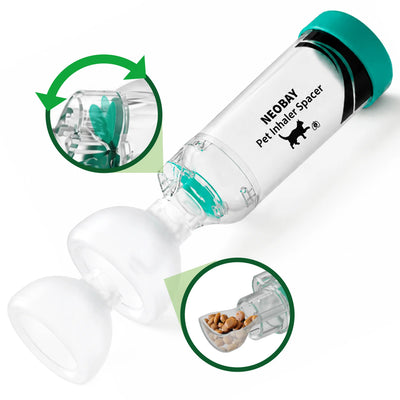
- Keep the treatment side solid: daily preventer through a Neobay cat inhaler spacer, salbutamol puffer loaded for flare-ups — the purifier reduces what triggers the inflammation, the medication treats it.
For the full picture, our Australia cat inhaler spacer buyer's guide covers what to check before buying a chamber, and the complete feline asthma owner's guide covers the disease end to end. Visit our FAQ page or contact us with questions.
Related Reading
This article is part of our Feline Asthma: The Complete Owner's Guide — purifiers are one environmental control; our guide to common asthma triggers covers the rest.
Sources:
- Asthma Australia. "About asthma triggers." asthma.org.au
- Environment Protection Authority Victoria. "Air quality categories." epa.vic.gov.au
- NSW Health. "Who is affected by air pollution?" health.nsw.gov.au
- Amazon AU. Levoit Core Mini / Core 300 / Core 400S listings, prices checked 23 September 2026 via LinkFox Amazon search. amazon.com.au
- Cornell Feline Health Center. "Feline Asthma: What You Need to Know." vet.cornell.edu