Key Takeaways
- Australia does not use the US 0–500 AQI. Your state publishes air quality categories instead: Good, Fair, Poor, Very Poor, Extremely Poor.
- Act at Poor, which starts at a 1-hour PM2.5 reading of 50 µg/m³ in NSW but only 25 µg/m³ in Victoria.
- The 2019–20 Black Summer caused an estimated 429 smoke-related premature deaths and 3,230 hospital admissions (Johnston et al., Nature Sustainability, 2021).
- Asthma Australia says avoid outdoor activity once air quality drops below Good, and keep 30 days of medicine for evacuations.
- Australia's rescue bronchodilator is salbutamol (Ventolin), not albuterol, and it only reaches the lungs through a spacer chamber.
Bushfire smoke is the biggest airborne trigger an Australian cat with asthma will face, and the point where you act is the Poor air quality category, not the Orange band on American sites. In NSW, Poor begins at a 1-hour PM2.5 reading of 50 µg/m³; in Victoria it begins at 25 µg/m³. The routine is short: shut the house at Poor, run a HEPA purifier in one room, keep a Neobay spacer chamber loaded with your cat's prescribed salbutamol, and ring your vet if resting breathing rate climbs or open-mouth breathing appears.
Australian smoke seasons arrive in two waves. Summer brings bushfires; either side of them come hazard reduction burns, and in winter wood heater smoke settles over suburbs on still, cold nights. Asthma Australia groups bushfires, woodfires and wood heaters as one trigger for that reason.
Bushfire smoke — fine particulate matter (PM2.5), carbon monoxide, nitrogen dioxide and volatile organic compounds released by burning vegetation, able to travel hundreds of kilometres from the fire front.
Why Smoke Hits a Cat With Asthma Harder
Feline asthma — a chronic and incurable inflammatory disease of the small airways requiring lifelong management, in which the bronchi narrow in response to triggers and produce cough, wheeze and laboured breathing.
PM2.5 particles slip past a cat's nasal filtration and settle deep in the bronchi, exactly where asthma inflammation already sits. A cat whose asthma has been quiet for months on a daily preventer can start coughing within hours of smoke arriving.
NSW Health lists people with asthma and other lung disease among those most affected by air pollution, because exposure worsens symptoms and can trigger attacks. A cat's airways run the same physics at a smaller diameter, and flat-faced breeds, seniors and kittens carry the highest flare risk.
Australian Air Quality Categories, and Where to Act
AQC (air quality category) — the five-band, colour-coded index Australian state environment agencies publish in place of a single national number, running from Good to Extremely Poor.
There is no national Australian AQI. Each state runs its own network and its own cut-offs, and NSW's sit roughly double Victoria's, so check the site for your own state.
| Category | PM2.5, 1-hour | What it means for a cat with asthma |
|---|---|---|
| Good (green) | NSW under 25 µg/m³ · Vic under 12.5 µg/m³ | Baseline. Catio, balcony and enclosure access are all fine. |
| Fair (yellow) | NSW 25–50 · Vic 12.5–25 | Asthma Australia says stop outdoor activity below Good. Shut the catio and consider closing windows. |
| Poor (orange) | NSW 50–100 · Vic 25–50 | Trigger band. Keep your cat indoors with windows and doors closed. |
| Very Poor (red) | NSW 100–300 · Vic 50–150 | Symptoms likely. Stay indoors, run the HEPA purifier, use the rescue puffer if coughing starts. |
| Extremely Poor (dark red) | NSW 300 and above · Vic 150 and above | Emergency range. One sealed, filtered room, follow your vet's flare plan and ring the clinic. |
The number to remember is the bottom of the Poor band where you live, because that is where state health advice shifts from "consider closing windows" to "close windows and doors, and avoid outdoor activity".
My cat only uses an enclosed balcony for twenty minutes a day — does Fair still matter?
Yes, if you follow Asthma Australia's guidance to avoid outdoor activity whenever air quality is below Good. A screened balcony offers no filtration, so keep the twenty minutes indoors and run a purifier instead.
Build One Cleaner Air Room
Pick the room your cat already sleeps in and make that the clean one.
- A portable air cleaner with a HEPA filter, running continuously. EPA Victoria and Asthma Australia both name HEPA filtration as the indoor measure that works during smoke episodes.
- No indoor smoke sources. No candles, incense, frying, or smoking near the cat, and skip vacuuming because it lifts settled particles.
- Sealed openings. Windows and doors shut, and seal the gaps around them before summer rather than during it.
Put water, food and the litter tray inside, and prepare the coolest room in the house, because that is the one a cat picks on a hot smoke day.

The Rescue Puffer Protocol During a Smoke Event
Salbutamol — the fast-acting bronchodilator Australian vets prescribe as a rescue medicine, opening narrowed airways within minutes; it is sold here as Ventolin, not the American "albuterol".
If your cat already has a prescribed puffer and a spacer chamber, a smoke event is the exact scenario that equipment was dispensed for. Healthdirect notes that inhalers can be used with a spacer to make the medicine easier to take.
- Watch for new coughing, wheezing, or a resting breathing rate well above your cat's baseline.
- Give one puff through the chamber, using the breath count your vet prescribed, usually 7–10 breaths.
- Repeat once if there is no improvement within 30 minutes, then ring the clinic.
- Do not exceed two rescue doses in four hours without veterinary advice.
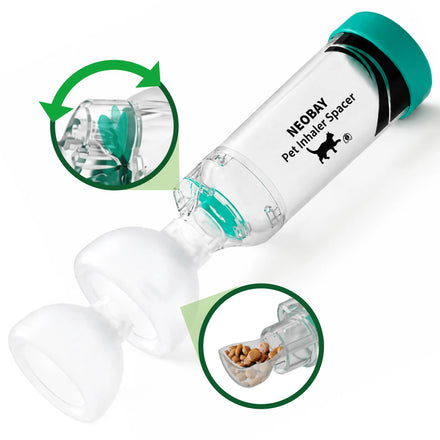
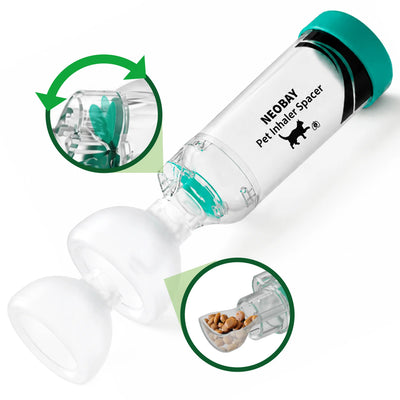
Neobay Cat Inhaler Spacer with Breath Indicator in Australia
- See each breath with the Breath Indicator
- Built-in treat holder makes mask practice easier
- Anti-static chamber helps keep medication airborne
Keep the chamber loaded and within reach, and put a spare in your go-bag. Asthma Australia's advice to hold a 30-day medicine supply for evacuations applies to your cat's puffer as much as your own.
My cat is stable on a preventer and has never needed a rescue dose — should I still bother?
Yes. Smoke overrides preventer control because the particles land directly in the inflamed tissue. Have the chamber loaded before the smoke arrives, not after the first cough.
When to Call the Vet

Ring your vet during a smoke event if you see any of these:
- Open-mouth breathing at rest, always an emergency in cats
- A sleeping breathing rate at or above 30 breaths per minute
- A cough that does not settle after one rescue dose
- Wheezing you can hear without a stethoscope
- Blue-tinged gums or tongue
- Lethargy, stumbling or disorientation
- Refusing food or water for more than 12 hours
Smoke can also leave a cat vulnerable to a secondary respiratory infection in the week after the air clears, so a new cough seven days later is still worth a call. For what your vet checks in a full workup, see our guide to how vets diagnose feline asthma.
Frequently Asked Questions
What air quality category means I should keep my cat inside?
Bring your cat inside at Poor and keep them there until the reading returns to Good. Asthma Australia goes further and advises avoiding outdoor activity below a Good rating, so shut the catio at Fair.
Can bushfire smoke trigger asthma in a cat that has been stable for months?
Yes. PM2.5 particles bypass the nose and deposit straight into the inflamed bronchi, which can override the protection of a daily preventer. Have the puffer and spacer chamber ready before the smoke reaches you.
Is a normal air conditioner enough, or do I need a HEPA purifier?
A recirculating air conditioner helps but does not reliably remove fine particulate matter. Asthma Australia recommends a HEPA air purifier indoors during smoke episodes, so run one in the room your cat uses most.
How do I count my cat's breathing rate during a smoke event?
Count chest rises for 15 seconds while your cat is asleep, then multiply by four. Ring your vet if the rate sits at 30 breaths per minute or more, or if you see open-mouth breathing.
Should I increase my cat's fluticasone dose during bushfire smoke?
Never change a prescribed dose without your vet's instruction. Fluticasone is a daily preventer, not a rescue medicine, and raising it does nothing during an acute flare. Use the prescribed salbutamol instead.
What to Do Next
- Find your state's air quality site or app and work out the PM2.5 number that starts the Poor band where you live. NSW and Victoria differ.
- Set up your cleaner air room now, with a HEPA purifier, and put food, water and the litter tray inside it.
- Check the expiry on your cat's salbutamol puffer, confirm your spacer chamber is loaded, and add a spare to your go-bag.
If your cat does not yet have a spacer chamber, our Australia cat inhaler spacer buyer's guide covers what to check before you buy, and the Neobay cat inhaler spacer ships with the chamber, mask and visual flow indicator you need to deliver a dose properly. Visit our FAQ page or contact us with questions.
Related Reading
This article is part of our What Is a Cat Inhaler Spacer? pillar. Smoke is one of several triggers, and our guide to common triggers that make your cat's asthma worse covers the rest.
Sources:
- NSW DCCEEW and NSW Health. "Air quality categories." airquality.nsw.gov.au
- Environment Protection Authority Victoria. "Air quality categories." epa.vic.gov.au
- Asthma Australia. "Smoke: bushfires, woodfires and wood heaters." asthma.org.au
- NSW Health. "Bushfires and bushfire smoke." health.nsw.gov.au
- NSW Health. "Who is affected by air pollution?" health.nsw.gov.au
- healthdirect Australia. "Asthma." healthdirect.gov.au
- Johnston FH, Borchers-Arriagada N, Morgan GG, et al. "Unprecedented health costs of smoke-related PM2.5 from the 2019–20 Australian megafires." Nature Sustainability 2021;4:42–47. doi.org
- Barchilon M, Reinero CR. "Breathe easy: inhalational therapy for feline inflammatory airway disease." Journal of Feline Medicine and Surgery 2023;25(9). PubMed