

Key Takeaways
- Most UK cats can be trained to accept a vet-prescribed inhaler pump through a spacer in 1–3 weeks, with short daily sessions of gradual familiarisation — not force.
- Let your cat learn the chamber, then the mask, then the pump sound separately; skipping that desensitisation is the most common reason training fails.
- A mask rim that holds a squeeze treat (Comfort Feeder design) works with a cat's instinct to push its face into food — most cats start pressing in voluntarily within days.
- A visual flow indicator shows each real breath, so you can count 7–10 and know the dose is being inhaled, not held.
- The pump and medication (a preventer such as Flixotide or a reliever such as salbutamol) come from your UK vet with a prescription; the chamber is a non-medicated accessory you buy separately.
Most cats can be trained to accept inhaler treatment in 1–3 weeks — but the training is about the mask and the pump sound, not the medication. When UK owners say their cat "fights the pump," the cause is usually that the chamber, the mask and the loud actuation were all introduced at once, in the one moment the cat needed to stay still. Neobay's cat spacer chamber shortens the process two ways: a Comfort Feeder rim that holds a squeeze treat, so your cat presses its face in voluntarily, and a visual flow indicator, so you can confirm each breath and stop the moment the dose is done. Below is a familiarisation protocol for the UK vet context — the pump and Flixotide or salbutamol come from your practice; this guide covers the chamber and the training.
Why Many Cats Refuse the Mask
It helps to see the mask from your cat's point of view:
- Face sensitivity. A cat's whiskers are packed with sensitive nerve endings; anything pressing on the face triggers an instinctive withdrawal.
- Loss of control. Cats are predator and prey. Being restrained or having the face covered switches on a fight-or-flight response.
- Novelty aversion. Cats are neophobic — new objects read as danger. That is a survival trait, not stubbornness.
- A bad first association. If the first experience involves being held down or a sudden loud "pssh," the cat remembers and resists harder next time.
The training principle: overwrite an instinctive "this is scary" response with a learned "this predicts something good" response. That takes repetition, patience and the right equipment — and it is the same whether your vet has prescribed Flixotide for asthma or another inhaled medication.
What You'll Need Before You Start
- A cat-sized spacer chamber with both mask sizes — ideally with a Comfort Feeder rim
- The inhaler pump — prescribed by your vet, but not used in the early training stages
- High-value treats — small pieces of cooked chicken, tuna or a lickable treat your cat does not get any other time
- A quiet, familiar room and a consistent time of day
- Patience — the most important item on the list
Your vet practice may order a chamber for you — often the simplest route, because the practice can check the mask fit at the same visit. Many owners also buy the chamber themselves once they know the mask size. Either way, the pump and medication stay on the prescription side; the chamber is a non-medicated pet accessory.
The Step-by-Step Familiarisation Process
Work through these stages in order, and do not move on until your cat is comfortable. Some cats race through; others need several days per stage. That is normal.
Stage 1: Introduce the chamber (days 1–3)
- Leave the chamber on the floor near a favourite resting spot and ignore it.
- Scatter a few treats around it so your cat approaches voluntarily.
- When your cat sniffs, paws or even looks at it, give a treat and quiet praise.
- Repeat in two or three short sessions a day.
Success signal: your cat walks up to the chamber without hesitation.
Stage 2: Introduce the mask (days 3–5)
- Attach the mask and let your cat investigate it. Reward any interaction.
- Hold the chamber in your hand and let your cat come to it.
- Rest the mask against your cat's cheek for one to two seconds, then remove it and treat immediately.
- If your cat pulls away, end the session — do not chase.
A Comfort Feeder rim earns its keep here: squeeze a treat into the rim, and your cat discovers that pressing its face forward into the mask is how it reaches the food. Most cats make that connection within a few sessions.
Success signal: your cat no longer flinches when the mask briefly touches its face.
Stage 3: Brief mask-on contact (days 5–8)
- Settle your cat somewhere comfortable — a lap or a perch.
- Hold a treat in one hand and the chamber in the other. Rest the mask gently over the nose and mouth — resting, not pressing.
- Count to two, remove the mask and give the treat. Repeat three to five times.
- Gradually lengthen the contact: two seconds, then three, then five.
Success signal: your cat accepts the mask for five seconds without pulling away — and often looks for the treat the moment the mask lifts.
Stage 4: Add the pump sound (days 8–11)
This is the stage most owners skip — and skipping it is the most common reason training falls apart. If the first time a cat hears the pump is also the first time it has a mask on its face, the two become linked as one frightening event.
- With the chamber on the floor away from your cat's face, actuate the pump once. Treat immediately.
- Repeat two or three times per session so the sound predicts a treat.
- Once your cat no longer reacts, combine the steps: mask on for three to five seconds, actuate once (aimed away from the mask, so no medication is involved yet) and treat.
Success signal: no flinch or attempt to escape when the pump sounds, even with the mask on.
Stage 5: First real dose (days 11–14)
- Prepare the pump and chamber as your vet demonstrated, then actuate into the chamber.
- Place the mask over the nose and mouth. Hold gently but steadily — your cat should settle without being pinned down.
- Count 7–10 breaths. Watch the flow indicator to confirm your cat is actually breathing in.
- Remove the mask and give a high-value treat immediately.
If your cat struggles here: do not push through. Go back to Stage 4 and try again the next day. One forced session can set training back a week.
Stage 6: Build the routine (week 3 onwards)
- Keep the same time and place every day so treatment becomes routine.
- Always end with a treat. You can make rewards smaller over time, but do not remove them entirely.
- When your cat walks to the treatment spot on its own, you have succeeded.
Why the Chamber Design Affects Training Success
Two design features make a measurable difference to how fast a reluctant cat settles.
Comfort Feeder: let the food do the persuading
The most reliable way past face sensitivity is to give your cat a reason to press forward into the mask. A Comfort Feeder is a small rim that holds a squeeze treat, so the cat chooses to press its face in to reach the food instead of being held still. Because the cat presses in voluntarily, the seal is more stable while you count breaths — training reframed from restraint to reward.
Visual flow indicator: know when the dose is done
Once the mask is accepted, the worry becomes: is my cat actually breathing the medication in? A visual flow indicator — a small flap that moves with each breath — answers in real time. You can see calm breaths (acceptance) versus a cat holding its breath (stress), and stop the moment 7–10 breaths are counted instead of guessing and over-holding the mask.
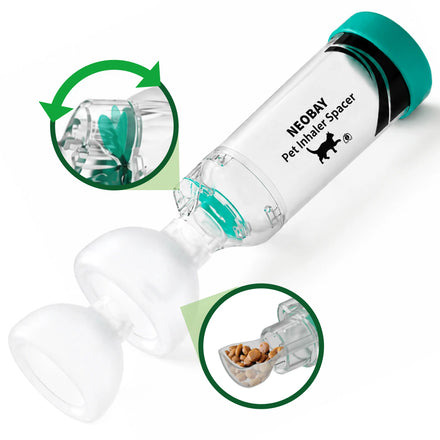
Cámara de aerosol Neobay para gatos con alimentador cómodo — Verde
- See each breath with the Flow Indicator
- Built-in treat holder makes mask practice easier
- Anti-static chamber helps keep medication airborne
Common Training Mistakes to Avoid
- Rushing the stages. Each stage builds on the last; stepping back is not failure.
- Using force or restraint. Never pin a cat down or force the mask on. A fight teaches the cat the mask is dangerous and can take weeks to undo. If your cat is fighting, end the session and try again tomorrow.
- Skipping the pump-sound stage. Introduce the sound separately in Stage 4, or the mask becomes linked to a frightening noise.
- Training at random times. Cats thrive on routine — pick a time and stick to it.
- Using ordinary treats. Kibble will not compete with a cat's instinct to avoid the mask. Reserve a genuinely special treat for training only.
- Training during stress. Skip sessions right after a vet visit, fireworks or building work; wait for a calm window.
How Long Does Training Really Take?
| Cat temperament | Typical training time | Notes |
|---|---|---|
| Relaxed, food-motivated | 7–10 days | May move through early stages quickly |
| Average | 2–3 weeks | Where most cats land |
| Anxious or previously handled roughly | 3–6 weeks | Keep sessions very short; go slower |
| Senior cat with health problems | 2–4 weeks | May need gentler handling and shorter holds |
Signs it is working: your cat approaches the chamber voluntarily, does not flinch at mask contact, stays calm at the pump sound and breathes normally with the mask on. Signs you need to slow down: your cat runs from the chamber, shows dilated pupils or flattened ears during sessions, holds its breath with the mask on (check the flow indicator), or you feel yourself getting frustrated.
Troubleshooting: When Training Gets Stuck
"My cat won't let me anywhere near them with the mask"
Return to Stage 1. Leave the chamber out longer with treats on and around it, and let your cat discover it on its own terms — even over a week. A Comfort Feeder rim helps because it gives the cat a food reason to approach.
"My cat was doing well, then suddenly refused"
This is a normal training regression. Common causes: a stressful event broke the routine, your cat is unwell, or you moved a stage too fast last session. Drop back one stage and rebuild without frustration.
"My cat tolerates the mask but holds its breath"
A visual flow indicator shows this immediately — if the flap is not moving, the cat is holding its breath. Try gently blowing on its face to trigger a breath, briefly removing and reapplying the mask, and keeping sessions short.
"I've been training for a month and my cat still fights it"
Check: are you consistent with timing and treats? Is there a higher-value treat you have not tried? Would a Comfort Feeder-style mask change the equation? If training is stalled after four weeks, talk to your vet.
Making Long-Term Treatment Sustainable
- Same time every day. A predictable schedule makes treatment feel ordinary.
- Always end with a reward. Even after training, a small treat keeps the association positive.
- Count real breaths with the flow indicator, and keep a simple symptom log (coughing, breathing rate) to help your vet judge whether the medication is working.
- Stay calm yourself. Cats read their owner's state; approach each session matter-of-factly.
New to inhaled treatment? Our what is a cat inhaler spacer guide explains how the chamber and mask deliver a metered dose, and the 5-day timeline shows the fastest realistic pace for a food-motivated cat. To compare chambers available in the UK — masks, flow indicators, packs and cleaning — see our UK cat inhaler spacer buyer's guide.
Frequently Asked Questions
How long does it take to train a cat to use an inhaler?
Most cats are trained in 2–3 weeks of short daily sessions. Relaxed, food-motivated cats may accept the mask in 7–10 days; anxious cats or those with a bad prior experience can need 4–6 weeks. Consistency matters more than session length.
Will my cat ever really accept the mask?
The large majority do. With patient, stage-by-stage familiarisation and positive reinforcement, even initially resistant cats usually learn to tolerate treatment. Never force the mask, and always end the session with a reward.
My cat is terrified of the mask — where do I start?
Start with the mask nowhere near the cat: leave the chamber in the room with treats around it and let desensitisation happen at the cat's pace, even over a week or more. A Comfort Feeder rim helps because the mask itself then holds a squeeze treat, giving the cat a food reason to press forward.
Do I need a prescription to buy a chamber in the UK?
The chamber is a non-medicated pet accessory, so most UK retailers sell it without a prescription. The inhaler pump and medication — a preventer such as Flixotide or a reliever such as salbutamol — require a veterinary prescription. Your vet decides the medication and dose; the chamber simply delivers each metered dose as the cat breathes.
How do I know my cat is actually inhaling the medication?
Use a chamber with a visual flow indicator — a flap that moves with each breath. It confirms in real time that the cat is inhaling rather than holding its breath, and lets you count the 7–10 breaths most vets recommend per dose.
What to Do Next
- Confirm the plan with your vet practice — the pump, medication and mask size come from your vet; ask them to show you the actuation and breath-counting technique once.
- Gather your kit: a cat-sized chamber, the pump (kept aside for now), high-value treats and a quiet room.
- Start Stage 1 today — even two minutes of leaving the chamber out with treats is progress.
- Choose a chamber that trains well: a Comfort Feeder rim and a visual flow indicator remove the two biggest causes of failed training. The Neobay UK chamber includes both mask sizes, the Comfort Feeder and the flow indicator at £39.99 for One Pack (checked 2 September 2026).
Have questions the guide did not cover? Visit our FAQ page or contact us directly.
Related Reading
This article is part of our UK Cat Inhaler Spacer Buyer's Guide — the central hub covering what to check before you buy, AeroKat availability and pricing in the UK, and how to get started once the chamber arrives.
Sources
- Trzil JE, Reinero CR. "Update on Feline Asthma." Veterinary Clinics of North America: Small Animal Practice, 2014.
- Padrid P. "Use of Inhaled Medications to Treat Respiratory Diseases in Dogs and Cats." Journal of the American Animal Hospital Association, 2006.
- Cornell Feline Health Center, Cornell University College of Veterinary Medicine. "Feline Asthma: What You Need to Know." Accessed 2026.
- International Cat Care, guidance on medicating cats and inhaler familiarisation.
- Neobay UK store pricing, checked 2 September 2026.


