Key Takeaways
- Most cats can be trained to accept an inhaler mask — but it takes patience, positive reinforcement, and a gradual approach rather than force.
- Most Canadian owners get there in 1–3 weeks, using short daily sessions of 2–5 minutes.
- Starting with mask desensitization before you ever add medication is the critical step — your cat has to link the mask with good things first.
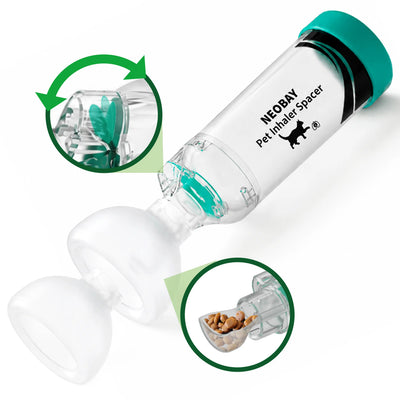
- A spacer with a Comfort Feeder design lowers your cat's initial resistance because its rim holds a squeeze treat, so your cat presses their face in voluntarily.
- A Visual Flow Indicator lets you confirm your cat is genuinely breathing in the medication — which is how you know training has worked.

Most cats can be trained to accept an inhaler mask in 1–3 weeks using 2–5 minute daily sessions of gradual desensitization, and skipping that phase — not the medication itself — is the single most common reason inhaled therapy fails. A Neobay spacer chamber with a Comfort Feeder and a Visual Flow Indicator shortens the timeline: the Comfort Feeder's rim holds a squeeze treat so your cat voluntarily presses their face into the mask, and the flow indicator confirms when training has genuinely succeeded. Below: a day-by-day protocol built around your cat's instincts, plus what to do when your cat regresses.
Understanding Why Cats Resist the Mask
- Face sensitivity: A cat's face is dense with whiskers (vibrissae) — highly sensitive tactile sensors. Anything pressing against the face triggers an instinctive withdrawal response.
- Loss of control: Cats are prey animals as well as predators. Restricting movement or covering the face switches on a fight-or-flight response.
- Novelty aversion: Cats are neophobic — they instinctively avoid new objects and situations. A survival trait, not stubbornness.
- Negative association: If your cat's first encounter with the mask is stressful (being held down, the inhaler's hiss), they'll remember it and resist harder next time.
The training principle: Overwrite the instinctive "this is scary" response with a learned "this means good things happen" association. That takes repetition, patience, and the right equipment.
What You'll Need Before You Start
In Canada the two halves of this treatment come from different places. The medication — usually salbutamol (Ventolin HFA) for fast relief, or fluticasone (Flovent HFA) as the daily controller — is a prescription your vet writes and you fill at a pharmacy. The chamber, the device your inhaler slots into, is a pet accessory you buy separately — and Neobay makes that second half: a non-medicated delivery accessory, not a medication. Our Canadian price guide covers what a chamber costs here.
- Spacer chamber with mask — ideally one with a Comfort Feeder design (more on why below)
- Your prescribed inhaler (MDI) — filled at your pharmacy, but do NOT use it during the early training stages
- High-value treats — something your cat loves and doesn't get otherwise (cooked chicken, tuna, lickable treats)
- A quiet, familiar space — where your cat already feels safe and there are no distractions
- A consistent time — the same time each day so it becomes part of the routine
- Patience — the most important item on this list
The Step-by-Step Training Process
Work through these stages in order. Don't move on until your cat is comfortable with the current stage — some cats move quickly, others need more time at each step.
Stage 1: Introduce the Spacer (Days 1–3)
Goal: Your cat is comfortable having the spacer in the same space.
- Place the spacer (mask detached) on the floor near your cat's favourite resting spot.
- Don't try to interact with your cat — just let the spacer sit there.
- Put a few treats around the spacer so your cat approaches it voluntarily.
- If your cat sniffs or touches the spacer, give a treat and verbal praise straight away.
- Repeat 2–3 times per day for 2–3 minutes each time.
Success signal: Your cat approaches the spacer on their own without hesitation.
Stage 2: Introduce the Mask (Days 3–5)
Goal: Your cat is comfortable with the mask as a separate object.
- Attach the mask to the spacer and set it on the floor.
- Let your cat investigate — sniff it, paw at it, even push it around.
- Reward any interaction with treats.
- Hold the spacer in your hand and let your cat approach it.
- Gently touch your cat's face with the mask — briefly, for just 1–2 seconds — and give a treat immediately.
- If your cat pulls away, that's fine. Don't chase. Try again later.
Success signal: Your cat doesn't flinch when the mask briefly touches their face.

Stage 3: Brief Mask Contact (Days 5–8)
Goal: Your cat accepts the mask resting on their face for a few seconds.
- Get your cat into a comfortable position — on your lap, on a favourite perch, or wherever they naturally relax.
- Hold a treat in one hand and the spacer in the other.
- Place the mask gently over your cat's nose and mouth — resting, not pressing.
- Count to 2, then remove the mask and give the treat immediately.
- Repeat 3–5 times per session.
- Gradually increase contact time: 2 seconds, then 3, then 5.
Pro tip: If your cat resists, drop back to a shorter duration. Never force the mask on — one bad experience can set training back days.
Success signal: Your cat accepts the mask for 5 seconds without pulling away, and may start looking for the treat when it comes off.
Stage 4: Add the Inhaler Sound (Days 8–11)
Goal: Your cat is not alarmed by the inhaler's spray sound while the mask is on.
Many owners slip up here — they combine the mask and the inhaler sound for the first time, and the sharp "pssh" startles the cat badly. Introduce the two separately first.
- With the spacer on the floor (not near your cat's face), actuate the inhaler once so your cat hears the sound. Give a treat right away.
- Repeat 2–3 times per session so your cat learns the sound predicts a treat.
- Once your cat stops reacting, combine it with Stage 3: place the mask on for 3–5 seconds, actuate the inhaler (pointed away from the mask), and give a treat.
- This is sound desensitization only — no medication is going into the spacer yet.
Success signal: Your cat doesn't flinch or try to escape at the inhaler sound, even with the mask on their face.
Stage 5: First Real Treatment (Days 11–14)
Goal: Your cat receives their first actual dose of inhaled medication.
- Prepare the inhaler and spacer. Actuate the inhaler into the chamber.
- Place the mask over your cat's nose and mouth.
- Hold gently but firmly — your cat should be positioned so they can't back out easily, without being pinned down.
- Count 7–10 breaths, watching the Visual Flow Indicator to confirm your cat is breathing in.
- Remove the mask and give a high-value treat immediately.
- Praise your cat calmly.
If your cat struggles here: Don't force it. Go back to Stage 4 and try again tomorrow. Rushing creates an association that's hard to undo.
Success signal: Your cat completes a full 7–10 breath treatment without significant resistance.
Stage 6: Build the Routine (Week 3 and Beyond)
Goal: Treatment becomes a normal part of your cat's daily routine.
- Stick to a consistent schedule — same time, same place, every day.
- Keep sessions short and positive, and always end with a treat.
- Over time you can reduce the treats, but don't cut them out entirely — a small reward after each session keeps the association positive.
- If your cat starts coming to the treatment spot on their own, you've succeeded.
Why Your Spacer Choice Matters for Training Success
Not all spacer chambers are equal for training. The design can be the difference between a smooth few weeks and months of frustration.
Comfort Feeder Design
The single biggest factor in whether your cat accepts the mask is how the mask feels on their face. A plain mask can feel like a hard, suffocating barrier — triggering the exact fight-or-flight response you're trying to overcome.
A spacer with a Comfort Feeder design changes the first contact entirely: the rim holds a squeeze treat, so your cat leans in and presses their face into the mask on their own to reach the food. That voluntary movement is the whole point. Your cat is choosing to put their face in, so the first association becomes "this is where the treat lives" rather than "something is being done to me."
Visual Flow Indicator
During and after training, one of the biggest worries is: Is my cat actually breathing in the medication? With a basic spacer, you're guessing. With a Visual Flow Indicator — a valve or flap that moves with each breath — you can see in real time that your cat is inhaling, and count the breaths to confirm the treatment is being delivered.
This matters for training because:
- You know immediately when your cat is breathing calmly (acceptance) versus holding their breath (stress)
- You can end the session as soon as you've counted enough breaths
- You build confidence as an owner, which your cat can sense
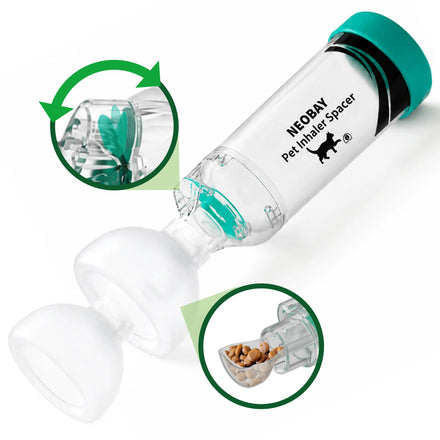
Cat Inhaler Spacer in Canada | Neobay Aerosol Chamber
- See each breath with the Breath Indicator
- Built-in treat holder makes mask practice easier
- Anti-static chamber helps keep medication airborne

Common Training Mistakes to Avoid
1. Rushing the Process
The most common mistake is moving too fast. If your cat isn't comfortable at Stage 2, don't jump to Stage 3. Going back a step isn't failure.
2. Using Force or Restraint
Never pin your cat down, grab them roughly, or force the mask onto their face — this creates an association that can take weeks to undo. If your cat is fighting you, stop and try again tomorrow.
3. Skipping the Sound Desensitization
The inhaler makes a sharp, loud "pssh". If the first time your cat hears it is with the mask on their face, they'll link the mask with a frightening experience. Always introduce the sound separately (Stage 4).
4. Inconsistent Timing
Cats thrive on routine. If you train at random times, your cat can't build a predictable association. Pick a time and stick to it — even on days you don't feel like it.
5. Using Low-Value Treats
Kibble or everyday biscuits won't cut it. You need something irresistible — something that makes the mask worth tolerating. Reserve these treats for inhaler training only.
6. Training When Your Cat Is Stressed
Don't train right after a vet visit, a loud event (thunderstorm, construction), or when your cat is clearly agitated. Choose calm moments when they're relaxed.
How Long Does Training Really Take?
Every cat is different, but here's a general timeline:
| Cat Temperament | Typical Training Duration | Notes |
|---|---|---|
| Relaxed, food-motivated | 7–10 days | May skip some early stages |
| Average | 2–3 weeks | Most cats fall here |
| Anxious or previously traumatized | 3–6 weeks | Go slow, keep sessions very short |
| Senior cat with health issues | 2–4 weeks | May need more gentle handling |
Signs your cat is progressing well:
- Approaches the spacer voluntarily
- Doesn't flinch at mask contact
- Accepts the mask for increasing durations
- Stays calm at the inhaler sound
- Breathes normally (not holding their breath) with the mask on
Signs you need to slow down:
- Your cat runs away when they see the spacer
- Dilated pupils, flattened ears, or hissing during sessions
- Your cat holds their breath with the mask on (check the flow indicator)
- You feel frustrated or tempted to force the mask
Troubleshooting: When Training Gets Stuck
"My cat won't let me anywhere near them with the mask"
Go back to Stage 1. Leave the spacer out longer, and try placing treats on top of it. Let your cat discover it on their own terms — this may take a week, and that's fine.
"My cat was doing well, but now suddenly refuses"
This is a training regression, and it's normal. Possible causes:
- A stressful event disrupted the routine (visitors, a smoke alarm, a vet visit)
- Your cat isn't feeling well (check for other symptoms)
- You accidentally moved too fast in the previous session
Solution: go back one stage and rebuild. Don't get frustrated — your cat will sense it.
"My cat tolerates the mask but holds their breath"
This is where a Visual Flow Indicator earns its keep. If the indicator isn't moving, your cat is holding their breath. Try:
- Gently blowing on your cat's face — this often triggers an involuntary breath
- Briefly removing and reapplying the mask — the change often prompts a breath
- Keeping sessions very short so your cat doesn't feel the need to "wait it out"
"I've been training for a month and my cat still fights it"
Some cats are genuinely harder to train. Consider:
- Are you being consistent with timing and treats?
- Is there a higher-value treat you haven't tried?
- Would a different mask design (Comfort Feeder) reduce the face aversion?
- Is your cat in pain or discomfort that's making them irritable?
Talk to your vet if training stalls for more than 4 weeks. They may have behaviour modification suggestions, or can check whether your cat's breathing itself has changed — in which case start with why is my cat wheezing. To understand how the diagnosis was reached in the first place, see how vets diagnose feline asthma.
Making Long-Term Treatment Sustainable
Training is just the beginning. Keeping your cat on medication for months or years takes a routine you can maintain through a Canadian year — wildfire smoke season, then months of dry forced-air heating.
- Same time, every day. Cats are creatures of habit. A predictable schedule makes treatment feel normal rather than an intrusion.
- Always end with a reward. A small treat after each session maintains the positive association.
- Monitor breathing quality. Use the Visual Flow Indicator to confirm 7–10 good breaths each session.
- Track symptoms. Log coughing frequency, breathing rate, and energy level so your vet can judge whether it's working.
- Stay calm yourself. Cats are finely tuned to their owner's emotional state, so approach each session with a matter-of-fact attitude.
Learn more about managing asthma triggers at home — including smoke and dry indoor air: Common Triggers That Make Your Cat's Asthma Worse
Comparing what's available in Canada, or weighing a local purchase against an imported device? See our AeroKat Price & Availability: Canadian Alternatives.
Frequently Asked Questions
How long does it take to train a cat to use an inhaler?
Most cats can be trained in 2–3 weeks with short daily sessions. Relaxed, food-motivated cats may accept the mask in as little as 7–10 days, while anxious cats or those with a negative past often need 4–6 weeks.
Can all cats learn to accept an inhaler mask?
The large majority can. With patient, step-by-step training and positive reinforcement, even cats who resist at first usually learn to tolerate treatment. The two things that matter most: never forcing the process, and always ending on something rewarding.
What if my cat is too scared of the mask?
Start with the mask nowhere near your cat — just sitting in the same room with treats scattered around it. That stage can take a week or more, and it's essential. A spacer with a Comfort Feeder design can help as well, because the mask rim holds a squeeze treat and your cat steps forward to reach it.
Should I restrain my cat during inhaler treatment?
Minimal, gentle restraint is fine — your cat should be in a comfortable position where they cannot easily back away. Never pin your cat down or use force. If your cat is fighting you, that session is over — force builds negative associations that make the next attempt harder.
How do I know if my cat is actually breathing in the medication?
Use a spacer with a Visual Flow Indicator, a valve or flap that moves with each breath. It gives you real-time confirmation; without it you are guessing. If your cat seems to be holding their breath, gently blowing on their face often triggers a breath.
How many breaths should my cat take through the spacer?
Most veterinarians recommend 7–10 breaths per treatment, and the Visual Flow Indicator helps you count them accurately. Once you have seen 7–10 clear breath movements, you can remove the mask — but always follow the specific instructions your own veterinarian has given you.
Related: Cat Scared of the Inhaler Puff Sound? Desensitization Guide — a 4-phase protocol for cats who fear the hissing noise, plus a bridge technique to keep medication going while you train.
Choosing equipment before you begin? Our Canadian cat inhaler spacer buyer's guide covers the practical product, delivery and support checks.
What to Do Next
Just diagnosed? Before training, work through our complete owner guide to feline asthma — it covers the condition, medication setup, and the early days.
Once you're ready to begin, here's your plan:
- Gather your supplies: spacer chamber, high-value treats, and a quiet space.
- Start with Stage 1 today — even 2 minutes of leaving the spacer near your cat with treats makes progress.
- Be patient and consistent — short daily sessions beat occasional long ones.
- Choose the right spacer: a chamber with a Comfort Feeder design and a Visual Flow Indicator gives you the best chance of success — your cat resists less, and you can confirm delivery. If your cat's resistance is really about mask fit, though — a small head, a flat face, or senior muscle loss — no amount of training will fix it; read our AeroKat mask sizing guide first.
Once your cat is accepting the mask, our guide to giving inhaled medication without stress covers the day-to-day routine. The Neobay Cat Inhaler Spacer is built with both features designed in, to make training easier for cats and owners.
Have questions about the training process? Visit our FAQ page or contact us — we're here to help.
Sources:
- For realistic timing expectations, see how long it really takes to train a cat to use an inhaler — a day-by-day starter protocol.
- Trzil JE. "Feline Asthma: Diagnostic and Treatment Update." Veterinary Clinics of North America: Small Animal Practice, 2020;50(2):375–391.
- Padrid P. "Use of Inhaled Medications to Treat Respiratory Diseases in Dogs and Cats." Journal of the American Animal Hospital Association, 2006;42(2):165–169.
- Fernández-Parra R, Pey P, Reinero C, Malvè M. "Salbutamol Transport and Deposition in the Upper and Lower Airway with Different Devices in Cats." Animals (Basel), 2021;11(8).
- Canadian Veterinary Medical Association (CVMA). canadianveterinarians.net — Canadian veterinary standards and pet-owner resources.
- Ontario Veterinary College, University of Guelph. uoguelph.ca/ovc — companion-animal clinical guidance.
- Health Canada. "Wildfire smoke and your health." canada.ca — guidance on smoke exposure and indoor air in wildfire season.
Related Reading
This article is part of our What Is a Cat Inhaler Spacer? series — covering device types, how to use them, proper technique, cleaning, and troubleshooting.
A new diagnosis brings more than medical questions — it carries real emotional weight for the household. Our complete feline asthma owner guide covers the practical side of the first weeks.
Related: How Fast Can You Train a Cat to Accept an Inhaler? 5-Day Timeline — the accelerated protocol for food-motivated cats or those with prior positive training.