

Key Takeaways
- Most cats can be trained to accept an inhaler mask — but only with patience, reward-based repetition and a gradual build-up, never force.
- Training usually takes 1–3 weeks, using short daily sessions of two to five minutes.
- Desensitise your cat to the mask on its own before you introduce the sound of the inhaler — the mask has to mean "something good is coming" first.
- A spacer with a Comfort Feeder rim holds a squeeze treat, so your cat chooses to press its face into the mask rather than being held still.
- A Visual Flow Indicator shows each breath, so you can count them and confirm the dose is being inhaled rather than held.
Most cats can be trained to accept an inhaler mask in 1–3 weeks of short daily sessions, and getting that build-up right is the single biggest factor in whether inhaled therapy succeeds. A Neobay spacer with a Comfort Feeder and Visual Flow Indicator shortens the process: the feeder rim holds a squeeze treat, so your cat presses its face into the mask voluntarily, and the flow indicator confirms each breath so you know when training has worked. Below is the full protocol — six stages, a realistic timeline, the mistakes that stall progress, and what to do when your cat regresses.

Understanding Why Cats Resist the Mask
Before you begin, it helps to see the mask from your cat's point of view:
- Face sensitivity: A cat's face is dense with whiskers (vibrissae) that work as sensitive touch sensors, so anything resting on the face triggers an instinctive pull-away.
- Loss of control: Cats are both predator and prey. Restraining them, or covering their face, switches on a fight-or-flight response.
- Novelty aversion: Cats are neophobic — new objects read as danger. This is a survival trait, not stubbornness.
- A bad first experience: If the first encounter involves being held down or a sudden loud hiss, your cat will remember it, and resist harder next time.
The training principle: you are overwriting an instinctive "this is frightening" response with a learned "this predicts something good". That takes repetition, patience and the right equipment — whether your vet has prescribed a preventer such as fluticasone (Flixotide Evohaler) or a reliever such as salbutamol (Ventolin Evohaler).
What You'll Need Before You Start
- A cat-sized spacer with a mask — ideally one with a Comfort Feeder rim (more on why further down)
- The inhaler — prescribed by your vet, but kept out of the early stages entirely
- High-value treats — something your cat loves and gets at no other time (cooked chicken, tuna, or a lickable treat)
- A quiet, familiar room — somewhere your cat already feels safe
- A consistent time of day — the same daily slot, so the session becomes routine
- Patience — the most important item on the list
In the UK the medication route runs through your vet: a consultation, then a written prescription you take to a pharmacy or an online veterinary pharmacy. The spacer itself is a non-medicated accessory, bought separately.
The Step-by-Step Training Process
Work through the stages in order, and don't move on until your cat is comfortable where they are. Some cats move quickly; others need several days at each stage. Both are normal.
Stage 1: Introduce the Spacer (Days 1–3)
Goal: your cat is relaxed with the spacer simply being in the room.
- Place the spacer, without the mask fitted, on the floor near your cat's favourite resting spot.
- Don't try to engage your cat with it — let it sit there.
- Scatter a few treats around it so your cat approaches on their own terms.
- The moment your cat sniffs or even looks at it, give a treat and quiet praise.
- Repeat two or three times a day, for two to three minutes each time.
Success signal: your cat walks up to the spacer without hesitation.
Stage 2: Introduce the Mask (Days 3–5)
Goal: your cat is comfortable with the mask as a separate object.
- Fit the mask to the spacer and set it on the floor.
- Let your cat investigate — sniffing, pawing, even shoving it across the floor all count.
- Reward every interaction with a treat.
- Pick the spacer up and hold it, letting your cat come to it rather than bringing it to them.
- Rest the mask against your cat's face for one or two seconds, then remove it and treat immediately.
- If your cat pulls away, that's fine. Don't chase. Try again later.
Success signal: your cat no longer flinches when the mask briefly touches their face.

Stage 3: Brief Mask Contact (Days 5–8)
Goal: your cat accepts the mask resting on their face for a few seconds.
- Settle your cat somewhere they're already relaxed — a lap, a favourite perch, a sunny windowsill.
- Hold a treat in one hand and the spacer in the other.
- Rest the mask gently over the nose and mouth — resting, not pressing.
- Count to two, lift the mask off and give the treat straight away.
- Repeat three to five times per session.
- Lengthen the contact gradually: two seconds, then three, then five.
Pro tip: if your cat resists, drop back to a shorter hold. A single bad experience can put training back by days.
Success signal: your cat accepts the mask for five seconds without pulling away — and may start looking for the treat as soon as it comes off.
Stage 4: Add the Inhaler Sound (Days 8–11)
Goal: your cat is untroubled by the sound of the inhaler while the mask is on.
This is the stage most owners skip, and skipping it is the most common reason training falls apart. If the first time your cat hears the actuation is also the first time they wear the mask, the two become one frightening event.
- With the spacer on the floor and away from your cat's face, actuate the inhaler once. Give a treat immediately.
- Repeat two or three times per session, so the sound starts to predict a treat.
- Once your cat stops reacting, combine it with Stage 3: mask on for three to five seconds, actuate once with the inhaler pointed away from the mask, then treat.
- Only the sound is being introduced here — no medication goes into the spacer at this stage.
Success signal: no flinch and no attempt to escape when the inhaler sounds, even with the mask on.
Stage 5: First Real Treatment (Days 11–14)
Goal: your cat receives their first genuine dose of inhaled medication.
- Set up the inhaler and spacer as your vet showed you, then actuate into the spacer.
- Place the mask over your cat's nose and mouth.
- Hold gently but steadily — your cat should be positioned so they can't easily back out, but never pinned down.
- Count 7–10 breaths. Watch the Visual Flow Indicator, if your spacer has one, to confirm your cat is breathing in.
- Remove the mask and give a high-value treat immediately.
- Praise your cat calmly.
If your cat struggles here: go back to Stage 4 and try again tomorrow. Rushing this stage builds a negative association that takes far longer to undo than the extra day costs.
Success signal: a full 7–10 breath treatment completed without significant resistance.
For a calm run-through of the actual dose once your cat is comfortable, see our guide to giving inhaled medication without stress.
Stage 6: Build the Routine (Week 3 Onwards)
Goal: treatment becomes an ordinary part of your cat's day.
- Keep to a consistent schedule — same time, same place, every day.
- Keep sessions short and positive, and always finish with a treat.
- Over time you can make the rewards smaller, but don't remove them entirely.
- If your cat starts walking to the treatment spot on their own, you've cracked it.
Why Your Spacer Choice Matters for Training Success
Spacers are not interchangeable. The design of the mask and chamber can be the difference between a smooth few weeks and months of frustration.
Comfort Feeder Design
The biggest single factor in whether your cat accepts the mask is how it feels on their face. A conventional mask can read as a hard, covering barrier — triggering the fight-or-flight response you are trying to defuse.
A spacer with a Comfort Feeder takes a different route: the rim holds a squeeze treat, so the mask arrives with food already in it. Your cat works out that pressing their face forward is how they reach the treat, which means they hold themselves in position instead of being held there. Face contact stops being something done to your cat and becomes something your cat chooses — and that is what makes Stages 2 and 3 move faster.
Visual Flow Indicator
During training and afterwards, the nagging worry is: is my cat actually breathing the medication in? With a plain spacer you are guessing. With a Visual Flow Indicator — a flap or valve that moves with each breath — you can see in real time that your cat is inhaling, count the breaths, and know the dose has been delivered.
That matters for training because:
- You can tell a calm, breathing cat (acceptance) from one holding their breath (stress) straight away
- You can stop as soon as you have counted enough breaths, rather than holding the mask on for longer than needed
- You gain confidence as an owner, and cats read that
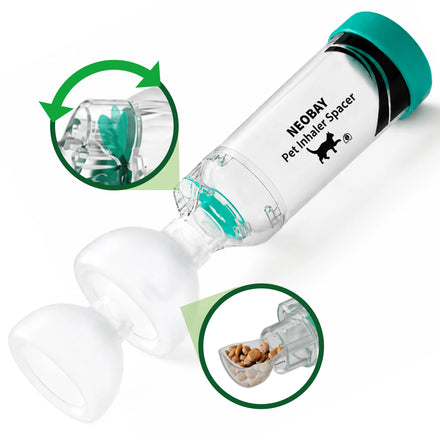
Cat Inhaler Spacer in UK | Neobay Aerosol Chamber
- See each breath with the Breath Indicator
- Built-in treat holder makes mask practice easier
- Anti-static chamber helps keep medication airborne

Common Training Mistakes to Avoid
1. Rushing the Stages
The most frequent mistake is moving on too soon. If your cat isn't settled at Stage 2, don't jump to Stage 3. Each stage builds on the last, and stepping back is not failure — it is good training.
2. Using Force or Restraint
Never pin your cat down, grab them roughly or push the mask onto their face. That teaches your cat the mask is dangerous, and it can take weeks to undo.
3. Skipping the Sound Desensitisation
The inhaler makes a sharp, loud hiss. If the first time your cat hears it is with a mask on their face, the mask becomes linked to something frightening. Introduce the sound on its own, well before it matters (Stage 4).
4. Training at Inconsistent Times
Cats run on routine. Train at random times and your cat has nothing predictable to attach to. Pick a slot and keep to it.
5. Using Ordinary Treats
Kibble or a routine biscuit won't compete with a cat's instinct to avoid the mask. You need something genuinely irresistible, kept back for training only.
6. Training When Your Cat Is Already Stressed
Don't train straight after a vet visit, during fireworks or building work, or when your cat is clearly wound up. Wait for a calm window — a relaxed cat learns far faster than a tense one.
How Long Does Training Really Take?
Every cat is different, but this is a realistic guide:
| Cat temperament | Typical training time | Notes |
|---|---|---|
| Relaxed and food-motivated | 7–10 days | May move through the early stages quickly |
| Average | 2–3 weeks | Where most cats land |
| Anxious or previously frightened | 3–6 weeks | Go slowly, keep sessions very short |
| Older cat with other health problems | 2–4 weeks | May need gentler handling and shorter holds |
For a faster route with a relaxed, food-motivated cat, our 5-day training timeline condenses the same protocol.
Signs your cat is progressing well:
- Approaches the spacer on their own
- Doesn't flinch at mask contact
- Accepts the mask for longer each session
- Stays calm when the inhaler sounds
Signs you need to slow down:
- Your cat runs off when they see the spacer
- Dilated pupils, flattened ears or hissing during sessions
- Your cat holds their breath with the mask on (check the Visual Flow Indicator)
- You feel frustrated, or tempted to force the mask
Troubleshooting: When Training Gets Stuck
"My cat won't let me anywhere near them with the mask"
Go back to Stage 1 and leave the spacer out for longer. Try putting treats on top of it. Let your cat discover it entirely on their own terms. This can take a week, and that is fine.
"My cat was doing well, but now suddenly refuses"
This is a training regression, and it is normal. Common causes:
- A stressful event broke the routine (visitors, loud noise, a vet visit)
- Your cat isn't feeling well — worth checking for other signs
- You moved a stage on too fast in the previous session
Solution: drop back one stage and rebuild, without frustration. If the refusal comes with coughing, wheezing or a change in breathing, it is worth reading how vets diagnose feline asthma and speaking to your practice.
"My cat tolerates the mask but holds their breath"
This is where a Visual Flow Indicator earns its place. If the indicator isn't moving, your cat is holding their breath. Try:
- Gently blowing towards your cat's face — this often prompts an involuntary breath
- Lifting the mask off and reapplying — the change frequently triggers a breath
- Keeping sessions very short, so your cat doesn't settle into "waiting it out"
"I've been training for a month and my cat still fights it"
Some cats are genuinely harder to train. Work through these questions:
- Are you being consistent with timing and treats?
- Is there a higher-value treat you haven't tried yet?
- Would a Comfort Feeder rim change the equation at the face-contact stage?
- Is your cat in pain or discomfort that is making them irritable?
If training has stalled for more than four weeks, speak to your vet — they may have further behaviour advice, or can check for an underlying problem.
Making Long-Term Treatment Sustainable
Training is only the start. Keeping your cat on their medication for months or years needs a routine that holds up on the difficult days:
- Same time, every day. Cats are creatures of habit. A predictable schedule makes treatment feel ordinary rather than like an intrusion.
- Always finish with a reward. Even once training is done, a small treat after each session keeps the positive association intact.
- Check the breathing, not just the clock. Use the Visual Flow Indicator to confirm 7–10 good breaths each session, so you know the medication is actually going in.
- Keep a simple symptom log. Note coughing episodes, breathing rate and energy levels — this gives your vet something concrete to judge the medication against. If you notice new wheezing between doses, our guide to why cats wheeze explains what different sounds can mean.
- Stay calm yourself. Cats are finely tuned to their owner's mood — if you are anxious or rushed, your cat will feel it. Approach each session matter-of-factly.
Household irritants matter too. Common asthma triggers — damp and mould in older housing, central heating drying the air through winter, and pollen in hay fever season — can make a cat's breathing worse and training harder.
Frequently Asked Questions
How long does it take to train a cat to use an inhaler?
Most cats need two to three weeks of short daily sessions. A relaxed, food-motivated cat may accept the mask in seven to ten days, while an anxious cat may need four to six weeks. Consistency matters more than the length of any single session.
Can all cats learn to accept an inhaler mask?
The large majority can. With patient, stage-by-stage training built on rewards, even cats who initially resist usually learn to tolerate treatment.
What if my cat is too scared of the mask?
Start with the mask nowhere near your cat — leave the spacer in the room with treats around it and let the cat set the pace, even over a week or more. A spacer with a Comfort Feeder can help because the rim holds a squeeze treat, so your cat chooses to press its face in to reach the food.
Should I restrain my cat during inhaler treatment?
Gentle, minimal restraint is fine — your cat should be in a position where they cannot easily back away. Never pin your cat down or use force. If your cat is fighting you, end the session; forcing it creates associations that make the next attempt harder.
How do I know if my cat is actually breathing in the medication?
Use a spacer with a Visual Flow Indicator — a flap or valve that moves with each breath. That gives you real-time confirmation that your cat is inhaling rather than holding their breath. If the indicator is still, try gently blowing towards your cat's face to prompt a breath.
How many breaths should my cat take through the spacer?
Veterinarians commonly recommend seven to ten breaths per dose. A Visual Flow Indicator lets you count them accurately, and once you have seen seven to ten clear breath movements you can take the mask off.
What to Do Next
New to a diagnosis? Before training starts, our complete owner guide to feline asthma covers what the diagnosis means, how it is managed and what to expect day to day.
When you are ready to begin, here is the plan:
- Gather your kit: spacer, high-value treats and a quiet room.
- Start Stage 1 today — even two minutes of leaving the spacer out with treats is progress.
- Be patient and consistent — short daily sessions get you much further than occasional long ones.
- Pick the right spacer. A chamber with a Comfort Feeder and a Visual Flow Indicator gives you the best chance of success. If the resistance is really about fit — a small head, a flat face or muscle loss in an older cat — training alone won't solve it; read our guide to mask sizing for small, senior and flat-faced cats first.
The Neobay Cat Inhaler Spacer is built with both features as standard. To compare what is available in the UK first, our UK cat inhaler spacer buyer's guide covers masks, indicators, pack sizes and cleaning.
Questions this guide has not answered? Visit our FAQ page or contact us.
Sources:
- International Cat Care. "Asthma and chronic bronchitis in cats." icatcare.org
- International Cat Care. "Inhaler Training." icatcare.org
- Cats Protection. "Feline Asthma." cats.org.uk
- PDSA. "Cat Asthma." pdsa.org.uk
- Trzil JE. "Feline asthma: diagnostic and treatment update." Veterinary Clinics of North America: Small Animal Practice, 2020;50(2):375–391.
- Padrid P. "Use of inhaled medications to treat respiratory diseases in dogs and cats." Journal of the American Animal Hospital Association, 2006;42(2):165–169.
- Fernández-Parra R, Pey P, Reinero C, Malvè M. "Salbutamol transport and deposition in the upper and lower airway with different devices in cats: a computational fluid dynamics approach." Animals, 2021;11(8).
Related Reading
This article is part of our What Is a Cat Inhaler Spacer? pillar guide — covering device types, technique, cleaning and troubleshooting.
Related: Cat Scared of the Inhaler Hiss? Desensitisation Guide — a four-phase protocol for cats who fear the noise, plus how to keep medication going while training continues. For the UK-specific picture — prescriptions, local sourcing and seasonal triggers — see How to Train a UK Cat to Accept an Inhaler Mask.
